Sunday, February 25, 2024

[The Domain Game] part 3: Keeping Player Interest


"The Anointing of Solomon" by Cornelis De Vos

Now the players have a domain and they are being kept busy by the random encounters that lead to classic adventures like "find the lycanthrope", "protect the farms", and others that monsters and the like exist to enable. But that isn't everything that can happen.

 Oriental Adventures had its share of problems, from unbalanced character classes (an issue it shared with Unearthed Arcana, but that's a matter for another time) to a vaguely racist orientalism (though that was probably less of an issue than some make it out to be, it was and is still an issue). But, those matters aside, it presented a couple of truly great elements and one of those was the tables for yearly and monthly events. (Another was the fairy-tale atmosphere that it tended to bring to play, including some truly innovative creatures like the Ikiryo. Someday, I might like to completely redesign the fairy creatures from the Monster Manual such as the brownie, leprechaun, sprite, pixie, and so on in the same sort of style. It would be a big undertaking, though, and they do already have some of that going on, so I dunno.)

The basic concept was that the DM would roll on the yearly event table at the start of each year to sort of establish a tone for the coming 12 months. This would result in any of a number of major events, from the death or assassination of a lord in the region to the appearance of a new religious movement all the way to a rebellion or war. The specific time of year would be fixed by a roll of a d12 to figure out the month, and perhaps a d30 to figure out the exact day of the month if relevant. Then, depending on the exact type of yearly event, there would be monthly rolls on a set of monthly event tables. These would be generally related to the tone set by the yearly event, so that in a year with a natural disaster as the dominating event, the players are more likely to see hauntings, bandits, or minor natural disasters, while in a year of assassination, incursion, political plots, rebellion, or war there are likely to be incursions, battles, and troop movements. And then there's a column for "other" events, which are any event other than the sort listed in those first two columns, and tend to lead to more normal sorts of events like births, marriages, injustices, or the appearance of a Maiden of Virtue who sets off a competition among the unmarried lords to woo her for her virtuous character, the prestige marriage to such a person brings, and such. Those things are tuned specifically to the sort of cultural model implied by even the title of that book, but they should prove inspirational for setting up similar tables for your own setting.

We also have help in this regard, because the article from Dragon magazine issue 125 that we have already referenced a couple of times, "Meanwhile, Back at the Fief…", brings a more generic-fantasy oriented table of annual events. In this method, the DM will roll for 1d4-2 (to a minimum of zero, of course) events for the upcoming year, placing them by rolls of d12 and d30 as before. The article was short, though, and had no room to present monthly events in the same manner, but it shouldn't be hard to come up with a set of tables for those for your own setting, or to expand the fairly brief tables in the Dragon magazine article. It's worth noting, too, that the events related to natural disasters in the article rely on the suggestions in an earlier article, "The Role of Nature", found in issue 108, but due to some editing or layout errors they are somewhat confusingly described in "Meanwhile…" so it is probably best to have a copy of the earlier article available as well.

In addition, in Dragon magazine issue 145, in an article titled "Holding Down the Fort", there is a table for weekly event checks for a castle or other stronghold, with a 50/50 chance each week of rolling on the table presented. This gives a mix of good, bad, and ambiguous events such as rotten or excellent food stores, magical or non-magical duels, the appearance or leaving of various figures, and so on. These might be just minor color, or they might be the start of an adventure of their own. The DM might roll a d7, or d8 re-rolling 8s, to determine which day of the week the event occurs on.

Finally, there is the matter of DM-incited adventures. This includes, but is far from limited to, the sorts of intrigues that occur around the neighboring lords maneuvering for advantage and to take over the resources available to the players, the appearance of heroic or legendary figures with their own agendas, the really large sorts of incursions such as those inspired by the Mongol invasions of Europe in the 13th century or European crusaders invading the Middle East, and so on. That is, the sorts of things that are not really applicable to random event tables for generating them, the sorts of things that mark turning points in history or that are so omnipresent and tied to the personalities of non-player characters that they need to be specifically guided by the DM's discretion. Further, this category can include all sorts of "side quests", as it were, small-scale adventures unrelated to the larger forces in motion in your setting. There are plenty of examples to be found in sources like Dungeon magazine (though as Bryce points out repeatedly, many of those are really terrible design). I'd also recommend Pendragon for many useful examples in this regard.

Updating my thinking on the last entry, I wanted to point out that there are disadvantages to underground lairs of the sort that Rogahn and Zelligar built. In addition to the enormous expense such a massive excavation requires, a big one is that while a castle serves as a present and visual reminder to the people that someone is looking out for their safety, that does not apply nearly as much to a hole in a cliff side. It seems that the doughty adventurers who set up Quasqueton were going to fix this by building a tower to mark their territory, but they never completed it. Perhaps your players might, should they claim the place for themselves. They should certainly keep that issue in mind if they instead excavate an underground lair of their own design.

Saturday, February 24, 2024

[The Domain Game] part 2: Setting Up a Domain

Reconstruction of an early stage of Kidwelly Castle

 Now that you've convinced your players that having a base of operations is a good idea, they have to actually get one. While there are certain benefits that accrue to characters of a certain level upon acquiring such a base, it is not necessary that they are at that level before they can try. They can simply buy a building, of course, or pay to have one built, but other options exist. They might take over an existing castle or fort by replacing its current owners through proper application of force, which was mentioned in the comments to the previous post in this series. This is probably the most attractive option, especially if the players want to have an unusual and difficult to construct base of operations such as Quasqueton, the underground fortress built and then abandoned for unknown reasons by Rogahn the Fearless and Zelligar the Unknown, presented in B1 In Search of the Unknown. But players of a certain bent—I am certainly of this mind—will want to create their castle or whatever entirely from scratch. It's a similar sort of joy to that of playing a tower defense game, watching the defenses you designed operate to repel attackers, as well as being much like designing imaginary home floor plans. You can put in a library of the sort you would like to see, secret passages, and other objects of your home-owning fantasies.

Either way, the base of operations is going to cost the players money, and getting them to spend money is always a good thing. See page 25 of the DMG for the cost of maintenance, but the upshot is that it will cost 1% of the cost of the stronghold each month to keep it from starting to decay. There's no exact method listed for adjudicating what happens if that amount isn't paid, but any DM/GM is perfectly capable of introducing leaking roofs, cracks in the walls, and other home maintenance inconveniences based on their assessment of how much the players are underpaying. But how much did the place cost, since you need to know that to assess the maintenance cost? It's really a simple matter to just add up the elements, as listed in the DMG, again, this time on pages 106-108. It's perhaps a little more effort to figure out how many person-days of mining it took for excavated strongholds like Quasqueton in order to price how much the tunnels cost, but the information is there to do it. As an aside, if you can get them to do it, stone giants make the best miners, but dwarfs are not far behind and are much more hireable for the purpose.

While this is fine for the purposes of having a place to stash their stuff, players at lower levels will lack an important legal right: the right to tax the population. This only comes, for Fighters and Clerics, at 9th level, or 12th level for Magic-Users. Thieves don't worry about legalities, of course, but nobody takes a Thief seriously as head of a Thieves' Guild until they reach 10th level. This makes getting that maintenance cost much easier, though of course lower level characters can always go off adventuring to find treasure to pay for their home bases.

There are some other options, such as setting up a business (Dragon magazine issue 113 "A Capital Idea") or a mine (Dragon magazine issue 152 "In a Cavern, in a Canyon…"), or finding a similar business opportunity. Thieves can always set up a protection racket, run numbers, traffic in illegal items, or whatever, as long as they have the blessing of the local Thieves' Guild and pay their dues. Yay, sandbox play!

In any case, the players will be acquiring money and spending it. This is part of the reason that I usually suggest that the DM award XP for money spent (on most things; training is an example of a cost where I'd not award XP for the monetary outlay) rather than money acquired, and to go ahead and give players XP regardless of the source of the money. This encourages the players to, potentially at least, do more than just rob tombs all day erryday, and leads to more social roleplaying than murderhoboing.

Now, when they do get to the point of being able to legally tax their citizenry, that can end up being potentially very lucrative. A Fighter, in the Players Handbook, is able to get 7 silver pieces per month per inhabitant, on average. The article "Armies from the Ground Up" in Dragon magazine issue 125 offers guidelines on allowing the ruler to vary this rate from 5 silver pieces to 9 silver pieces, with rewards and consequences for the variations. If that particular system doesn't appeal to you, there's a similar but different system for setting different tax rates in "Meanwhile, Back at the Fief…", found in the same issue. But at the basic rate, with a modest population of only 10,000 scattered across the fairly large domain that AD&D assumes (for Fighters, a region ranging from 40 to 100 miles across, which is bigger than Luxembourg or Rhode Island; a 40 mile diameter circle is over 1250 square miles, compared to the roughly 1000 square miles of each of those two examples), gives 70,000 silver pieces per month. That is 3500 gold pieces per month, kids, or 42,000 gold pieces per year. It may take some time to build up to that level of population, of course, if the new domain is being carved out of the howling wilderness, but an active campaign of inviting settlers and accepting the wandering bands that show up will have the population getting up there.

The suggestion in the DMG (pages 93-94) is to start with campaign hexes of 30 miles across, divide them up into 1 mile hexes, then divide those up into hexes of around 200 yards across in the direct region of the place the players intend to build their fortress. These hex sheets, Trevor's Hex Grids, will come in handy for these suggestions, including a large hex divided into 30 hexes across, as well as a hex divided into 10 hexes across (a 1 mile hex divided into 10 across will have 176-yard smaller hexes, close enough to the DMG recommendation of ~200 yards). There's also a large hex divided into 24 across, in case you prefer a 24-mile campaign hex, or for that matter one that is 12 miles across such as I've seen used in one case for a hex map of North America. The players will then spend some time exploring and clearing these hexes of monstrous denizens, using the normal wilderness adventuring rules, to make them safe for the settlers to come. After clearing them, the players should set up patrols of mercenary or loyal soldiers to keep them cleared of intruders. At this time, the encounter checks are modified so that the whole domain experiences one check per day to see if some encounter has appeared on the perimeter, and another check per week to see if a monster or group has shown up in the interior of the domain.

If those encounters are with friendly types, such as "men", "elves", or the like, it is possible that they will settle down and join the growing population of the domain. If a monster or other hostile, then the players will need to deal with them as appropriate. A lycanthrope, for example, might require figuring out who, exactly, is transforming and ravaging the people, while an ankheg needs to be tracked down and destroyed before it tears up too many farms. But does the lycanthrope really need to be destroyed? Maybe it can be recruited to aid the players' growing army, if they're willing to take on that risk. A wandering tribe of orcs or goblinoids might be defeated in open battle and run out of the domain, or they might be induced to settle down and ally themselves with the players. How will they react to being forced to pay taxes or to being called up for military service (see pages 105-106 of the DMG for one set of guidelines)? How will their proximity affect the human population of the region? And so on. So-called "wandering" encounters should be seen by the DM/GM as scenario, or at least scenario idea, generators. These adventuring possibilities, alone, will keep the players busy, but there's still more that can happen.

Friday, February 23, 2024

[The Domain Game] part 1: Getting Players to Buy Into the Idea


Amberley Castle and environs, from here  

I want to set down an outline of how to play the Domain Game, which is to say that stage of the game in which the players have taken their characters and started to advance them into movers and shakers among your setting's powerful members. Rubbing shoulders with kings and princes, or at least barons and counts, they move beyond simply robbing tombs and ruins and into intrigue and similar opportunities to roleplay without constantly fighting. The characters have acquired enough wealth and material goods that it is physically difficult for them to move around, but also difficult to keep enterprising thieves from finding and taking it for themselves. I also want to discuss how to encourage the players to move into this phase of play instead of just becoming more efficient murderhobos. Now, that's a lot to take on, and frankly I haven't had any opportunity to test these ideas out in actual play so a lot of it will just be theoretical musings about a framework for this sort of campaign play, but it has to start somewhere, so I'll start it there. Obviously, there are some DMs/GMs who aren't interested in this sort of play, and so this series of posts won't be for them.

I want to minimize looking to outside sources or complicated procedures, too, so a lot of this will just be summarizing the Domain Game as it was presented in the Dungeon Masters Guide from 1979 and related materials. For this approach, the DM (or GM/Referee adapting these ideas to another game) will need at least the following: the aforementioned DMG, the Players Handbook, the Monster Manual, Oriental Adventures, and Dragon Magazine issues 108 ("The Role of Nature") and 125 ("Meanwhile, Back at the Fief…", "Armies from the Ground Up"). Optionally, any of the following can expand on the experience, depending on your setting and the characters looking to start playing the game of power: the Fiend Folio, Monster Manual II, other monster collections, and Dragon Magazine issues 80 ("Who Lives in that Castle?"), 94 ("An Army Travels on its Stomach"), 99 ("Tables and Tables of Troops"), 109 ("Fighters for a Price"), 113 ("A Capital Idea"), 115 ("Lords of the Night", "A Den of Thieves"), 123 ("Mystic College"), 127 ("Fighting for Keeps"), 142 ("Made-to-Order Clerical Orders"), 145 ("Holding Down the Fort", other articles in this issue may also prove useful), 152 ("In a Cavern, in a Canyon…"), 165 ("Anchors & Arrows"), 184 ("Courts & Courtiers"), and 231 ("The Thief Who Came in from the Cold", "The Spying Game") may all be of interest for the articles listed in relation to the Domain Game. I especially recommend issue 115 to expand on Thieves' Guilds, 123 to give Magic-Users more options than just a tower, 142 to flesh out a Cleric's holdings a bit, and 231 to give a look at Thieves as an intelligence service instead of or in addition to organized crime.

As an aside, I'd suggest giving XP to characters for spending money rather than acquiring it. Perhaps also use the special class bonuses to XP found in the 2E DMG for inspiration. The relevance of this will be more apparent in a later entry.

All of that preliminary finished, let's get into the meat of the matter. First off, we want to encourage our players to build a castle or whatever, to set up a domain and a home base. The first step toward that is going to be to get rid of some of the things we have done in the past as a convenience for us as the DM, or at least make them more inconvenient for the players' characters. Most importantly, there shouldn't be any banks, or rather they shouldn't be invisible. Characters collect money, but carting it around shouldn't be easy (it is 10 or 50 or however many coins per pound), and leaving it somewhere should make it vulnerable. Obviously, they can't just leave it in the inn, especially if the amount is considerably more than the innkeeper normally makes in a year. If there is some kind of a bank vault, it should be expensive in order to cover the costs of protecting large amounts of coin. If the bank charged 1% of the value each month, that's probably pretty cheap, actually. Going up to 4% per month (48% per year!) is maybe too expensive. I imagine that the average relatively secure bank vault would charge around 2% per month, 24% per year, in advance. Banks that charge a discounted rate would see correspondingly more heists, as they can't afford proper security, and there's no such thing as financial insurance. And if the client left the money there without paying for storing it, it can be legally confiscated by the bank.

Okay, now either the players are spending money like there's no tomorrow or they're existing in a state where their money, beyond what they can carry, is at risk. Time to start hinting that maybe they should consider finding a safe place to store it. Like a house with a locked treasury room and guards or something. A big stone house with walls and gates to keep out unwanted thieves. And wouldn't a home base be nice to operate from? It's a good place to rest up and heal from injuries, research new spells, and all that jazz. After all, healing up in that inn is nice, but remember when that assassin broke in so easily and it was all your characters could do to defeat her? Hey, there's a small mansion in the rich quarter of the city up for sale and it's in your price range. Those mercenaries are still hanging around the tavern looking for work, too, and you do need someone to guard the place.

And so on. The point is that players play murderhobos because being a murderhobo is easy. Make it hard and they'll start acting like they live in the setting, not like they're just passing through.

There was a small rule in City-State of the Invincible Overlord that I think got overlooked all too often. It seems that there was a monopoly, in the City-State, on moneychanging. This meant that those who weren't moneychangers weren't allowed to make change between types of coin. If something cost a silver piece and all your character had was gold, you either went without or handed over the whole gold piece for a measly silver piece worth of whatever. Trying to get change would make the merchant angry that the character would try to get them to break the law like that. Things work a lot more smoothly when you're getting supplies for a castle than when you're having to deal with nuisance laws like that which make life a bit more expensive. Remember, the game is rigged against the small guy because the small guy is small. You don't become big until you have an army. And an army needs a castle to stay at. It might be cheap to sleep in the park, but the park is where sneak thieves pilfer everything that isn't nailed down. Let the Magic-User contemplate that when looking at their spellbook, and consider where they'd be without it.

The solution, your players should come to understand, is to have a base of operations. And a base of operations, they should be taught, requires money to maintain, hired personnel to keep running, and at a certain point soldiers. Mercenary soldiers. Adventurers should be spending money, and they should be needing a solid infrastructure to keep that money safe until they need to spend it, and then they should need to spend it to keep it safe, and so on. But it becomes a little bit cheaper per gold piece to protect it the more gold pieces they have.

Then they'll need a steady source of money to maintain their castles, and that's to be found in the domain. 7 silver pieces per month per person in the domain, on average, the Players Handbook tells us, at least for Fighters. As we will see, that's just the beginning and we can make things more interesting by giving players decisions to make, but for now we've laid out a plan of attack to get the players interested in the idea. Just keep pushing it, though we don't have to be overbearing about it. "Wouldn't it have been nice to have a place to put your money that those thieves couldn't have just climbed into the inn window while you were off at the dungeon? What plan do you want to make for this money you've just carted out from the eighth level of Castle Braufenlurg? You're going to bury it by the third tree in the Hidden Meadow? How are you going to be sure nobody sees you digging?" Just keep pointing out the consequences of their intentions.

Eventually, they'll see that the best plan for a rich person in a world where law is the prerogative of the powerful is to have the power to hold onto their money, and the best source of power is an army. Even if you eventually have to send an army after them to teach them that lesson. A 10th level Fighter might be able to kill as many as 10 Normal Men in a melee round, but when there are 600 or 1000 Normal Men knocking on the door, that's still just a drop in the bucket. Having some Normal Men of their own to guard their flanks and rear might come in handy. How do they get 600 or 1000 Normal Men to even up the odds? That's something we'll get to in an upcoming post.

Wednesday, February 7, 2024

Mass Combat in AD&D 1st Edition, a New Approach

I've been thinking about "domain-level" play in AD&D 1E lately, going through old Dragon magazine articles on the topic and picking out the best ideas. For those interested in that broader topic, I'd suggest that two issues are especially relevant to that matter: 125 and 108 (the latter because one of the articles in 125 made use of ideas found in "The Role of Nature", an article in that issue, but poor editing scrambled them somewhat). Issue 125 has articles titled "Meanwhile, Back at the Fief" and "Armies from the Ground Up" that cover some of the most important concepts relevant to domain-level play. However, that digression is not what this article is about. Mostly, this article is me thinking through an idea and playing with it to see if it's useful.

Here, I want to consider how to use AD&D to play out mass combat without going far outside of the rules in the Dungeon Masters Guide. I realize that sounds like a tall order, but bear with me.

A couple of attempts have been made over the years to make mass combat wargames for AD&D, most notably Battlesystem. In its first edition, the author created a somewhat abstracted method of discovering how many general "hit dice" of damage a unit, stand, or figure dealt in a combat turn. The second edition abstracted things further, reducing a set of attacks to a roll on one of the various polyhedral dice. Those are very convenient, but aren't mathematically stringent. This is, of course, not really a concern for most players and DMs, but other options do exist.

Recently, Daniel Collins of Delta's D&D Hotspot used large-scale simulations of the sort only possible in the modern computing era to develop a set of miniatures rules called Original Edition Delta: Book of War. This is mathematically stringent (Collins is a college lecturer in mathematics in real life), but is mostly set up for Delta's particular house rules of original D&D. On the other hand, it bears some resemblance to 2nd edition Battlesystem, for those who like that game, and those house rules are sufficiently similar to other D&D editions as to be close enough for most purposes.

That said, I wanted to just find a way to get through all of the hundreds of rolls required in a large-scale AD&D combat as quickly as possible. That led me to an article published in Dragon magazine issue 113 titled "One Roll, to Go". This article used statistics and probability to reduce 5, 10, or 20 rolls of a d20 to one simple percent roll, with the roll on the d% cross-referenced to a binomial table to determine how many of the rolls would be successful. Using this table with an average result for damage (count each d4 of damage as 2.5 points, each d6 as 3.5, each d8 as 4.5, and so on), as well as for hit points for each member of a unit (a "normal man", with 1d6+1 hit points but a minimum of 4, the normal amount for a soldier would have 5.5 hit points, for example, since that is equivalent to 1d4+3). The main issue is working out how many soldiers can attack at any given time, and spreading those attacks out across a unit randomly as per the DMG.

My suggestion would be to use the figure scales from Battlesystem 1st edition, where a unit with so many hit dice per individual is at a 10:1 scale, with more hit dice being at 5:1, 2:1, or individual figures depending on the exact hit dice amount. The front rank of such figures would be the ones able to attack, with ranks further back being able to bring longer weapons to bear. So, a 10:1 figure might bring 5 individuals to bear in melee, or all 10 if the second rank is equipped with spears (for example), a 5:1 would bring 2.5 (I'd allow it to round up, but just counting 5 individuals for every two figures is easy enough, too), while 2:1 and 1:1 figures would allow all of the individuals so represented to attack normally when in contact with the enemy.

There's a lot still to work out, of course. As melees go on, the ranks of each unit start to interpenetrate in melee circumstances, for example, maybe bringing one more rank to bear each melee round until reaching the back rank of one or the other unit. But beyond that, morale rules already exist in AD&D, so that is handled. I'm well aware that this system would not be as quick-playing as those more abstracted and streamlined systems, but my intention isn't to make it into that, only to offer an option for just using AD&D with minimal additions. I also fully realize that most people won't want to use this method. But it's something to consider, anyway (chances are, I'd just use Battlesystem, 1st edition, myself; it doesn't beef up individual heroes in the same way 2nd edition does, and the results are close enough to AD&D results to keep me happy).

Perhaps this method is best used for mid-scale battles, where there are maybe 50-100 goblins fighting the PCs and their retinue of henchmen and maybe a couple dozen mercenary soldiers or whatever. That is, battles that are barely worth breaking out Battlesystem or Book of War for. After all, 5 or 10 figures of goblins on the battlefield might not be worth the time, but on the other hand that many are very unwieldy when every one has to be rolled for individually.

Sunday, January 28, 2024

Fifty Years of Adventure Gaming


Though the exact date isn't known, it was in late January 1974 that Gary Gygax and friends put copies of the original woodgrain boxed set of Dungeons & Dragons out for sale. Jon Peterson of Playing at the World has proposed that the last Sunday of January makes a suitable date to celebrate. So today, 28 January 2024, marks 50 years since the release of the first adventure (or "roleplaying" if you prefer) game, sparking a revolution that irrevocably changed the course of the culture, and of other cultures around the world as well.


Surprisingly, perhaps, certainly dismayingly, the official website maintained by Wizards of the Coast, the current caretakers of the brand, has had no mention of the event even though they have planned to take some advantage of it by releasing a new edition, or at least a new revision, later in the year. Sadly, given the events of the last year, this seems to be par for the course for an impersonal corporation that no longer has any noticeable concern for the game beyond how it can benefit its shareholders' bottom lines. Since I am writing this in advance, perhaps they have put some mention there, and if so I apologize for that portion of this statement in which I say that they have not. The rest of it stands, though, as they have done only little to redress their mismanagement of the brand over the last year and earlier.

Monday, January 15, 2024

Magical Powers for a Low-Powered GURPS Campaign

I've been working on a GURPS Fantasy campaign set in a world of my own creation. One of the characteristics of the setting is that magic is very low-key, subtle, and like in this world many people don't believe it is real. Spirits are very important to this magic system, and I am eagerly awaiting Template Toolkit: Spirits to add to it.

Books needed beyond Basic Set:

  • GURPS Fantasy-Tech 1: The Edge of Reality
  • GURPS Horror
  • GURPS Low-Tech Companion 1: Philosophers and Kings
  • GURPS Powers
  • GURPS Power-Ups 1: Imbuements
  • GURPS Thaumatology
  • GURPS Thaumatology: Urban Magics

(Thamatology and Thaumatology: Urban Magics might not be included in the final campaign setup, while Fantasy might be considered more or less useful for aspects unrelated to this magic system.)

Astrology and Esoteric Medicine from GURPS Fantasy-Tech 1: The Edge of Reality.

Alchemy in this system should just be Chemistry/TL with Disciplines of Faith and possibly Erotic Art (per Technicians of the Sacred), plus an appropriate Philosophy type.

Sacred Architecture from GURPS Thaumatology: Urban Magics. Allow the results to be in regard to areas of activity, especially but not limited to the magic-related Skills listed below, rather than Spells particularly (since Spells as such do not exist in the setting). This is something I am going back and forth on, and it may or may not appear in the final campaign.

Technicians of the Sacred from GURPS Low-Tech Companion 1: Philosophers and Kings; may use Hypnotism Skill to induce a deep trance in someone else instead of relying on the trance candidate's Meditation Skill. See especially the expanded uses of the Dreaming Skill here; the GM should be generous in allowing a deep trance to have the effects of a Dreaming success.

Abilities (All other than Autotrance, Blessed, the Empathy variations, Higher Purpose, Illuminated, or Imbuement should take Magic -10%)
  • Animal Empathy [5], May take Specialized (var.) or Remote (+50%)
  • Autotrance [1]
  • Blessed (if more than one type, each Blessing after the first costs 1 point less, as all include Licensed Exorcist)
    • Blessed (Armor of Faith) [12]
    • Blessed (Divine Guidance) [10]/Very Blessed (Divine Guidance) [20]
    • Blessed (Heroic Feats: ST, DX, or HT) [10 for ST or HT, 15 for DX] (DX only increases DX-based Skills and DX rolls, not Basic Speed or other characteristics)
    • Licensed Exorcist [1]
    • True Faith [15], May take Chosen (+0%) or Turning (+65%)
  • Channeling [10], May take Aware (+50%) or Preparation Required (var.)
  • Danger Sense [15]
  • Daredevil [15]
  • Detect (Spirits) [10], (Magic) [10], or (Magicians) [10], May take Vague (-50%), Precise (+100%), or Analyzing (+100%)
    • Spirits: Any entity with a Spirit Template.
    • Magic: Any use of these listed Abilities other than Autotrance, Blessed, Higher Purpose, Illuminated, or Imbuement, or of Spirit Abilities that seem appropriate.
    • Magicians: Any entity with any of these listed Abilities other than Autotrance, Blessed, Higher Purpose, Illuminated, or Imbuement and without a Spirit Template.
  • Empathy/Sensitive [15] or [5], May take Remote (+50%)
  • Higher Purpose [5]
  • Illuminated [15]
  • Imbuement 1 (Ghostly Weapon only -80%) [2]
  • Intuition [15], May take Inspired (+100%)
  • Luck/Extraordinary Luck/Ridiculous Luck [15/30/60], May take Wishing (+100%), Active (-40%), Aspected (-20%), or Defensive (-20%)
  • Medium [10], May take Manifestation (+100%), Universal (+50%), Visual (+50%), or Preparation Required (var.)
  • Oracle [15], May take Inspired (+100%)
  • Plant Empathy [5], May take Specialized (var.) or Remote (+50%)
  • Psychometry (Hypersensory -50%) [10]
  • Racial Memory [15] or [40], May take Immersive (+50%)
  • Serendipity [15/lvl], May take Wishing (+0% or +100%)
  • Special Rapport [5], May take One-Way (+20%) or Transferable (var.)
  • Spirit Empathy [10]
  • Visualization [10], May take Blessing (+0% or +100%) or Cursing (+100%)
  • Wild Talent [20/lvl], May take Retention (+25%), Emergencies Only (-30%), or Focused (-20%)

Skills associated with magic
  • Autohypnosis¹ Will/H (Meditation-4)
  • Body Language Per/A (Detect Lies-4 or Psychology-4)
  • Detect Lies Per/H (Per-6, Body Language-4, or Psychology-4)
  • Dreaming² Will/H (Will-6)
  • Esoteric Medicine Per/H (Per-6)
  • Exorcism³ Will/H (Will-6, Religious Ritual-3, Ritual Magic-3, or Theology-3)
  • Fortune-Telling IQ/A (IQ-5, Fast-Talk-3, or Occultism-3)
  • Ghostly Weapon IQ/VH (Prerequisite: Imbuement 1; None)
  • Hidden Lore IQ/A (None)
  • Hypnotism IQ/H (None)
  • Meditation Will/H (Will-6 or Autohypnosis-4)
  • Meteorology/TL (Weather Sense) IQ/A (IQ-5)
  • Naturalist IQ/H (IQ-6 or Biology-3)
  • Observation Per/A (Per-5 or Shadowing-5)
  • Occultism IQ/A (IQ-5 or Ritual Magic (any)-4)
  • Pharmacy/TL (Herbal) IQ/H (Prerequisite: Naturalist; IQ-6, Biology-5, or Naturalist-5)
  • Philosophy IQ/H (IQ-6)
  • Poisons/TL IQ/H (IQ-6, Chemistry-5, Pharmacy-3, or Physician-3)
  • Psychology IQ/H (IQ-6 or Sociology-4)
  • Religious Ritual IQ/H (Ritual Magic (same)-6 or Theology (same)-4)
  • Ritual Magic⁴ IQ/VH (Occultism-6 or Religious Ritual (same)-6)
  • Symbol Drawing⁵ IQ/H (Occultism-6 or Ritual Magic (same)-4)
  • Theology IQ/H (IQ-6 or Religious Ritual (same)-4)
Note that a few of these skills have had their defaults adjusted slightly.

¹May be used to initiate an attempt at using the Dreaming Skill without going to sleep.

²May be used to communicate with Spirits, requiring Dreaming and IQ or Fortune Telling (Dreaming) rolls as normal to interpret the Spirit's intended meaning, and Dreaming rolls to impart a message to the Spirit. May also be used to visit a collective Dreamland as per GURPS Horror, p. 114. Make Dreaming and IQ or Fortune Telling (Dreaming) rolls as normal to interpret any communications via the Dreamland. Does this require both Dreamers to be asleep at the same time, or is the message held waiting until the second Dreamer sleeps? Up to the GM. Perhaps the first Dreamer must leave a message with a Spirit of Dreams who then awaits the second Dreamer, possibly impersonating the first Dreamer. Certainly, two-way real-time communication requires both Dreamers to be Dreaming at the same time and making successful Dreaming rolls.

³May be used as an Influence Skill with Spirits even without Spirit Empathy, treat as Intimidation. Affected by Holy status (Blessed (Any), Licensed Exorcist Perk, or True Faith) as usual.

⁴May be used in place of an IQ roll for any use of Channeling, Detect, Intuition, Medium, Oracle, Psychometry, Racial Memory, or Visualization. Requires 1 minute preparation time. May take Extra Time or Haste (p. 346).

⁵May be used to assist Autohypnosis, Dreaming, Exorcism, Hypnotism, Meditation, or Ritual Magic. May not be used to benefit raw IQ rolls or rolls from default. Requires 5 minutes preparation time. May take Extra Time or Haste (p. 346).

The GM may choose to allow modifiers from GURPS Thaumatology for Correspondences, significant times, sacrifices, and so on to apply to uses of Ritual Magic. These may be subject to the particular sort of Ritual Magic Skill involved.

Spirit Templates, generally, start with one of the Spirit Meta-Traits found in GURPS Horror, though other Spirit-related Meta-Traits may also be useful, such as those in GURPS Fantasy or the Basic Set.

Spirits should have Visualization (Blessing +0% or +100%) or Visualization (Cursing +100%), usually costing FP, if they can affect the world at all. Very rarely they may also have Telekinesis, almost never greater than ST 1, but occasionally as high as ST 3 or even more. Spirit Telekinesis should always cost FP to use. Most Spirits will only be able to observe the world and communicate with those characters with appropriate Advantages or Skills. All Spirit Templates should have Walk on Air if they don't have Flight. Possession is not uncommon, but not universal, among Spirits, and they should have Permeation (Flesh) to stay in contact with a target that does not have Channeling.

Spirits might occasionally have Afflictions, Innate Attacks, and so on, but these should always cost FP to use. They shouldn't have abilities like Mind Control or Mind Reading, outside of Possession. Perhaps a Spirit that is Possessing a target could have Mind Control (Suggestion only) that they can only use on the Possessed target. Again, this should cost FP to use.

Note that a group of Spirits with Telekinesis can combine their Basic Lifts to lift heavier objects.

Many magicians in the setting will have "stage magic" skills like Escape, Filch, Performance, Sleight of Hand, Stealth, and so on in order to be able to put on a show for clients.

Thursday, March 2, 2023

Surprises

 When Chaosium announced that they were going to be making a big announcement, I was underwhelmed. Years of disappointments from gaming companies has conditioned me to expect little that is actually interesting when that sort of pronouncement is laid out.

I probably should trust Chaosium more.

For those unaware, they've announced a new series of books for RuneQuest to be called Cults of Glorantha. It proposes to be a ten-volume series describing the gods, goddesses, and religious life of the Glorantha setting in detail, beginning with a systemless Prosopaedia that will lay out the basic structures, followed by volumes that detail the cults in game terms for RuneQuest: Roleplaying in Glorantha. For the most part, those should also be usable with previous editions of the game, too. After the Prosopaedia, the first volumes will cover the Lightbringers and the Earth Goddesses followed by a book on Gloranthan Mythology, then next year will move on to the Lunar cults, presumably (but not yet confirmed; I've only seen the first five volumes confirmed so far) followed by the Chaos gods.

Probably time for me to get serious about picking up the RQ:RiG books I don't have yet. I'm still waiting for more word on Lords of the Middle Sea, though.

Wednesday, February 22, 2023

Some Obscure But Fun Small Rules

 One thing about learning many games (here, I am talking about adventure games/RPGs, or "tabletop" RPGs, since now we have to accept that there's a type of computer game that adopted the name but has gained currency over the original usage of the term) is that you'll almost always find some small rule in a game that makes sense and seems fun, but isn't included in most other games. A lot of these are famous, such as the Personality Trait rules in Pendragon or the Sanity rules in Call of Cthulhu, but others are less well-known. I'll do a quick overview of a few of these.

In the Traveller supplementary game, Snapshot, there is a list of actions that a character can take each game turn by spending Action Points. Turns are about 15 seconds long and an average character has a range of from 2 to 30 APs for human characters with no enhancements, and an average of 14 APs. That is roughly 1-2 AP per second or a bit less, in the game turn (but that's not relevant here). During a turn, a character can try to pick up an object that has been dropped. To do so, it takes a random number of AP, generated by rolling a d6. If the player wants, the character can abort this by spending 1 AP, but may not attempt to pick up the object again until a different action is taken. One of the actions permitted is the 1 AP action called "Expletive", which is pretty descriptive. So, a character might reach for a dropped knife, but not get a good grip, draw back and swear, then attempt to pick it up again. Alternate uses for "Expletive" include filling time while a machine, such as an automatic door for example, cycles through its action. So, a door might take 3 APs to open, requiring the character to spend 3 AP before going through the door. Sure, some other action might be taken, but if nothing else presents itself, the character can spend three consecutive "Expletive" actions, costing a total of 3 AP.

Sticking with Traveller-related games, let's discuss the Jack-of-All-Trades skill. In most versions of the game, JoT (the usual abbreviation) alleviates the penalty for not having a skill. That is, if a skill is not possessed by the character, usually they will take a penalty to attempts to perform actions using that skill, varying slightly by particular edition. With JoT, that penalty is reduced or alleviated in some fashion (for example, in Marc Miller's Traveller, or T4 for short, if the difficulty of the action is greater than the character's skill level plus their JoT level, then the difficulty is increased by one; in others, the numeric die roll penalty of -3 or -4 for lack of skill is reduced by the JoT level toward 0, but never providing a bonus). To my way of thinking, that does a poor job of representing what JoT skill actually represents in the setting. MegaTraveller (MT is the official abbreviation) took a very different tack with the JoT skill. Rather than providing a situational bonus to characters who lack a skill, it tried to simulate flexible thinking. In MT, there is an economy of re-attempting a failed skill roll, assuming that it isn't an urgent skill like an attack or attempt at social influence. If a character normally fails an attempt, which is a failure by 1, they can go ahead and retry, but of course this takes as much time as the original attempt. However, if they have an "Exceptional" failure (missing the roll on 2d6 by 2 or more), they normally must roll to "Stay Determined", that is to say they need to be able to come up with a new approach to the problem. This roll is based on the character's Intelligence and Education attributes. The advantage given by JoT skill is that they get a number of free attempts to retry a task equal to the JoT skill level, representing greater resourcefulness at approaching the task. Note that this means that JoT is not typically useful for the types of urgent skill uses described earlier, but that's kind of the point. The skill objectively improves the ability of any character, skilled or not, to perform technical, research, crafting, and similar actions by giving them more attempts to succeed, assuming they have the time to spend. This represents coming up with different approaches to the problem. It doesn't do this by simply increasing the character's effective skill level (even if fractionally) as the other editions do.

Moving on to GURPS 4th edition, there is an optional rule called "The Last Gasp", found in Pyramid magazine issue 3/44: Alternate GURPS II. This actually comprises two separate sections that revise the Fatigue rules in GURPS, but I'm only going to deal with the second section, "Short-Term Fatigue" (there's also a lot to love about the first section, "Long-Term Fatigue", though). In this optional rule, characters get a number of Action Points at the start of combat, based mainly on their attributes. In addition, they get a small pool of points for Skills they have at a high level that can only be used for actions using that Skill, but this pool can only be recovered when the normal AP pool is fully recovered. In this system, unlike the Snapshot APs above (or the APs in FASA's Star Trek and Doctor Who RPGs, which are very similar to the Snapshot ones), APs have to be actively recovered by taking what amount to resting actions during combat, mainly the Do Nothing, Evaluate, and Wait actions (though with a Wait, APs can only be recovered if the Wait is not triggered during the turn). An important exception is that the player may choose to expend regular Fatigue Points (FPs) in exchange for a number of APs recovered (and I think that this should replace the regular system of spending 1 FP for any fight that lasts 10 or more seconds/turns). The system isn't fully developed as printed, with a notable issue being how movement and AP interact, but serves as an excellent basic system for modeling certain types of emergent behaviors that occur during real fights.

In Lace & Steel, one of the skills a character may have is Travel. This skill is used to avoid minor mishaps on the road, ranging from fatigue, embarrassment, lost temper, and the like to rips in clothing (that must be repaired with the Tailor skill or buying new clothing), lost items ("What in the world did I do with that bottle of ink?"), minor injuries like sprains or small animal bites, and so on. Each of these mishaps is given a specific penalty (becoming "disheveled" might be critical if one, say, meets the Duke at a wayside inn on the way to the royal court due to the deleterious effects on Charisma) and a specific way to alleviate it. This also provided reasons to stop at a comfortable waystation like an inn when possible, and to pay more for more comfort, rather than sleeping outside all of the time.

Fantasy Wargaming has an extensive and interrelated magic and religion system that has many interesting features, but I'm only going to deal with one small one here. In the Norse religion section, deities are described in part by their relationships with other deities (this one is the son of so-and-so, this one is married to that one, another is close friends or bitter enemies of yet another, and so on). This affects the ability of a deity to intercede with another on behalf of a character. Normally, of course, one would simply approach the deity in question, but perhaps they have a "Resistance to Appeals" characteristic that is too high, or there is a specific penalty related to that character and that deity for some reason. In such cases, a character might want instead to appeal to another, more sympathetic deity (or perhaps even one's own personal fylgja, which is something not entirely unlike a Guardian Angel, though perhaps not quite the same either) to ask the original deity for a favor. This allows for much more personal nuance to affect the religious actions of characters in the game and helps bring out the personalities of the deities in ways that less flexible, more mechanical systems do not. To an extent, RuneQuest dealt with similar issues by listing "Allied Deities" and the spells that they provide to followers of the main deity, but in a way that was much more rigid than the FW approach allowed.

Do you have any favorite small rules? What games are they found in?

Thursday, January 26, 2023

Random Musings of Gaming-related Nature

 I had it spelled out to me recently (not in so many words, but the implication was pretty clear) that I am exactly the sort of gamer that isn't really welcome in the SJG Forums. After the stinging of the semi-public rebuke wore off, I came to the conclusion that they were probably right to do so, and since I have had poor luck with getting my own questions answered there I have, somewhat reluctantly but with resignation, decided to not participate there anymore (note, they have not asked me to leave, but I'm not likely to change my ways and those particular ways are ones they have made plain they don't want around). Better for us all. And thus passes from me the last forum-style internet site I had any interest in participating in; which I guess is a milestone worth marking in some way, thus this comment here. Blogs and social media work better for me. I should probably get back to paying attention to TikTok, though, as I am not really interested in social media with marked learning curves like Mastodon.

Speaking of SJG, they have hinted that they might be thinking about a 5th edition for GURPS, using similar language to the last time they were preparing for a new edition (20 years ago!) I've answered them as to what I'd like to see, but it's pretty clear from other responses that my interests for that game are not those of the majority of their customers so I don't expect to see them enacted. Meanwhile, I was reminded that Basic Roleplaying has an Open License (and is working with other companies like Paizo on a new one that WotC can't pretend to touch). I'd have to do some work to hammer that into the sort of game I'd be interested in getting deep into in the same way I've been getting into GURPS, but that remains a thought.

The ridiculousness of WotC, in trying to create a power in regard to the OGL 1.0a that is not granted to anyone, has certainly upended D&D significantly. Nobody knows what the future is going to hold, and so it feels like most of the industry is holding its breath, even the people who are loudly declaiming their disinterest.

I continue to think about the idea of a city-as-dungeon project and its practicality. Coincidentally, there's been an interesting series running on Mailanka's blog (I, II, III, IV) that is directly relevant to such a project. So, perhaps it draws closer to actual realization. I'm definitely thinking about a post on the concept.

I spent a lot of today thinking about The Beastmaster, a film from 1982 that was widely considered to be a low-budget coattail-hanger on Conan the Barbarian. Certainly, there are some similarities, but the differences are also pretty pronounced. One thing that both films have in common that I notice is a reliance on a sort of implicit Bronze Age setting, even though the tools and weapons are obviously made of iron. The village in The Beastmaster, especially, reminds me (vaguely, not in detail) of reconstructions of Bronze Age settlements on the Central Asian steppe. The same can be said for a number of "barbarian" films of the era. Deathstalker doesn't have a medieval flavor, The Warrior and the Sorceress employs Cyclopean masonry, which is a Bronze Age hallmark, nearly. So, I looked at Bronze Age architecture and design. Lots of fun sword & sorcery ideas to be found there. It also fits in with a recent interest I've had in sword & sandal adventures… with sorcery. A lot of adventure ideas to be found in Genesis, and there's a lot more sorcery in there than people want to say, apparently. The bit where Abraham forges his compact with God reads like a goetic blood rite with all the animal sacrifices going on.

Speaking of those films, The Arcanum includes a character class, aptly called the Beastmaster, directly modeled on Dar from The Beastmaster, and Tales from the Fallen Empire, a setting supplement for Dungeon Crawl Classics, includes a character class, called the Sentinel, modeled on Kain from The Warrior and the Sorceress. Those would seem to go along well with the Thief, modeled on the Grey Mouser, the Ranger, modeled on Strider/Aragorn, or even Unearthed Arcana's Barbarian, modeled on Conan the Cimmerian (though in my opinion that last was not very well done). For that matter, the Cleric owes much of its form to Peter Cushing as Van Helsing in the Hammer Studios Dracula films and perhaps Christopher Lee's character of Nicholas, Duc De Richleau in The Devil Rides Out (aka The Devil's Bride in the US release, because the studio worried that American audiences would mistake it for a Western). I wonder what other characters from fantasy fiction might deserve to have a character class modeled after them?

More later, I think.

Saturday, January 14, 2023

A Minor Point In The OGL Dustup

 I watched an interview with Ryan Dancey, architect of the Open Gaming License, in which he discussed what is copyrightable and what is not. His example, though, was the combat tables in AD&D (1st edition, naturally), which he claimed were not made according to a formula, but were instead adjusted by Gary Gygax manually according to "what looked good", and were therefore art and copyrightable. That, though, is not the case at all. All of the combat tables in AD&D (and the "alternative combat system" in the original D&D booklets) were simply a highly "at the table" usable expression of a fairly complicated, but still systematic, formula. This can be attested to by the existence of THAC0 ("To Hit Armor Class 0") in the listing of monsters in the 1st edition Dungeon Masters Guide. There was also an "AL", standing for "Attack Level", listed in the Monster & Treasure Assortment, Sets One-Three: Levels One-Nine, which is effectively a "To Hit Armor Class 9" (where Armor Class 9 represented an unarmored target) entry. Dancey is simply confused by what he thinks his team was able to add to the D&D legacy in terms of rules systems.

Anyway, that's just a thing that I felt I had to get out there.

Thursday, January 12, 2023

New Year, Who Dis?

 It's been almost a year since I last posted in this blog. Does it have any point anymore? Should I just set it aside and let it die? I don't know. Maybe I'll figure out an answer by typing words in this box.

It's not like I've been doing a lot of gaming. I played in a Call of Cthulhu campaign which was a run through the classic Masks of Nyarlathotep adventure/campaign. That was fun, with many gasoline explosions, dynamite explosions, 'splosions, 'splosions, 'splosions. Soon, I'll be playing in a Chronicles of Darkness game, as a high school history teacher who has a yearning for adventure and a burning desire to prove to herself that the paranormal exists. I have a couple of games I want to run in various states of preparation, but lacking a group or venue to play them with or in. I keep considering getting and learning Foundry VTT for GURPS, but that is both a fair amount of money and a serious commitment of time; not even to mention that I have other games than GURPS I'd like to run as well. Perhaps I'll just give up on the idea of using maps and automated tools over the internet and play on Discord, or maybe vanilla Roll20. We had plenty of technical problems getting just the Roll20 videoconferencing feature to work reliably, though.

Now there's the whole OGL 1.1 kerfluffle going on. In the end, I think it's probably for the best that people are giving up on it. Now, we can openly speak of Mind Flayers and Umber Hulks again, no longer constrained by the terms of a peace treaty that WotC offered to settle the T$R/They Sue Regularly wars of the '90s. It seems that they want to return to those days, which they should already know they are doomed to lose. You can't copyright procedures or rules. And good luck telling computer game publishers that you're trademarking "hit points" or "levels". Those ships have long sailed into the public domain. People not even involved with WotC have gotten nervous, but there's no way to revoke a contract that you aren't any party to, so WotC has no say in what happens with other companies that chose to use the same or similar language in their own contracts. Cepheus Engine remains safe, as far as I understand it (though I am not, myself, a lawyer). Still, people should probably switch to a better Open License, like CC BY 4.0.

I've spent time watching anime this past year. Such a fount of creativity, much more so than the really constrained and conventional shows on regular or even streaming TV of the US and UK and related regions. My top five of the last year were Bibliophile PrincessSPY×FAMILYMobile Suit Gundam: The Witch from Mercury, SHADOWS HOUSE (second season), and MADE IN ABYSS: The Golden City of the Scorching Sun. MADE IN ABYSS, particularly, is quite amazing fantasy that I can't recommend highly enough, and the anime so far consists of a first season, a movie that serves as a connection between the first and second seasons, and of course the second season, subtitled "The Golden City of the Scorching Sun". There is also a manga, which is the source material. I'd also recommend Requiem of the Rose King, which is loosely adapted from Shakespeare's Richard III with much added queer romance, and Urusei Yatsura, a remake of the '80s sitcom that gave rise to Teenagers from Outer Space and so served as a brilliant launch pad for Mike Pondsmith's career (not to mention, the creator, Rumiko Takahashi, has a tendency to create series after series that would each constitute the highlight of an entire career for anyone else). Speaking of Mike Pondsmith, Cyberpunk: Edgerunners is also a great bit of anime from the last year. Includes one of my favorite voice actors, Aoi Yuki, if you watch the Japanese dialogue version.

This season of anime has a lot of interest for me, so much that, for the first time in years, I'm probably not going to be able to watch every series that caught my eye. Aoi Yuki has a role in Spy Classroom, which has resemblances to Princess Principal and perhaps Assassination Classroom, the Urusei Yatsura remake is ongoing, The Magical Revolution of the Reincarnated Princess and the Genius Young Lady had a remarkable opening episode, In/Spectre is finally getting its second season, Chillin' in My 30s After Getting Fired from the Demon King's Army was recommended to me by someone who knew I liked Banished from the Hero's Party, I Decided to Live a Quiet Life in the Countryside (please do not fault me for these unwieldy, overdescriptive titles, they are currently fashionable in Japanese fiction) so I'm giving that a go, NieR:Automata Ver1.1a sounds interesting, and there are no less than three new fantasy series that caught my attention, Giant Beasts of Ars, Kaina of the Great Snow Sea, and The Fire Hunter.

I should probably add that anime isn't a perfect dreamland of endless creativity. There is plenty of convention there and potboiler series are not exactly uncommon. I can't bring myself to watch hardly any series that is billed as "isekai" at this point (some exceptions include InuYasha, The Executioner and Her Way of LifeThe Saga of Tanya the Evil, The Vision of Escaflowne, and Ascendance of a Bookworm), anything described as shōnen causes me to reevaluate any interest I might have had, and even my beloved mahō shōjo stories have sort of bogged down into endless repeats of Pretty Cure (with some notable exceptions—the latter being much better than you might expect) or start off strong and then collapse. This season, outside of Pretty Cure (Delicious Party♡Pretty Cure is coming to an end and Hirogaru Sky! Pretty Cure is getting ready to start), there isn't even a single magical girl series, unless you really stretch the definition. At least there is a second season of Tokyo Mew Mew New to look forward to next season.

Back to gaming, I find myself with a renewed interest in Fading Suns, and both Barbarians of Lemuria and Majus are on my shortlist of games I'd run. I'd really like to run a GURPS Voodoo: The Shadow War game, though rather than train a new group to that system I'd rather run Majus. If I were to run GURPS at this point, it would either have to be players who already know the game or else start off with a run-through of Caravan to Ein Arris as a means of teaching the game, starting with a stripped-down set of rules and adding more options as the journey across the desert continues. I still need to go through that adventure and adjust the characters, as it was converted at an early stage when 4E was still operating under the assumptions that governed 3E. As a result, the characters are extremely over-skilled for their descriptions, with mere bandits (to pick one example) wielding weapons at a level of skill more suited to highly-trained commandos. It's like running across 8th level fighters—level title: "Superhero"—everywhere.

That last reminds me, too, of the old City-State of the Invincible Overlord. I've been thinking about that product a fair amount. The idea of "city as dungeon crawl" is one that holds a lot of sway in my head. However, both because that product's copyright is currently owned by a less-than-savory person and because it was always operating under some odd assumptions as to the demographic makeup of its setting, I would rather create my own version, one where there are perhaps fewer shopkeepers who qualify to run their own domain and attract a body of troops, even where not every noble is given a class and level. It would also give me a chance to refine some of the mechanics (I'm not fond of rolling for one type of encounter in the even turns and another type in the odd turns, for example, maybe use a d12 instead of a d6, with type I, general city, encounters on a 1 and type II, local neighborhood/street, encounters on a 2 each turn). I am still interested in the "crapsack city" feel of the CSIO, too, which is not something I am seeing in other city products I've seen under development lately. Maybe I should write an entire post on the "city as dungeon crawl" idea sometime.

Well, I don't think I've come to any conclusions about the future of this blog now, but I do seem to have come to an end of things to talk about at the moment. Maybe I'll write more before another year has passed.

Thursday, January 27, 2022

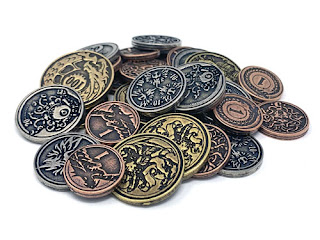
Some Notes on Coins in AD&D

You can buy these here.
Physical coins are fun.

Advanced Dungeons & Dragons
, in its first edition, is famous for its heavy coins. Each has a weight of a full tenth of a pound, or 1.6 ounces for each coin! In the second edition, this was changed to 50 coins to the pound, which is better. Though still pretty heavy compared to average historical coinage, it is within the typical coin weight range.

For most purposes, either one of these is fine. The heavy coins make figuring weight carried easier (so easy, in fact, that all weights were scaled to the coin, with each "gold piece weight" being equal to a tenth of a pound*; simply divide the number of "gold piece weight" units carried by ten to get the weight in pounds), while the later coins made for a reasonable compromise.

In Dragon magazine issue #80, an author named David F. Godwin provided an article titled "How Many Coins in that Coffer?", which proposed to work out volumes taken up by coins so that chests and other boxes of coins (not to mention magic items that were given volumes but not weight limits) could be appropriately evaluated. The article details the math and physics, but the upshot is that, if you don't want to go into detail, the large coins can be assumed to take up 0.25 cubic inches each, loosely arranged, or put another way a box can hold up to 4 loosely packed coins per cubic inch. Also, coins are about an inch and a half across, and about 1.5mm thick. The author makes the assumption that all of the metals are alloyed to have a similar specific gravity for simplicity. The article was written long before the arrival of the second edition, so it didn't include the math for the lighter coins, but it works out simply to divide the volume of the coins by 5 (0.05 cubic inches per coin) or multiply the number of coins per volume by 5, so 20 of those coins per cubic inch. That is certainly the easiest way to handle the matter.

For those who aren't interested in an array of artificial alloys that make everything easier, I have worked out more detailed numbers for the AD&D coins, but trust me that you probably don't really want to use them. Still, here they are. The assumptions are that loosely stacked coins take up 10% more volume on average than neatly stacked ones, which is based on the article referred above, and that neatly stacked coins take up a number of cubic inches equal to their diameter squared times their thickness. Note that coins are given diameter and thickness in millimeters, but volumes are converted to cubic inches. I'll be using the normal abbreviations for the coin types, which are: PP for Platinum Pieces, GP for Gold Pieces, EP for Electrum Pieces, SP for Silver Pieces, and CP for Copper Pieces. The metals were worked out as 90% pure, with the alloys being: Platinum 90%/Silver 10%, Gold 90%/Copper 10%, Gold 45%/Silver 45%/Copper 10% (Electrum), Silver 90%/Copper 10%, Copper 90%/Zinc 10%. The difference of using Copper 90%/Tin 10% (or Bronze) is so small as to make effectvely no difference, about 0.2% greater specific gravity, so you could do that if you preferred.

Given those assumptions, the heavy coins are as follows:

PP: 37.73mm diameter x 2mm thick
GP: 40.87mm diameter x 2mm thick
EP: 44.94mm diameter x 2mm thick
SP: 52.92mm diameter x 2mm thick
CP: 57.58mm diameter x 2mm thick

Note that the silver and copper coins have gotten very large in diameter, over 2", so it is possible to make them 3mm thick instead, which makes the SP 43.21mm in diameter and the CP 47.01mm in diameter. This has no appreciable effect on the volume of the coins.

Loose coins per cubic inch/Cubic inches per loose coin

PP: 0.1911/5.2329
GP: 0.2243/4.4583
EP: 0.2712/3.6873
SP: 0.3760/2.6596
CP: 0.4451/2.2467

If instead you prefer the lighter coins that weigh 1 pound per 50 coins, those sizes and numbers are:

PP: 19.49mm diameter x 1.5mm thick
GP: 21.10mm diameter x 1.5mm thick
EP: 23.21mm diameter x 1.5mm thick
SP: 27.33mm diameter x 1.5mm thick
CP: 29.73mm diameter x 1.5mm thick

Cubic inches per loose coin/Loose coins per cubic inch

PP: 0.0383/26.1097
GP: 0.0449/22.2717
EP: 0.0542/18.4502
SP: 0.0752/13.2979
CP: 0.0890/11.2360

But again, it would be much simpler to simply assume that each coin has an equivalent weight and volume due to the array of alloys used, and allow exactly 4 or 20 coins per cubic inch of storage space. If your coins have another ratio to pounds, then simply multiply the volume appropriately. For example, if you have 100 coins per pound, then allow twice as many as the 50 coins per pound number, or 40 coins per cubic inch. My historical £sd coins, of which the pennies are approximately 300 per pound, would have 120 coins to the cubic inch (yes, they are tiny, just as the historical Tower pound pennies were, at 240 pence to the Tower pound; as you can see at the original article on my blog**, the silver pennies are 14.73mm in diameter and 1.28mm thick, while the larger Gold Crowns measure 17.55mm diameter by 1.5mm thick), which seems odd, but is because the specific gravity of silver is not the same as the specific gravity of the "Universal Alloy" used in the referenced article.

*In fact, in the "basic" D&D line (B/X, BECMI, Cyclopedia), weights were simply called "coins", keeping the same tenth of a pound per coin ratio.

**I am going to have to re-figure a lot of that article, as I never accounted for impure metal and all of those sizes and weights are based on pure silver, copper, and gold. I can get away with simply multiplying the diameters by the square root of the ratios of the specific gravities of the pure metals to the impure alloys (I think; right now figuring the math in my head is giving me a headache so I'll work it out in detail later). I never did figure the volume of the coins, either, but I was figuring on abstracting specific volumes to the stone/item weight categories, which was a feature of the encumbrance system I was planning.

Sunday, September 19, 2021

On The Deities Of The World Of Greyhawk

Images of Some Greyhawk Deities

For the purposes of this article, I am going to stick (mostly) to the so-called "Gold Box" release of The World of Greyhawk. In part, this is because I like 576 CY campaigns and the freedom they give for the individual DM to develop the setting as they see fit. I also take the events in the Greyhawk's World series of articles found in Dragon magazine from 1981-1982—and to a lesser extent the Deities & Demigods of the World of Greyhawk series of articles (and Gods of the Suel) that appeared in that magazine from 1982-1984—as mostly canonical, though I reserve the right to change anything in those articles to suit my purposes. So, I suppose you can call it a 578 or 579 CY campaign. One of the more obvious elisions in this article, then, will be the Elder Elemental God, Zuggtmoy, Lolth, and so on, except of course for Iuz. I'm also going to skip over the demihuman and humanoid pantheons as they are mostly disconnected from the main subject of this article.

Pretty obviously, the list of gods in the Guide divides the gods into four main "ethnic" pantheons (though, as we will see, things are not so cut-and-dried): the Oeridian, the Suel, the Flan, and the Baklunish. A number of the gods from each of these pantheons are also included in what is termed the "Common" pantheon, which we can imagine is the pantheon of gods imagined by people who aren't particularly connected to any of the particular religious expressions in the Flanaess—the gods of the common people, if you will. This Common pantheon includes all of the gods of the Flan, most of the gods of the Oeridians, a very few of the gods (to be exact, two goddesses) of the Suel, and the lesser gods of the Baklunish. In addition, the Common pantheon includes a number of gods unconnected to the other pantheons, and for the most part not to each other except for their inclusion in the Common pantheon.

It is important to note that Gygax noted that the "Greater" gods see very little actual worship, being too big to be credible in responding to the needs of some shepherd in the Hestmark Highlands or whatever, so most of the religious activity of those who are not actual clerics or the great nobility is concentrated on the so-called "Lesser" gods and the demigods.

The Flan pantheon consists of nine gods, four "Greater" gods, four "Lesser" gods, and the Demigod Iuz. The four Greater gods are Beory, the Oerth Mother, Pelor, the god of the Sun, Nerull "the Reaper", god of Death and the Underworld, and Rao, god of Reason and Serenity. This is mostly the typical "pagan" pantheon envisioned by neopagans in the real world today with the addition of a god of Reason. We can perhaps envision a central myth similar to the "Oak King-Holly King" one that developed among neopagans in the 20th century, where a great Goddess is alternately wed to a God of summer and a God of winter, changing at the equinoxes or solstices (or perhaps at the midway point between an equinox and solstice) when each God meets the other in combat and the winner takes the bride. That is, a typical seasonal myth. It's up to the DM how they might want to envision this myth as a rite, perhaps varying from place to place in the Flanaess.

The "Lesser" gods of the Flan include two who are connected to the world and two who are associated with social behavior. The two worldly gods are Berei, goddess of the home and agriculture, and Obad-hai "the Shalm", god of nature and the wilderness. The social gods are Allitur, god of ethics and proper behavior, and Zodal, the god of mercy and hope. Iuz, of course, is a demigod whose machinations drive the overarching action hinted at in the existence of the land named for him as well as the opening moves described in the Greyhawk's World articles and of course the events in such classic adventures as The Village of Hommlet.

The Oeridian pantheon is much larger, but has only two "Greater" gods, Procan, the god of oceans, and Zilchus, the god of power, prestige, and money. I envision the former as the god of the physical world, which the Oeridians must understand as arising from the surrounding ocean, while the latter is the god of actions, understood as the powers of the nobility to command, the "invisible hand" of the market, and so on.

Similarly, the "Lesser" gods of the Oeridians can be divided into gods of the physical world and gods of mental states that drive actions. In the former case we have the gods of the four winds and their associated seasons, Atroa, goddess of the east wind and spring, Sotillion, goddess of the south wind and summer, Wenta, goddess of the west wind, autumn, and the harvest, and Telchur, god of the cold north wind and winter. In addition, there are Celestian, god of the stars and wanderers, Fharlanghn, god of the horizon and travel, and Velnius, god of the sky and weather. Pholtus "of the Blinding Light" stands, perhaps, in between the physical world gods and the mental gods, being god of light but also of law. To a certain extent, Pholtus seems to have developed as a nearly monotheistic god, jealous of other deities, at least in the early material about him.

The rest of the Oeridian gods include Delleb, god of reason and intellect, Erythnul, god of hate and envy, the very similar Kurell, god of jealousy and revenge, and the opposing pair of Heironeous, god of chivalry, honor, justice, and valor, and Hextor, god of war, discord, and massacres. Finally, there is the demigoddess Rudd, associated with both chance and skill. Of these gods, only Delleb, Velnius, and Kurell do not make the leap into the Common pantheon, perhaps because Kurell is difficult to differentiate from Erythnul, Velnius seemingly duplicates the four wind gods, Pholtus, and Celestian, and Delleb is maybe seen as a lesser version of Rao.

The Suel pantheon is commanded by three "Greater" gods, Kord, god of athletics, sports, and brawling, Wee Jas, goddess of magic and death, and Lendor, god of tedium and the passing of time. This suggests a culture that values on the one hand physical activity and on the other the uncanny, but considers all other events to be merely wasting time.

The "Lesser" gods of the Suloise include an interesting mix that deserve some contemplation. There are four goddesses, Bralm, goddess of insects and industriousness, Lydia, goddess of music, knowledge, and daylight, Beltar, goddess of caves and malice, and Syrul, goddess of deceit and lies. In addition, there are seven "Lesser" gods, Fortubo, god of metals, stone, and mountains, Llerg, god of beasts and strength, Norebo, god of gambling and luck, Phaulkon, god of wind and clouds, Phyton, god of beauty and nature, Xerbo, god of the sea and money, and Pyremius, god of fire, poison, and murder. Of all of these gods, "Greater" and "Lesser", only the goddesses Bralm and Lydia are to be found in the Common pantheon.

The Baklunish people hold Istus, Lady of Fate, to be the greatest, and under her are two "Lesser" goddesses, each pointing the way to a different way to meet fate. On the one hand is Xan Yae, goddess of stealth and shadows, but also mastery of mind over matter, and on the other is Geshtai, goddess of rivers, lakes, and wells. The one demigod of the Baklunish people mentioned is Zuoken, associated with physical and mental mastery, who maybe can be understood as the consort or son of Xan Yae, or perhaps her devoted follower. Of these, only Istus is not widely worshiped in the Common pantheon. My own take on this pantheon is to draw parallels to medieval Islam, with its focus on fate being previously written, and the "Lesser" goddesses being representative of an appreciative and aesthetic approach to meeting fate, and an approach to fate of mastery, suggesting a Sufi-like mysticism or, alternately, cults of assassins exerting their will.

Anyway, this has gotten long, so I'll save the rest of the gods, unassociated with any particular pantheon, for another time if there's any interest. That's where you'll find St. Cuthbert "of the Cudgel", Boccob "the Uncaring", and the nearly-Lovecraftian Tharizdun, among quite a few others.

Monday, August 16, 2021

[Obscure Games] Flashing Blades


Fantasy Games Unlimited was notorious for publishing excessively complex games like Chivalry & Sorcery, Aftermath!, or Space Opera, but in fact they just as frequently published games of normal complexity, like Villains & Vigilantes or Psi-World. Some of their games, like Bunnies & Burrows, were on the much less complex side of the hobby. And that is where we find ourselves with the swashbuckling game, Flashing Blades.

Character creation is fairly straightforward, with a few stats each rolled on 3d6, a number of figured stats including a hit point pool, the choice of several character backgrounds that give varying access to skills, giving different skills a cost of one, two, or three points each, and a number of skill points to pick up those skills. In addition, a character can learn how to fight in various ways, from picking up the skill on the mean streets to formal instruction in a fencing salle. Finally, the character can have any of a number of advantages or be burdened with a secret that gives story hooks to the character.

Non-combat skills are easy to use, simply rolling against one of the character's stats if the skill is possessed, half the stat if it isn't, and getting bonuses for a couple of levels of increasing mastery. In addition, mastery of a skill should cause the Referee to call for rolls less often, only for situations of increased difficulty.

Combat isn't much more difficult, being a process of figuring the chance to hit on a d20, rolling for hit location by picking a target, rolling 2d20 and using the result that is closest to the target location, and doing damage that is reduced by armor rating.

But a swashbuckling game would be remiss if it didn't provide a way to rise in society, and in some ways the heart of the game is found in the social status and careers. Characters start with a social status based on their background and possibly their advantages if those provide them with a position at the start of the game. They may use their skills and background to enter into any of various careers, whether in the army, the royal bureaucracy, the Church, the banking system, or a number of other possibilities. Each career starts with a low-level position, such as a minor bureaucrat, law student, or priest, then provides opportunities for advancement as the game progresses, potentially advancing as far as Pope of the Church! Of course, most characters will not make it so far in their careers, but even a Town Mayor or Provincial Tax Collector has significant clout. There are also minor careers that can be pursued, such as rising as an official within a Gentlemen's Club. The most active characters might even pursue careers in several directions. Holding a number of positions can increase the character's social rank, after all.

Most of the supplementary materials for the game simply provided some adventures to undertake, but High Seas in particular expanded the game by providing for life in the Caribbean instead of France, and opened the possibility of playing a pirate, with information on how that sort of a career could be pursued.

Designer Mark Pettigrew was only 19 years old when the game was published in 1984, but its clean design and sophisticated approach to a lifetime career speaks to a solid understanding of how those could work in a gaming environment.

In the end, it's an excellent game. You can still buy it in print or PDF. PDFs are available at DTRPG, while the print game can be ordered from Fantasy Games Unlimited directly. I do not get any kickbacks or anything from those links, I am only providing them for your convenience.

Wednesday, August 11, 2021

Let's Talk About Game Design


A long-time project of mine has been to update the old RPG Fantasy Wargaming, a game which was never properly developed or even well-edited. Different authors had different chapters, and those portions of the game weren't very well integrated into a cohesive whole. In addition, the people involved had very little collective experience at game design, though of course some had more than others. Further, the game was based on very early designs like D&D and Tunnels & Trolls and so had few models to examine to provide the best ways of approaching different parts of the game.

Even with all of those flaws, though, some of the ideas incorporated into the game verged on brilliant. I still haven't seen religion, especially polytheistic religion, handled quite as well (I'm  not sure that there's any other game which included the idea of appealing to a Power to intervene on the appellant's behalf with another Power and make it meaningful), and magic drew on then-cutting-edge ideas current in the so-called "Chaos Magick" movement that was happening at the time in England. It wouldn't be until Mage: The Ascension was published a dozen years later that similar ideas would be seen again in game design.

As I sit down to turn my notes into a playable game, I find myself thinking about things that I haven't seen discussed in game design before. For example, I am thinking about the relationship of the player, the character, and the setting. Some games treat the character as a mere extension of the player's desires, allowing an absolute control and decoupling the character from any setting-based relationships. This is a reflection of the purely individualist conception of a person that prevails in a lot of Western cultural contexts, but most especially as a very American attitude toward the person. I want to encourage a more social understanding of the character within the setting, so I am looking to models like Pendragon and Lace & Steel to examine elements of a character that constrain the omnipotent control by a player over the character usually assumed in RPGs. Factors like emotions, attitudes, and so on should be included in the game I am conceiving. These ideas were included in a rough form in Fantasy Wargaming, of course, in the systems related to Temptations and the resisting thereof, in the Leadership and Social Class rules, and so on.

As I'm conceiving the metaphysics of the game, as it were, I see the player as representing the soul, giving purpose and direction to the character. The character, though, has a history within the game setting, and this affects the attitudes and assumptions of the character that might run counter to or align with the will of the player. Fears, desires, hatreds, and devotions mix with personality traits like Honesty or Generosity to influence the decisions the player might make, for good or ill. Getting those personality elements to align with the player's preferences is part of the psychological work that the character and player might embark upon. In addition, social traits like Social Class and Leadership value have their effects on how the player approaches the game as well.

In Fantasy Wargaming, the personality traits were mostly expressed as the negative pole of the trait, so that they were described as Greed, Selfishness, and Lust (there's also Bravery, but that served as both fearlessness and anger). I am reversing that, so that those three traits are Temperance, Generosity, and Chastity, respectively, and I'm adding two others, Honesty and Stability, while the final personality trait, Bravery, I am leaving largely as-is. Stability is sort of the odd man out here, since it isn't involved with many Temptations, but it does allow the player to choose to temper the excesses of the character's passionate emotional reactions. I might choose to make it a regular attribute of the character instead.

In regard to more prosaic game design issues, I am still struggling with whether I should retain the odds tables of FW or re-figure things so that the game produces simple target numbers to roll on a d20. I am almost certainly going to replace "hit point" style damage pools with descriptive injuries, simply because that is a major aesthetic preference of mine. I am certainly going to keep the character levels approach, divided into the three types of Combat & Adventuring, Magical, and Religious, but instead of 1000 experience points of the appropriate type per level, it'll be 1000 for first level, doubling for every level after. That does mean that most characters won't be rising much above 6th or 7th level over their whole adventuring career, and rising above 14th level will be nearly impossible, but that's well within the parameters I want to see anyway. It also means that players who have to start a new character won't be really left that far behind their fellows and can catch almost all the way up fairly quickly.

Anyway, just some initial thinking about how to approach the game. In some ways, this is also related to JB's thoughts on fudging dice rolls, in the sense that we are both exploring what it means to be playing a game as opposed to just playing around. I'm not, of course, saying that JB would necessarily agree with my thinking here, only that we seem to be exploring the same questions of purpose.