Showing posts with label AD&D. Show all posts

Thursday, July 30, 2026

AD&D Combat - House Rules

Here are some house rules changes to the AD&D (1st edition) combat system intended to tune it a bit to suit my sensibilities. I think shields should be more important, helmets meaningful, and a few smaller tweaks.

  •  There is no free attack or attack routine against a combatant breaking off from melee. Chase them down. (See The Princess Bride for an example of why, when Inigo first confronts Count Rugen in the hallway.)
  • During surprise segments, missile weapons get their normal rate of fire per segment, not triple rate of fire. (This seems to have been a mistake in the original text.)
  • Only spears held in two hands get ×2 damage when set to receive a charge. (This seems obvious, but as written is not mentioned.)
  • Multiple attacks due to weapon speed factor (DMG, p. 66) occur on tied initiative as usual, but also when the attacker has won initiative. (I dislike the possibility that having better initiative may mean fighting less effectively.)
  • When a character reaches 0 or fewer HP from injury, they are unconscious and mortally wounded. If they reach -4 or fewer HP from injuries, they are immediately dead. A mortally wounded character loses an additional 1 HP per round until their wounds are tended to and stabilized. If the total reaches -6 HP or fewer, the character gains a permanent injury, such as a scar, missing limb or extremity, or the like. If the total reaches -10 HP, the character is dead. HP loss from poisons or other non-injury sources will kill at 0 HP or fewer. (Mainly, this attempts to clarify one interpretation of the rules as written.)
  • Shield Block: Members of any classes that are permitted shields who have a shield and are struck by a damaging attack (except gaseous ones) can attempt a Shield Block by making a save vs. Breath Weapon, with Fighter-types, except Witch Hunters, getting a +1 bonus to this save (and Paladins being able to use their additional +2 as normal). Bucklers may not Block actual Breath Weapons. Monsters with shields save as Fighters always, but do not get the bonus +1. On a success, the attack does no damage but the shield must save (as thin wood, usually, but with the normal +5 against a normal or crushing blow—but not other types of attack—for being "in its own mode" and the normal bonus for a magical item with a plus). On a successful save, the shield is battered and takes a permanent -1 against future saving throws (only). On a failed save, the shield is shattered, unless it has magic bonuses in which case it takes a -1 until repaired for 100% the cost of a shield per -1. Repairing battered shields costs 5% the cost of a shield per -1 to saves removed. (While this may look complex at first glance, the intent is simple in principle. Characters trained to use shields may use them to get a saving throw to avoid attacks, with the possibility of losing the shield.)
  • Critical Hits: On an attack that rolls a natural 20, if the attack hits and the target is not wearing a helmet then the attack does maximum damage. If the target is wearing a helmet and the attack otherwise hits, then the helmet makes a save against the appropriate type (normal blow, crushing blow, or whatever attack type) with the normal bonuses (and an additional +5 for a great helm; note that great helms have penalties outside of their normal combat function, such as reduced vision and hearing). Success means that the helmet is battered and takes a permanent -1 to future saving throws and the attack inflicts normal damage. Failure means that the helmet is destroyed and the attack inflicts maximum damage. Also do not use the normal 1E helmet rule. (I agree that a "good" roll should give some benefit, but most systems that do so are even more cumbersome than my shield block rule. This also gives value to wearing a helmet without requiring "hit location" rolls or whatever.)
  • Critical Failures: If an attack rolls a natural 1, then the attacker, if using a weapon only, must make a save vs. Breath Weapon, at +1 for Fighter-types, except Witch Hunters, -1 for Magic-User-types, and add or subtract any Dexterity Reaction/Attacking Adjustment. Success means no effect. Failure means the weapon is dropped (if necessary to know how far away, use 1d30 (or 1d20) feet in a random direction). If not using a weapon, then make the same save or fall down. (Another case of wanting to make extreme rolls have an effect on play, without cluttering things up too much.)


In addition to these, I've adjusted the Monk (d6 instead of d4 hit dice, other changes), clarified 0-level Fighter hit points, reworked the Weapon Proficiency categories so that, for example, a Long Sword and a Broad Sword aren't two entirely separate proficiencies. I've also added Combat Maneuvers, on the model of Martial Arts in Oriental Adventures, to give Fighters and most Fighter subclasses (and Monks) some other things to expend Weapon Proficiency slots on in exchange for various combat bonuses, without resorting to clumsy and overpowered "Weapon Specialization". Among other things unrelated to combat. All told, not including new class level limits or minor changes to Experience Points, I have four pages of house rules or so, including character creation options like various methods of rolling attributes, lists of available subclasses, and so on.

Thursday, July 23, 2026

Rule Systems Matter - Glass Goblins

Here's a monster that only works properly using the 1st edition AD&D rules. In that set of rules, anyone can hit this creature on a "natural" roll of 20, with only 5th+ level Fighter-types, 7th+ level Cleric-types, 9th+ level Thief-types, 11th+ level Magic-User-types, or 2HD or greater monsters able to make use of any "to hit" bonuses, due to its unusually high Armor Class. Now, if it is hit, then it immediately dies, thanks to its fixed 1 hit point (treated otherwise as per any creature of less than 1HD). Based on an entry in All the World's Monsters, Volume 1 from Chaosium. The concept could easily be transplanted into another edition, but a harried converter might miss the subtleties involved, especially when translating into 2nd edition rules.


GLASS GOBLIN


FREQUENCY: Very Rare

NO. APPEARING: 4-40

ARMOR CLASS: -4

MOVE: 6”

HIT DICE: 1 hit point (but as 1-1 for to hit and saving throw purposes)

% IN LAIR: 40%

TREASURE TYPE: Individuals K; Lair C

NO. OF ATTACKS: 1

DAMAGE/ATTACK: 1-6 or by weapon

SPECIAL ATTACKS: nil

SPECIAL DEFENSES: nil

MAGIC RESISTANCE: Standard

INTELLIGENCE: Average

ALIGNMENT: Lawful evil

SIZE: S (4’ tall)

PSIONIC ABILITY: nil

Attack/Defense Modes: nil

LEVEL/XP VALUE: II/31


Another goblin affliction similar to nilbogism (see ADVANCED DUNGEONS & DRAGONS FIEND FOLIONilbog), the strange disorder resulting in glass goblins causes most strikes to bounce off of their rigid flesh, but a perfectly-angled attack will cause the glass goblin to shatter into tiny fragments, as if it were truly made of glass. Otherwise, glass goblins live among their normal kin and cannot be told apart from them without touching the glass goblin’s skin (see ADVANCED DUNGEONS & DRAGONS MONSTER MANUALGoblin). They live in perpetual fear of bugbears (see ADVANCED DUNGEONS & DRAGONS MONSTER MANUALBugbear), who are the members of goblin society most able to shatter them.


Friday, January 2, 2026

Making Plans

 I don't know if I'm going to go anywhere with these, but it's the beginning of the year and maybe I should organize my approach to this blog a bit. So, here are some things I might do.

  • Design a setting for GURPS - Starting from the same premise that led to Psi-Wars, I want to start laying out a setting that has occupied a part of my mind for a number of years. It's something of a post-apocalyptic one, inspired especially by S. M. Stirling's Emberverse series, as well as some other sources like the WarpWorld RPG (also, see my review from a while back here; I'd likely be kinder to the game were I to write that today, for a number of reasons). Actually, the setting will also be usable with other game systems, but the only other one I'd be interested in working with is basically out of print and definitely unsupported, and it'd be easy enough to convert so I probably won't bother. Alternately, I have a fantasy setting to work on that in concept goes back perhaps 40 years. I could work on that, too. In retrospect, working on it would not be unlike the Psi-Wars project, but related to the Malazan Book of the Fallen instead of Star Wars, since the world setting is convoluted and political much as Malazan is. Also has incarnate gods running around, too, which the players back then never got to see.
  • Write more Obscure Games reviews - I've got some relatively recent games I want to get to, and quite a few older ones.
  • Finish my overview of Domain Play in AD&D 1E - I just sort of let that one drop, but I do have more to say on the topic.
  • Write some material for MegaTraveller - That's a game I've been missing.
  • Write more AD&D material - I do have stuff to say. I need to sit down and type it out.

 I've also got some other design and theory articles in mind, like discussing the City as Dungeon Crawl concept and comparing it to more abstract methods - and, vice versa, the Abstract Dungeon, such as seen in Worlds Without Number (speaking of which, I need to finish my Obscure Games review of that one). I should probably also talk about the functions and merits of using or not using maps, which is closely related.

Now, let's see if I get to these. 

Wednesday, December 31, 2025

End of Year Assessments and Aspirations


Gaming projects I've been noodling around with and their working titles, an incomplete list:
 
Flanaess Sector: reskinning AD&D 1E as a space opera game, with new classes, spaceship combat, equipment from 1E/4E Gamma World, and intelligent aliens drawn from the intelligent species of Monster Manual/Fiend Folio/Monster Manual 2.

Towers of Saltgate: city-as-dungeon-crawl supplement in the tradition of City-State of the Invincible Overlord, the Chaosium Thieves' World boxed set, or even modules like "Dwellers of the Forbidden City".
 
Shining Swords: a space opera game in the tradition of Star Wars ("A New Hope" more than any of the other chapters), Traveller, or the Eric John Stark stories of Leigh Brackett, using the rules system found in Flashing Blades, especially including the careers and social climbing adapted to space fantasy; possibly with psionics, but very much not sure about that - even if it does, note that moving things with mind power did not show up at all in that first chapter of Star Wars.
 
Millennium: medieval fantasy, covering 486CE-1487CE, Europe to Persia, Scandinavia to North Africa. Really, a thorough revision and reworking of Fantasy Wargaming by Galloway et al.
 
Alpha Cephei: using the Cepheus Engine SRD to clone the MegaTraveller edition of Traveller, with my own setting centered on Terra.
 
Days of High Adventure: my own D&D, working from the already very stripped-down Swords & Wizardry: White Box, stripping it down to the barest essentials, then building it back up to a more complete rules set focused on long-term campaign play, possibly in combination with Towers of Saltgate, but certainly some sword & sorcery setting; would include faction rules and other GM tools designed to allow players to take full initiative and agency.
 
I really should just pick one at a time, focus on it, and not throw it away when I get frustrated with it… and try to ignore the most frustrating part, publishing and production, until I can actually look for solutions to questions like editing, art, and layout.

Friday, August 22, 2025

The Merchant Character Class


I haven't presented a character class for AD&D in a while, so let's do this one. The main thing I'm editing here is the Assessment ability, since I use a method from Dragon magazine issue 104, but have presented a really stripped-down version here, along with a radical simplification of the Forgery ability. Also, I'm switching to the "traditional" AD&D player races instead of those from my campaign setting. My version of the Merchant is based on my distaste for versions with magic or too many overpowered abilities, or overly complicated systems for their abilities.

EDIT TO NOTE: I have been discussing this class elsewhere, and there have been some changes. I'll post it to this blog when I feel that it is more finished. 


The Merchant

Merchants belong to a subclass of Thief specializing in buying low, selling high, and finding markets for goods in the first place. To become a Merchant, a character requires a Charisma of at least 9, an Intelligence of 8, and a Wisdom of no less than 7. At first level, a Merchant will learn the use of 2 weapon proficiencies, gaining another every four levels. Merchants fight using the Thief combat table, taking a penalty of -4 when using weapons with which the character has no proficiency, and may select weapons from among: Caltrop, Club, Crossbow, Dagger, Dart, Garrot, Knife, Sap, Scimitar, Sling, Staff, or any one-handed sword except the Khopesh. They may use Leather, Studded Leather, Padded, or Elfin Chain armor but not Shields, may use flaming oil, and may use poison if the DM permits. Humans and Half-Elves may be Merchants and advance without limit. Dwarfs may advance to the 8th level as Merchants, Elves to the 12th level if their Charisma is 16 or higher, to the 11th level if of Charisma 15, or to the 10th level if of lower Charisma, Halflings and Gnomes may advance as far as the 6th level as Merchants, and Half-Orcs may rise as high as the 4th level. They save using the Thief table. Merchants advance according to the following table:


Experience Points

Experience Level

Hit Dice (d6)

Level Title

Sense of Direction

0-1,500

1

1

Haggler

30%

1,501-3,000

2

2

Bargainer

35%

3,001-5,000

3

3

Hawker

40%

5,001-10,000

4

4

Vendor

45%

10,001-20,000

5

5

Entrepreneur

50%

20,001-40,000

6

6

Trader

55%

40,001-75,000

7

7

Master Trader

60%

75,001-135,000

8

8

Merchant

65%

135,001-220,000

9

9

Merchant Prince

70%

220,001-440,000

10

9+1

Merchant Prince (10th Level)

75%

440,001-660,000

11

9+2

Merchant Prince (11th Level)

75%

660,001-880,000

12

9+3

Merchant Prince (12th Level)

75%


220,000 experience points per level for each level beyond the 12th.

Merchants gain 1 hit point per level after the 9th.


The Merchant’s Sense of Direction ability allows the Merchant the stated chance to avoid the effects of being lost when traveling. It does not improve beyond the 10th level of ability.

Merchants have an improved ability to assess the value of items, having a ability to assess an item's value of 50%, +5%/level after the first. Failure will cause the DM to provide an incorrect value at the DM's discretion.

Merchants may attempt to forge documents, at the same chance as an Assassin of equal level (and further improving +5% per level after the 15th in each category). (Use the system in Dragon magazine 96 or give a base chance of 45% starting at 3rd level, +5% for each additional level; the DM can increase or decrease the chance by 15% for more or less difficult forgeries.)

Merchants are skilled negotiators, and gain a bonus of +3%/level on the Reaction table, to a maximum bonus of +30%, in addition to any bonuses for Charisma or other modifiers.

Merchants are expert bargainers, and can always buy items for a 10% discount while selling them for an additional 10% profit, calculated from the listed price. If two Merchants are bargaining against each other, there is a chance of 50% +5% for each level one Merchant is greater than the other, that the higher-level Merchant will get the 10% alteration in price, else the lower-level Merchant gets it. Add the higher-level Merchant’s Charisma Reaction Modifier to this chance and subtract that of the lower-level Merchant from it. Do not use the negotiation bonus above in this calculation.

Finally, a Merchant can Hear Noise and Read Languages exactly as a Thief of equal level.


Sunday, August 10, 2025

Notes On The Notes

Let's have some "behind the scenes director's commentary" about the notes I presented on my upcoming AD&D campaign.

The Tetradic Church is mainly inspired by an article in Dragon magazine issue 77 by Nonie Quinlan, titled "Elemental Gods". It argued for a less monster-style approach to gods and religions, presenting a model based on the classical Four Element system. The names of the gods are in Indonesian, Banteng meaning "bull, ox" and representing strong, solid earth, Kucing meaning "cat" and manifesting a sort of playful/cruel, almost-Dionysian air/wind, Naga Emas meaning "gold[en] dragon", the Church's understanding of fire, and Bidadari meaning "angel, nymph, beautiful woman", who is ever-changing water and the Moon.

The Church of the King of Life is inspired by the story game, Dogs in the Vineyard, and so is a fantasy version of the LDS/Mormon church. Like that game, my current plan is to leave specific scriptural justifications up to the players who choose to play adherents, or to the exigencies of play as I need them, but the patriarchal culture and Branch system of organization are the general basis of that religion. Padishah, of course, is Persian for "monarch".

The Weaving Goddess of Fate is my version of Gary Gygax's "Istus, Lady of Fate" from his World of Greyhawk setting, by way of the three Norns/three Fates, Islamic and Norse fatalist ideas, Irish weaving prophetesses, and so on. Her name is from Inanna, because I wanted that Middle Eastern connection.

The traditional D&D/AD&D cleric class fits best with those three religions, whose gods don't have hit points, per se. 

The Alien God is based mainly on G.R.S. Mead's analysis of what we know about Simon Magus. Aśundǒr and Śukar are words in Romani meaning, respectively, "listener", which is more or less the meaning of "Simon", and "brilliant, shining", a rendering of Helen, who was Simon Magus's partner, probably taking the role of Gnostic Sophia in his theology. I like the mix of Stoic, Neoplatonic, and Gnostic/Manichean ideas that Mead derives from the Simonian fragments we have. Plus, Mead's work is also a major influence on Tierney's and Rahman's "Simon of Gitta" stories, which are excellent sword and sorcery/sword and sandal/weird story yarns. There may come a time in the future of the setting when clerics of the Alien God travel the world of Dunia, but for now things are more personal, less involved with intermediaries.

I explained most of my take on Druidism already. Erodia is a rendering of Aradia, hero of an allegedly ancient Italian witchcraft poem collected by Charles Godfrey Leland. The name is related to the Biblical Herodias, but may also be related to Diana (I believe "Herodiana" is attested). Dunia, who gives her name to the world of the setting, is a Gaea-type (or Terra, Demeter, etc.) Briga's name comes from Celtic languages and means "High One" or "Powerful", the same as Brig in Irish legend, St. Brighid, Briginda, Brigantona, and so on. The particle also finds its way into Irish briocht/Gaulish briχtia, both meaning "magic spell", which I adapt as similar to "heka" in "Hekate/Hecate". Artor and Medraut come from Arthurian legend, being versions of Arthur and Mordred, and take roles in my game setting's Druidism from Robert Graves's poetic inventions that he tried to impose over historical ideas (and which have been adopted by some modern neopagans/Wiccans). The idea is, basically, that the Summer/Oak King and the Winter/Holly King meet in combat twice a year, representing the turning of the seasons, with the victor taking up the White Goddess as wife until the next combat. In reality, pretty weak sauce as theology in my opinion, but it has its supporters. Karnon is derived from "Cernunnos", a lightly-attested Gaulish deity of largely unknown (but perhaps not unknowable) character who was adopted by early neopagans/Wiccans as the Horned God of their craft, inspired by Margaret Murray's unfortunately flawed reconstructions. Whatever the historical flaws, I hasten to note, it does carry great meaning and depth for many. Mixing that with material from the Barddas of Iolo Morgannwg and other sources I mention, I get a fun naturalistic/esoteric philosophy that easily carries and supports the flavor of AD&D druids.

My vision of polytheistic cults worshiping/forging relationships with localized spirits is in part from long consideration of the place of gods depicted as a sort of monster in D&D-style games going back to Supplement 4: Gods, Demi-gods, & Heroes for original D&D (which used to be the only book from that edition I owned; it has since vanished from my collection, but at least I still have my original copies of Cults of Prax and Cults of Terror). As noted in my writeup, I'm looking to an article from Dragon magazine as the mechanical basis of this cleric-free religion cluster, though also including a version of the "warlock" class adapted to 1st edition AD&D terms and other approaches. I'm pretty sure there won't actually be any Zeus or Athena gods, those were merely examples demonstrating the idea of local epithets.

As an aside, I'm still working out the exact places of demons, devils, daemons, and so forth in the setting. Was it the demons or the devils who built the world-prison in opposition to the Alien God? Not fully sure. I'm actually leaning toward the devils at the moment. It will give them more purpose in the setting, and make Hell a somewhat meaningful place.

I didn't mention it, but that wasn't a comprehensive list of religions in the setting. Notably, I skipped over the Church of the Serpent, found among the Drakkonern people, my adaptation of the Dragonlord people found in Mayfair's Dragons supplement in their Role Aids line. I really liked the dragon civil war situation laid out in that supplement, and often work to fit it into my settings. The Dragon religion looks to four great elemental dragons, so it fits with my Tetradic Church, but I can also mine the Palladium Role-Playing Game, which also includes four elemental dragon-gods, for ideas. Another religion I have in mind is the Loathesome Toad Gods, inspired by Jeff Rients's Miscellaneum of Cinder, but also John Tynes's vision of the Lovecraftian gods laid out in Delta Green (as well as its supplements and follow-on games) and, especially, the D20 adaptation of Call of Cthulhu.

Saturday, August 9, 2025

AD&D Game Notes

Bryn Celli Ddu, a barrow mound

Time for a post, to remind you I am alive.

I started off working on the Gygax75 Challenge, though I didn't stick strictly to its schedule. Mainly, I decided that the opening location would be a version of Portown, of Ruined Tower of Zenopus fame, with an additional megadungeon of my own devising located a short journey away. Further, though I don't mention it in the following notes, I've also placed Quasqueton, from B1 In Search of the Unknown, nearby. I figure that the Tower, smugglers' caves, and ghoul tunnels, a megadungeon/mythic underworld, Quasqueton, and the usual port city-based activities should give the players any number of hooks on which to hang their adventures.

My megadungeon, as noted, is found beneath goblin-haunted barrow mounds, which hold entrances to a mostly classic mythic underworld, a place where adventurers, through bravery, skill, and luck, might make their big score. 

In  addition to a house rules document (that remains somewhat in flux as I keep running into rules interpretations to consider; at least it's short, only four pages plus a couple of pages on changes to experience point awards), I've written up the opening situation as the initial player-characters arrive by ship in Portown, and a précis of the religions of the setting, noting how most of the additional character classes I plan to make available fit into the world's religious landscape. Here are those:

Introduction

The players have sailed from a town on the Gold Coast, where they grew up. Choosing a life of adventure rather than waste their bodies in the rapidly diminishing mines or live the quiet lives of peasant farmers, they’ve come to a town they’ve heard might reward a brave, and lucky, adventurer.

Portown is a small but busy trading port on the coast, with a population of perhaps a couple thousand or so, including people from all over the known world and perhaps beyond. Rumored to be built up from foundations standing on the ruins of an ancient city that may predate the coming of humanity, it lies a short distance, perhaps three or four leagues, North of a field of goblin-haunted barrow-mounds.

Stories tell of an underworld kingdom beneath the mounds full of riches and magical terrors. Many have gone into the mounds, never to return, but some few have come back to the surface with loads of jewels, gold, and magical swords, enough that there are always some brave, foolish, or desperate enough to try their luck.

The players step off the ship they’ve arrived with onto the wooden dock. Seagulls call in the overcast, leaden skies, and a strong smell of decaying fish and seaweed in brackish seawater permeates the air. North of the docks, the harbor is protected by a narrow spit of land reaching from East of the town, making the harbor into a cold lagoon. The dock leads up to shore, where large warehouse buildings line the boardwalk promenade, beyond which hints of other buildings can be seen through the alleys between the warehouses, and a few taller buildings peek over the roofs of the storage buildings. To the West, across a part of the harbor that projects south of the main lagoon, the fisher’s quarter hosts dozens of fishing vessels along a shore that leads back to hundreds of decaying houses. North of that quarter a peninsula stretches into the sea, with a lighthouse tower overlooking a cliff side at the North end. Access to the sea lies between the end of the protective jetty and the lighthouse. Beyond the fisher’s quarter, further to the West, a ruined tower overlooks the town from the top of a hill. Between the tower hill and the fishing quarter, a cemetery can just be seen. Not far from the tower ruins, a few hundred feet at most, on a smaller hill to the southwest of the tower hill, is a smaller tower in much better repair.

There is much bustling of working sailors along the docks and boardwalk, much shouting and strong language in a dozen different tongues, ropes being tied or untied, boxes of cargo being moved and carried, and some passengers lugging their own baggage to or from the shore themselves.


Religions of Dunia

Tetradic Church – The Four Elemental Gods: Earth “Bantəng/Banteng” (Solidity/Strength/Emotion, masculine), Air “Kuching/Kucing” (Wind/Weather/Intellect, androgynous), Fire “Naga Emas” (Sun/Craftsmanship/Manifestation/the World, genderless), Water “Bidadari” (Moon/Magic/Illusion/dreams, feminine) – clerics, cloistered clerics, exorcists, warrior monks, witch hunters.

Church of the King of Life – Padishah, God of Life – clerics, cloistered clerics, exorcists, paladins, warrior monks.

Church of the Alien God – exorcists, magic-users, warlocks, warrior monks. Aśundǒr  says he has come to rescue the souls of humanity, demihumans, and humanoids from the world, which is a prison built by the Demons to trap human/demihuman/humanoid souls, which are the fragmented light of the Alien God. Also, the Aion of Wisdom was lured into the trap and degraded by the Demons, finally incarnating as Śukar, a slave-prostitute he found and bought away from the brothel which owned her. Aśundǒr and Śukar are living humans who are teaching the philosophy of the Alien God with a retinue of twelve Disciples. 

polytheist sects – see note on gods in "Demonology Made Easy" – exorcists, magic-users, steppe shamans, warlocks, summoners, witches. Local gods may be manifestations of "deity-types", sometimes with related or even the same names as others of the type, usually given a location epithet (like "Zeus of Stonedale", "Parisian Athena", or whatever). 

Druidism – Erodia, Dunia, Briga, Artor, Medraut, Karnon – bards, druids, monks, rangers, witches. A sort of mix of Wicca and Taoism with other random influences, with three goddesses, Erodia the Huntress, Dunia the Earth Mother, and Briga the Wise, and three gods, Artor the Oak King, Medraut the Holly King, and Karnon the Antlered God. There's a philosophy of manifest Summer and potential Winter as the fundamental energies of the universe that combine and recombine as the Four Elements, the Eight Trigrams, the 64 Hexagrams, and other symbolic indications. I'm taking ideas from the Barddas of Iolo Morgannwg, European alchemy, Chinese Yì jīng and wǔxíng, Japanese kusei kigaku and onmyōdō, and mixing them all up with whatever takes my fancy. Dunia embodies the Summery Feminine, Artor the Summery Masculine, Briga is Wintry Feminine, Medraut the Wintry Masculine, while Erodia and Karnon are varieties of androgyny and “non-binariness”.

Denialism – "world is illusion", spoken by Kuhare Nadi the Enlightened One – exorcists, illusionists, monks, psionicists. Kuhare Nadi saw through the illusion that is the world and learned how to impart that knowledge to others. Some Denialists learn how to manipulate the illusion and create Phantasms or even create substance as Shadow. 

Fatalism – Inan, the Weaving Goddess of Fate – clerics, cloistered clerics, dervishes, exorcists, paladins, warrior monks.

Tuesday, February 27, 2024

[The Domain Game] part 4: Raising Armies


This is the 1 2 3 4th part of this ongoing series, and it is time to discuss the wargamer's favorite part: how to get an army to send against your foes.

In AD&D, the subject is treated in the simplest way possible—just hire mercenaries, mostly. There are a few other options available, such as loyal followers or recruiting tribal bands, demihumans, or humanoids, but none are as generally useful as the mercenary option, and tribal bands and even demihumans are only treated cursorily. But the thing is, in history there were several options available, some used in some cultures and not others, and others that were almost universal. For this post, it's time to get out "Armies from the Ground Up", found in Dragon magazine issue 125.

The most universal method of raising an army is to put out a call to the people to send their sons out to die fight for their noble leader. In some places, this might be an explicitly guaranteed right for the nobility to call upon, while in others it might be a cultural prerogative, and in still others the noble sovereign might have to convince the people that it is in their best interest to bleed serve on the battlefield. "Armies from the Ground Up" chooses to call these the "fyrd", choosing a term used by the Anglo-Saxons before the Norman Conquest. The fyrd consists of about 30% of the population, or every male of reasonably sound body aged from 18 to 45 years old. The article provides the option to expand this fighting force by increasing the age of the fyrd by one or more years down and three or more up, so from 17-48, 16-51, and so on all the way to the maximum of every reasonably sound male from ages 13 to 60. Each unit of increase bumps up the potential size of the fyrd by 2% of the total population, so a maximum of 40%. The article makes the categories rigid, so that for every one year down the high end must be increased by three years and the total size of the fyrd increases by 2% for each such increase, but the DM might consider being more flexible and increase it by 1% for each year down and perhaps ⅓% for each year up. Or something like that, it's just an idea running through my head as I type this. The DM might also work out some factor to cover conscripting female population as well, but there should also be some kind of penalty for all of these, such as reducing the overall effectiveness of the fyrd when recruiting younger and older population, reducing the overall happiness of the population and showing that by reduced morale or loyalty numbers for the population, and so on, especially if the battle for which these citizens are being called up doesn't go well. Anyway, this is the ideal, potential size of the peasant army. In the event only a certain percentage will show up in time to march out, which "Armies from the Ground Up" figures by rolling 5d6, adding 55, modifying the number by a few factors such as tax rate, the leader's general domestic and foreign policies, and such and then using that as a percentage of the potential army. So, the base size of the army will be 72% or 73% of the potential army on average and ranging from 60% to 85%, with various modifiers bringing the final total from 45% to 100%. Keep in mind, though, that by default these are untrained peasants carrying what amount to slightly modified farming tools. It might be possible for the players to issue their peasants more dedicated weapons to use in these times, but that can get pretty expensive, especially if they are given armor.

Another sort of non-mercenary soldier discussed in the article that might be available is the militia. This is a group of people given time off from working in the fields or whatever and provided with basic military training and equipment. As before, the "Armies from the Ground Up" article provides some details on setting up a militia and the effects of calling them up for military service.

The third sort of troops that might be available in a domain are what the article we're referencing calls the yeomanry. This starts to verge on feudalism, so it might be limited to regions using that sort of organizational model. Yeomanry are relatively wealthy population who have been given special privileges such as lower taxes, the right to own and carry weapons and armor, and so on in exchange for the responsibility of providing their own weapons, armor, and training and responding to calls to arms. They also might bring along a few companions such as their sons (or daughters), apprentices, and similar members of their extended household, providing those with equipment and training as well. This is slightly risky, as it creates a portion of the population who are capable of rising against the lord if things go poorly, but they can usually be pacified by providing many nice benefits and entertainments. That's mostly up to the DM to work out based on how the players choose to approach the matter, and is one of those places where Charisma again proves that it had better not be the dump stat. It's also worth noting that citizen-soldiers of this sort are how Athens and other Greek city-states organized their armies.

There are other possibilities, not laid out in the "Armies from the Ground Up" article, such as the Roman practice of conscription, but for the most part these comprise the majority of troops that aren't mercenaries or similar professional armies. It might be worth a DM's time to work out how many population would want to join a volunteer standing army that is treated like mercenaries in terms of how much they are paid, or for simplicity just stick to the methods of hiring mercenaries that AD&D already provides. Certainly, the article from Dragon magazine issue 109, "Fighters for a Price", can expand the mercenary tables in ways that the DM will find very helpful.

Since mercenaries can also include marines, or troops accustomed to sailing and fighting on or from ships, it's also worth it for the DM to familiarize themself with the ship rules and perhaps consider using expanded rules such as the article "High Seas" and possibly its follow-up "The Oriental Sea" found in Dragon magazine issues 116 and 130, respectively. One advantage to those articles is that they include specifications for a ship's cargo capacity, something that the DMG unfortunately neglected, but which is important for both using ships for mercantile trade and determining the number of troops they can transport.

Anyway, this is as far as I planned out in advance for this series, though I hope to continue it anyway. I will try to think of subjects that need to be covered, or you can suggest things you would like some treatment of. I also want to work out a more systematized procedure for handling domain level events and so forth, but I'm still thinking about the details of that (for the most part, it would just be a formalized description of what's already in these articles). I might also discuss the implications of the entries in the Monster Manual and similar sources for settings, along with suggestions on how to vary them to more accurately reflect a particular setting. Would a post that provided an overview of some of the other articles I referenced ("In a Cavern, In a Canyon", "A Capital Idea", "The Thief Who Came in from the Cold", or whatever) be worthwhile, or is it just easier to point you to those articles (and do you need to be told where to look on the internet to find PDF copies of old Dragon magazines)? Do you want a similar summary for the Cleric, Magic-User, and Thief domain-game articles mentioned? Let me know!

Sunday, February 25, 2024

[The Domain Game] part 3: Keeping Player Interest


"The Anointing of Solomon" by Cornelis De Vos

Now the players have a domain and they are being kept busy by the random encounters that lead to classic adventures like "find the lycanthrope", "protect the farms", and others that monsters and the like exist to enable. But that isn't everything that can happen.

 Oriental Adventures had its share of problems, from unbalanced character classes (an issue it shared with Unearthed Arcana, but that's a matter for another time) to a vaguely racist orientalism (though that was probably less of an issue than some make it out to be, it was and is still an issue). But, those matters aside, it presented a couple of truly great elements and one of those was the tables for yearly and monthly events. (Another was the fairy-tale atmosphere that it tended to bring to play, including some truly innovative creatures like the Ikiryo. Someday, I might like to completely redesign the fairy creatures from the Monster Manual such as the brownie, leprechaun, sprite, pixie, and so on in the same sort of style. It would be a big undertaking, though, and they do already have some of that going on, so I dunno.)

The basic concept was that the DM would roll on the yearly event table at the start of each year to sort of establish a tone for the coming 12 months. This would result in any of a number of major events, from the death or assassination of a lord in the region to the appearance of a new religious movement all the way to a rebellion or war. The specific time of year would be fixed by a roll of a d12 to figure out the month, and perhaps a d30 to figure out the exact day of the month if relevant. Then, depending on the exact type of yearly event, there would be monthly rolls on a set of monthly event tables. These would be generally related to the tone set by the yearly event, so that in a year with a natural disaster as the dominating event, the players are more likely to see hauntings, bandits, or minor natural disasters, while in a year of assassination, incursion, political plots, rebellion, or war there are likely to be incursions, battles, and troop movements. And then there's a column for "other" events, which are any event other than the sort listed in those first two columns, and tend to lead to more normal sorts of events like births, marriages, injustices, or the appearance of a Maiden of Virtue who sets off a competition among the unmarried lords to woo her for her virtuous character, the prestige marriage to such a person brings, and such. Those things are tuned specifically to the sort of cultural model implied by even the title of that book, but they should prove inspirational for setting up similar tables for your own setting.

We also have help in this regard, because the article from Dragon magazine issue 125 that we have already referenced a couple of times, "Meanwhile, Back at the Fief…", brings a more generic-fantasy oriented table of annual events. In this method, the DM will roll for 1d4-2 (to a minimum of zero, of course) events for the upcoming year, placing them by rolls of d12 and d30 as before. The article was short, though, and had no room to present monthly events in the same manner, but it shouldn't be hard to come up with a set of tables for those for your own setting, or to expand the fairly brief tables in the Dragon magazine article. It's worth noting, too, that the events related to natural disasters in the article rely on the suggestions in an earlier article, "The Role of Nature", found in issue 108, but due to some editing or layout errors they are somewhat confusingly described in "Meanwhile…" so it is probably best to have a copy of the earlier article available as well.

In addition, in Dragon magazine issue 145, in an article titled "Holding Down the Fort", there is a table for weekly event checks for a castle or other stronghold, with a 50/50 chance each week of rolling on the table presented. This gives a mix of good, bad, and ambiguous events such as rotten or excellent food stores, magical or non-magical duels, the appearance or leaving of various figures, and so on. These might be just minor color, or they might be the start of an adventure of their own. The DM might roll a d7, or d8 re-rolling 8s, to determine which day of the week the event occurs on.

Finally, there is the matter of DM-incited adventures. This includes, but is far from limited to, the sorts of intrigues that occur around the neighboring lords maneuvering for advantage and to take over the resources available to the players, the appearance of heroic or legendary figures with their own agendas, the really large sorts of incursions such as those inspired by the Mongol invasions of Europe in the 13th century or European crusaders invading the Middle East, and so on. That is, the sorts of things that are not really applicable to random event tables for generating them, the sorts of things that mark turning points in history or that are so omnipresent and tied to the personalities of non-player characters that they need to be specifically guided by the DM's discretion. Further, this category can include all sorts of "side quests", as it were, small-scale adventures unrelated to the larger forces in motion in your setting. There are plenty of examples to be found in sources like Dungeon magazine (though as Bryce points out repeatedly, many of those are really terrible design). I'd also recommend Pendragon for many useful examples in this regard.

Updating my thinking on the last entry, I wanted to point out that there are disadvantages to underground lairs of the sort that Rogahn and Zelligar built. In addition to the enormous expense such a massive excavation requires, a big one is that while a castle serves as a present and visual reminder to the people that someone is looking out for their safety, that does not apply nearly as much to a hole in a cliff side. It seems that the doughty adventurers who set up Quasqueton were going to fix this by building a tower to mark their territory, but they never completed it. Perhaps your players might, should they claim the place for themselves. They should certainly keep that issue in mind if they instead excavate an underground lair of their own design.

Saturday, February 24, 2024

[The Domain Game] part 2: Setting Up a Domain

Reconstruction of an early stage of Kidwelly Castle

 Now that you've convinced your players that having a base of operations is a good idea, they have to actually get one. While there are certain benefits that accrue to characters of a certain level upon acquiring such a base, it is not necessary that they are at that level before they can try. They can simply buy a building, of course, or pay to have one built, but other options exist. They might take over an existing castle or fort by replacing its current owners through proper application of force, which was mentioned in the comments to the previous post in this series. This is probably the most attractive option, especially if the players want to have an unusual and difficult to construct base of operations such as Quasqueton, the underground fortress built and then abandoned for unknown reasons by Rogahn the Fearless and Zelligar the Unknown, presented in B1 In Search of the Unknown. But players of a certain bent—I am certainly of this mind—will want to create their castle or whatever entirely from scratch. It's a similar sort of joy to that of playing a tower defense game, watching the defenses you designed operate to repel attackers, as well as being much like designing imaginary home floor plans. You can put in a library of the sort you would like to see, secret passages, and other objects of your home-owning fantasies.

Either way, the base of operations is going to cost the players money, and getting them to spend money is always a good thing. See page 25 of the DMG for the cost of maintenance, but the upshot is that it will cost 1% of the cost of the stronghold each month to keep it from starting to decay. There's no exact method listed for adjudicating what happens if that amount isn't paid, but any DM/GM is perfectly capable of introducing leaking roofs, cracks in the walls, and other home maintenance inconveniences based on their assessment of how much the players are underpaying. But how much did the place cost, since you need to know that to assess the maintenance cost? It's really a simple matter to just add up the elements, as listed in the DMG, again, this time on pages 106-108. It's perhaps a little more effort to figure out how many person-days of mining it took for excavated strongholds like Quasqueton in order to price how much the tunnels cost, but the information is there to do it. As an aside, if you can get them to do it, stone giants make the best miners, but dwarfs are not far behind and are much more hireable for the purpose.

While this is fine for the purposes of having a place to stash their stuff, players at lower levels will lack an important legal right: the right to tax the population. This only comes, for Fighters and Clerics, at 9th level, or 12th level for Magic-Users. Thieves don't worry about legalities, of course, but nobody takes a Thief seriously as head of a Thieves' Guild until they reach 10th level. This makes getting that maintenance cost much easier, though of course lower level characters can always go off adventuring to find treasure to pay for their home bases.

There are some other options, such as setting up a business (Dragon magazine issue 113 "A Capital Idea") or a mine (Dragon magazine issue 152 "In a Cavern, in a Canyon…"), or finding a similar business opportunity. Thieves can always set up a protection racket, run numbers, traffic in illegal items, or whatever, as long as they have the blessing of the local Thieves' Guild and pay their dues. Yay, sandbox play!

In any case, the players will be acquiring money and spending it. This is part of the reason that I usually suggest that the DM award XP for money spent (on most things; training is an example of a cost where I'd not award XP for the monetary outlay) rather than money acquired, and to go ahead and give players XP regardless of the source of the money. This encourages the players to, potentially at least, do more than just rob tombs all day erryday, and leads to more social roleplaying than murderhoboing.

Now, when they do get to the point of being able to legally tax their citizenry, that can end up being potentially very lucrative. A Fighter, in the Players Handbook, is able to get 7 silver pieces per month per inhabitant, on average. The article "Armies from the Ground Up" in Dragon magazine issue 125 offers guidelines on allowing the ruler to vary this rate from 5 silver pieces to 9 silver pieces, with rewards and consequences for the variations. If that particular system doesn't appeal to you, there's a similar but different system for setting different tax rates in "Meanwhile, Back at the Fief…", found in the same issue. But at the basic rate, with a modest population of only 10,000 scattered across the fairly large domain that AD&D assumes (for Fighters, a region ranging from 40 to 100 miles across, which is bigger than Luxembourg or Rhode Island; a 40 mile diameter circle is over 1250 square miles, compared to the roughly 1000 square miles of each of those two examples), gives 70,000 silver pieces per month. That is 3500 gold pieces per month, kids, or 42,000 gold pieces per year. It may take some time to build up to that level of population, of course, if the new domain is being carved out of the howling wilderness, but an active campaign of inviting settlers and accepting the wandering bands that show up will have the population getting up there.

The suggestion in the DMG (pages 93-94) is to start with campaign hexes of 30 miles across, divide them up into 1 mile hexes, then divide those up into hexes of around 200 yards across in the direct region of the place the players intend to build their fortress. These hex sheets, Trevor's Hex Grids, will come in handy for these suggestions, including a large hex divided into 30 hexes across, as well as a hex divided into 10 hexes across (a 1 mile hex divided into 10 across will have 176-yard smaller hexes, close enough to the DMG recommendation of ~200 yards). There's also a large hex divided into 24 across, in case you prefer a 24-mile campaign hex, or for that matter one that is 12 miles across such as I've seen used in one case for a hex map of North America. The players will then spend some time exploring and clearing these hexes of monstrous denizens, using the normal wilderness adventuring rules, to make them safe for the settlers to come. After clearing them, the players should set up patrols of mercenary or loyal soldiers to keep them cleared of intruders. At this time, the encounter checks are modified so that the whole domain experiences one check per day to see if some encounter has appeared on the perimeter, and another check per week to see if a monster or group has shown up in the interior of the domain.

If those encounters are with friendly types, such as "men", "elves", or the like, it is possible that they will settle down and join the growing population of the domain. If a monster or other hostile, then the players will need to deal with them as appropriate. A lycanthrope, for example, might require figuring out who, exactly, is transforming and ravaging the people, while an ankheg needs to be tracked down and destroyed before it tears up too many farms. But does the lycanthrope really need to be destroyed? Maybe it can be recruited to aid the players' growing army, if they're willing to take on that risk. A wandering tribe of orcs or goblinoids might be defeated in open battle and run out of the domain, or they might be induced to settle down and ally themselves with the players. How will they react to being forced to pay taxes or to being called up for military service (see pages 105-106 of the DMG for one set of guidelines)? How will their proximity affect the human population of the region? And so on. So-called "wandering" encounters should be seen by the DM/GM as scenario, or at least scenario idea, generators. These adventuring possibilities, alone, will keep the players busy, but there's still more that can happen.

Friday, February 23, 2024

[The Domain Game] part 1: Getting Players to Buy Into the Idea


Amberley Castle and environs, from here  

I want to set down an outline of how to play the Domain Game, which is to say that stage of the game in which the players have taken their characters and started to advance them into movers and shakers among your setting's powerful members. Rubbing shoulders with kings and princes, or at least barons and counts, they move beyond simply robbing tombs and ruins and into intrigue and similar opportunities to roleplay without constantly fighting. The characters have acquired enough wealth and material goods that it is physically difficult for them to move around, but also difficult to keep enterprising thieves from finding and taking it for themselves. I also want to discuss how to encourage the players to move into this phase of play instead of just becoming more efficient murderhobos. Now, that's a lot to take on, and frankly I haven't had any opportunity to test these ideas out in actual play so a lot of it will just be theoretical musings about a framework for this sort of campaign play, but it has to start somewhere, so I'll start it there. Obviously, there are some DMs/GMs who aren't interested in this sort of play, and so this series of posts won't be for them.

I want to minimize looking to outside sources or complicated procedures, too, so a lot of this will just be summarizing the Domain Game as it was presented in the Dungeon Masters Guide from 1979 and related materials. For this approach, the DM (or GM/Referee adapting these ideas to another game) will need at least the following: the aforementioned DMG, the Players Handbook, the Monster Manual, Oriental Adventures, and Dragon Magazine issues 108 ("The Role of Nature") and 125 ("Meanwhile, Back at the Fief…", "Armies from the Ground Up"). Optionally, any of the following can expand on the experience, depending on your setting and the characters looking to start playing the game of power: the Fiend Folio, Monster Manual II, other monster collections, and Dragon Magazine issues 80 ("Who Lives in that Castle?"), 94 ("An Army Travels on its Stomach"), 99 ("Tables and Tables of Troops"), 109 ("Fighters for a Price"), 113 ("A Capital Idea"), 115 ("Lords of the Night", "A Den of Thieves"), 123 ("Mystic College"), 127 ("Fighting for Keeps"), 142 ("Made-to-Order Clerical Orders"), 145 ("Holding Down the Fort", other articles in this issue may also prove useful), 152 ("In a Cavern, in a Canyon…"), 165 ("Anchors & Arrows"), 184 ("Courts & Courtiers"), and 231 ("The Thief Who Came in from the Cold", "The Spying Game") may all be of interest for the articles listed in relation to the Domain Game. I especially recommend issue 115 to expand on Thieves' Guilds, 123 to give Magic-Users more options than just a tower, 142 to flesh out a Cleric's holdings a bit, and 231 to give a look at Thieves as an intelligence service instead of or in addition to organized crime.

As an aside, I'd suggest giving XP to characters for spending money rather than acquiring it. Perhaps also use the special class bonuses to XP found in the 2E DMG for inspiration. The relevance of this will be more apparent in a later entry.

All of that preliminary finished, let's get into the meat of the matter. First off, we want to encourage our players to build a castle or whatever, to set up a domain and a home base. The first step toward that is going to be to get rid of some of the things we have done in the past as a convenience for us as the DM, or at least make them more inconvenient for the players' characters. Most importantly, there shouldn't be any banks, or rather they shouldn't be invisible. Characters collect money, but carting it around shouldn't be easy (it is 10 or 50 or however many coins per pound), and leaving it somewhere should make it vulnerable. Obviously, they can't just leave it in the inn, especially if the amount is considerably more than the innkeeper normally makes in a year. If there is some kind of a bank vault, it should be expensive in order to cover the costs of protecting large amounts of coin. If the bank charged 1% of the value each month, that's probably pretty cheap, actually. Going up to 4% per month (48% per year!) is maybe too expensive. I imagine that the average relatively secure bank vault would charge around 2% per month, 24% per year, in advance. Banks that charge a discounted rate would see correspondingly more heists, as they can't afford proper security, and there's no such thing as financial insurance. And if the client left the money there without paying for storing it, it can be legally confiscated by the bank.

Okay, now either the players are spending money like there's no tomorrow or they're existing in a state where their money, beyond what they can carry, is at risk. Time to start hinting that maybe they should consider finding a safe place to store it. Like a house with a locked treasury room and guards or something. A big stone house with walls and gates to keep out unwanted thieves. And wouldn't a home base be nice to operate from? It's a good place to rest up and heal from injuries, research new spells, and all that jazz. After all, healing up in that inn is nice, but remember when that assassin broke in so easily and it was all your characters could do to defeat her? Hey, there's a small mansion in the rich quarter of the city up for sale and it's in your price range. Those mercenaries are still hanging around the tavern looking for work, too, and you do need someone to guard the place.

And so on. The point is that players play murderhobos because being a murderhobo is easy. Make it hard and they'll start acting like they live in the setting, not like they're just passing through.

There was a small rule in City-State of the Invincible Overlord that I think got overlooked all too often. It seems that there was a monopoly, in the City-State, on moneychanging. This meant that those who weren't moneychangers weren't allowed to make change between types of coin. If something cost a silver piece and all your character had was gold, you either went without or handed over the whole gold piece for a measly silver piece worth of whatever. Trying to get change would make the merchant angry that the character would try to get them to break the law like that. Things work a lot more smoothly when you're getting supplies for a castle than when you're having to deal with nuisance laws like that which make life a bit more expensive. Remember, the game is rigged against the small guy because the small guy is small. You don't become big until you have an army. And an army needs a castle to stay at. It might be cheap to sleep in the park, but the park is where sneak thieves pilfer everything that isn't nailed down. Let the Magic-User contemplate that when looking at their spellbook, and consider where they'd be without it.

The solution, your players should come to understand, is to have a base of operations. And a base of operations, they should be taught, requires money to maintain, hired personnel to keep running, and at a certain point soldiers. Mercenary soldiers. Adventurers should be spending money, and they should be needing a solid infrastructure to keep that money safe until they need to spend it, and then they should need to spend it to keep it safe, and so on. But it becomes a little bit cheaper per gold piece to protect it the more gold pieces they have.

Then they'll need a steady source of money to maintain their castles, and that's to be found in the domain. 7 silver pieces per month per person in the domain, on average, the Players Handbook tells us, at least for Fighters. As we will see, that's just the beginning and we can make things more interesting by giving players decisions to make, but for now we've laid out a plan of attack to get the players interested in the idea. Just keep pushing it, though we don't have to be overbearing about it. "Wouldn't it have been nice to have a place to put your money that those thieves couldn't have just climbed into the inn window while you were off at the dungeon? What plan do you want to make for this money you've just carted out from the eighth level of Castle Braufenlurg? You're going to bury it by the third tree in the Hidden Meadow? How are you going to be sure nobody sees you digging?" Just keep pointing out the consequences of their intentions.

Eventually, they'll see that the best plan for a rich person in a world where law is the prerogative of the powerful is to have the power to hold onto their money, and the best source of power is an army. Even if you eventually have to send an army after them to teach them that lesson. A 10th level Fighter might be able to kill as many as 10 Normal Men in a melee round, but when there are 600 or 1000 Normal Men knocking on the door, that's still just a drop in the bucket. Having some Normal Men of their own to guard their flanks and rear might come in handy. How do they get 600 or 1000 Normal Men to even up the odds? That's something we'll get to in an upcoming post.

Wednesday, February 7, 2024

Mass Combat in AD&D 1st Edition, a New Approach

I've been thinking about "domain-level" play in AD&D 1E lately, going through old Dragon magazine articles on the topic and picking out the best ideas. For those interested in that broader topic, I'd suggest that two issues are especially relevant to that matter: 125 and 108 (the latter because one of the articles in 125 made use of ideas found in "The Role of Nature", an article in that issue, but poor editing scrambled them somewhat). Issue 125 has articles titled "Meanwhile, Back at the Fief" and "Armies from the Ground Up" that cover some of the most important concepts relevant to domain-level play. However, that digression is not what this article is about. Mostly, this article is me thinking through an idea and playing with it to see if it's useful.

Here, I want to consider how to use AD&D to play out mass combat without going far outside of the rules in the Dungeon Masters Guide. I realize that sounds like a tall order, but bear with me.

A couple of attempts have been made over the years to make mass combat wargames for AD&D, most notably Battlesystem. In its first edition, the author created a somewhat abstracted method of discovering how many general "hit dice" of damage a unit, stand, or figure dealt in a combat turn. The second edition abstracted things further, reducing a set of attacks to a roll on one of the various polyhedral dice. Those are very convenient, but aren't mathematically stringent. This is, of course, not really a concern for most players and DMs, but other options do exist.

Recently, Daniel Collins of Delta's D&D Hotspot used large-scale simulations of the sort only possible in the modern computing era to develop a set of miniatures rules called Original Edition Delta: Book of War. This is mathematically stringent (Collins is a college lecturer in mathematics in real life), but is mostly set up for Delta's particular house rules of original D&D. On the other hand, it bears some resemblance to 2nd edition Battlesystem, for those who like that game, and those house rules are sufficiently similar to other D&D editions as to be close enough for most purposes.

That said, I wanted to just find a way to get through all of the hundreds of rolls required in a large-scale AD&D combat as quickly as possible. That led me to an article published in Dragon magazine issue 113 titled "One Roll, to Go". This article used statistics and probability to reduce 5, 10, or 20 rolls of a d20 to one simple percent roll, with the roll on the d% cross-referenced to a binomial table to determine how many of the rolls would be successful. Using this table with an average result for damage (count each d4 of damage as 2.5 points, each d6 as 3.5, each d8 as 4.5, and so on), as well as for hit points for each member of a unit (a "normal man", with 1d6+1 hit points but a minimum of 4, the normal amount for a soldier would have 5.5 hit points, for example, since that is equivalent to 1d4+3). The main issue is working out how many soldiers can attack at any given time, and spreading those attacks out across a unit randomly as per the DMG.

My suggestion would be to use the figure scales from Battlesystem 1st edition, where a unit with so many hit dice per individual is at a 10:1 scale, with more hit dice being at 5:1, 2:1, or individual figures depending on the exact hit dice amount. The front rank of such figures would be the ones able to attack, with ranks further back being able to bring longer weapons to bear. So, a 10:1 figure might bring 5 individuals to bear in melee, or all 10 if the second rank is equipped with spears (for example), a 5:1 would bring 2.5 (I'd allow it to round up, but just counting 5 individuals for every two figures is easy enough, too), while 2:1 and 1:1 figures would allow all of the individuals so represented to attack normally when in contact with the enemy.

There's a lot still to work out, of course. As melees go on, the ranks of each unit start to interpenetrate in melee circumstances, for example, maybe bringing one more rank to bear each melee round until reaching the back rank of one or the other unit. But beyond that, morale rules already exist in AD&D, so that is handled. I'm well aware that this system would not be as quick-playing as those more abstracted and streamlined systems, but my intention isn't to make it into that, only to offer an option for just using AD&D with minimal additions. I also fully realize that most people won't want to use this method. But it's something to consider, anyway (chances are, I'd just use Battlesystem, 1st edition, myself; it doesn't beef up individual heroes in the same way 2nd edition does, and the results are close enough to AD&D results to keep me happy).

Perhaps this method is best used for mid-scale battles, where there are maybe 50-100 goblins fighting the PCs and their retinue of henchmen and maybe a couple dozen mercenary soldiers or whatever. That is, battles that are barely worth breaking out Battlesystem or Book of War for. After all, 5 or 10 figures of goblins on the battlefield might not be worth the time, but on the other hand that many are very unwieldy when every one has to be rolled for individually.

Saturday, January 14, 2023

A Minor Point In The OGL Dustup

 I watched an interview with Ryan Dancey, architect of the Open Gaming License, in which he discussed what is copyrightable and what is not. His example, though, was the combat tables in AD&D (1st edition, naturally), which he claimed were not made according to a formula, but were instead adjusted by Gary Gygax manually according to "what looked good", and were therefore art and copyrightable. That, though, is not the case at all. All of the combat tables in AD&D (and the "alternative combat system" in the original D&D booklets) were simply a highly "at the table" usable expression of a fairly complicated, but still systematic, formula. This can be attested to by the existence of THAC0 ("To Hit Armor Class 0") in the listing of monsters in the 1st edition Dungeon Masters Guide. There was also an "AL", standing for "Attack Level", listed in the Monster & Treasure Assortment, Sets One-Three: Levels One-Nine, which is effectively a "To Hit Armor Class 9" (where Armor Class 9 represented an unarmored target) entry. Dancey is simply confused by what he thinks his team was able to add to the D&D legacy in terms of rules systems.

Anyway, that's just a thing that I felt I had to get out there.

Thursday, January 27, 2022

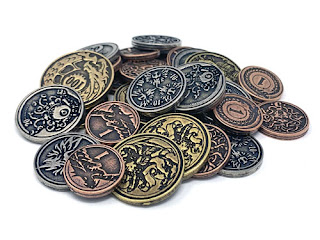
Some Notes on Coins in AD&D

You can buy these here.
Physical coins are fun.

Advanced Dungeons & Dragons
, in its first edition, is famous for its heavy coins. Each has a weight of a full tenth of a pound, or 1.6 ounces for each coin! In the second edition, this was changed to 50 coins to the pound, which is better. Though still pretty heavy compared to average historical coinage, it is within the typical coin weight range.

For most purposes, either one of these is fine. The heavy coins make figuring weight carried easier (so easy, in fact, that all weights were scaled to the coin, with each "gold piece weight" being equal to a tenth of a pound*; simply divide the number of "gold piece weight" units carried by ten to get the weight in pounds), while the later coins made for a reasonable compromise.

In Dragon magazine issue #80, an author named David F. Godwin provided an article titled "How Many Coins in that Coffer?", which proposed to work out volumes taken up by coins so that chests and other boxes of coins (not to mention magic items that were given volumes but not weight limits) could be appropriately evaluated. The article details the math and physics, but the upshot is that, if you don't want to go into detail, the large coins can be assumed to take up 0.25 cubic inches each, loosely arranged, or put another way a box can hold up to 4 loosely packed coins per cubic inch. Also, coins are about an inch and a half across, and about 1.5mm thick. The author makes the assumption that all of the metals are alloyed to have a similar specific gravity for simplicity. The article was written long before the arrival of the second edition, so it didn't include the math for the lighter coins, but it works out simply to divide the volume of the coins by 5 (0.05 cubic inches per coin) or multiply the number of coins per volume by 5, so 20 of those coins per cubic inch. That is certainly the easiest way to handle the matter.

For those who aren't interested in an array of artificial alloys that make everything easier, I have worked out more detailed numbers for the AD&D coins, but trust me that you probably don't really want to use them. Still, here they are. The assumptions are that loosely stacked coins take up 10% more volume on average than neatly stacked ones, which is based on the article referred above, and that neatly stacked coins take up a number of cubic inches equal to their diameter squared times their thickness. Note that coins are given diameter and thickness in millimeters, but volumes are converted to cubic inches. I'll be using the normal abbreviations for the coin types, which are: PP for Platinum Pieces, GP for Gold Pieces, EP for Electrum Pieces, SP for Silver Pieces, and CP for Copper Pieces. The metals were worked out as 90% pure, with the alloys being: Platinum 90%/Silver 10%, Gold 90%/Copper 10%, Gold 45%/Silver 45%/Copper 10% (Electrum), Silver 90%/Copper 10%, Copper 90%/Zinc 10%. The difference of using Copper 90%/Tin 10% (or Bronze) is so small as to make effectvely no difference, about 0.2% greater specific gravity, so you could do that if you preferred.

Given those assumptions, the heavy coins are as follows:

PP: 37.73mm diameter x 2mm thick
GP: 40.87mm diameter x 2mm thick
EP: 44.94mm diameter x 2mm thick
SP: 52.92mm diameter x 2mm thick
CP: 57.58mm diameter x 2mm thick

Note that the silver and copper coins have gotten very large in diameter, over 2", so it is possible to make them 3mm thick instead, which makes the SP 43.21mm in diameter and the CP 47.01mm in diameter. This has no appreciable effect on the volume of the coins.

Loose coins per cubic inch/Cubic inches per loose coin

PP: 0.1911/5.2329
GP: 0.2243/4.4583
EP: 0.2712/3.6873
SP: 0.3760/2.6596
CP: 0.4451/2.2467

If instead you prefer the lighter coins that weigh 1 pound per 50 coins, those sizes and numbers are:

PP: 19.49mm diameter x 1.5mm thick
GP: 21.10mm diameter x 1.5mm thick
EP: 23.21mm diameter x 1.5mm thick
SP: 27.33mm diameter x 1.5mm thick
CP: 29.73mm diameter x 1.5mm thick

Cubic inches per loose coin/Loose coins per cubic inch

PP: 0.0383/26.1097
GP: 0.0449/22.2717
EP: 0.0542/18.4502
SP: 0.0752/13.2979
CP: 0.0890/11.2360

But again, it would be much simpler to simply assume that each coin has an equivalent weight and volume due to the array of alloys used, and allow exactly 4 or 20 coins per cubic inch of storage space. If your coins have another ratio to pounds, then simply multiply the volume appropriately. For example, if you have 100 coins per pound, then allow twice as many as the 50 coins per pound number, or 40 coins per cubic inch. My historical £sd coins, of which the pennies are approximately 300 per pound, would have 120 coins to the cubic inch (yes, they are tiny, just as the historical Tower pound pennies were, at 240 pence to the Tower pound; as you can see at the original article on my blog**, the silver pennies are 14.73mm in diameter and 1.28mm thick, while the larger Gold Crowns measure 17.55mm diameter by 1.5mm thick), which seems odd, but is because the specific gravity of silver is not the same as the specific gravity of the "Universal Alloy" used in the referenced article.

*In fact, in the "basic" D&D line (B/X, BECMI, Cyclopedia), weights were simply called "coins", keeping the same tenth of a pound per coin ratio.

**I am going to have to re-figure a lot of that article, as I never accounted for impure metal and all of those sizes and weights are based on pure silver, copper, and gold. I can get away with simply multiplying the diameters by the square root of the ratios of the specific gravities of the pure metals to the impure alloys (I think; right now figuring the math in my head is giving me a headache so I'll work it out in detail later). I never did figure the volume of the coins, either, but I was figuring on abstracting specific volumes to the stone/item weight categories, which was a feature of the encumbrance system I was planning.