Showing posts with label The Arcanum. Show all posts

Thursday, January 26, 2023

Random Musings of Gaming-related Nature

 I had it spelled out to me recently (not in so many words, but the implication was pretty clear) that I am exactly the sort of gamer that isn't really welcome in the SJG Forums. After the stinging of the semi-public rebuke wore off, I came to the conclusion that they were probably right to do so, and since I have had poor luck with getting my own questions answered there I have, somewhat reluctantly but with resignation, decided to not participate there anymore (note, they have not asked me to leave, but I'm not likely to change my ways and those particular ways are ones they have made plain they don't want around). Better for us all. And thus passes from me the last forum-style internet site I had any interest in participating in; which I guess is a milestone worth marking in some way, thus this comment here. Blogs and social media work better for me. I should probably get back to paying attention to TikTok, though, as I am not really interested in social media with marked learning curves like Mastodon.

Speaking of SJG, they have hinted that they might be thinking about a 5th edition for GURPS, using similar language to the last time they were preparing for a new edition (20 years ago!) I've answered them as to what I'd like to see, but it's pretty clear from other responses that my interests for that game are not those of the majority of their customers so I don't expect to see them enacted. Meanwhile, I was reminded that Basic Roleplaying has an Open License (and is working with other companies like Paizo on a new one that WotC can't pretend to touch). I'd have to do some work to hammer that into the sort of game I'd be interested in getting deep into in the same way I've been getting into GURPS, but that remains a thought.

The ridiculousness of WotC, in trying to create a power in regard to the OGL 1.0a that is not granted to anyone, has certainly upended D&D significantly. Nobody knows what the future is going to hold, and so it feels like most of the industry is holding its breath, even the people who are loudly declaiming their disinterest.

I continue to think about the idea of a city-as-dungeon project and its practicality. Coincidentally, there's been an interesting series running on Mailanka's blog (I, II, III, IV) that is directly relevant to such a project. So, perhaps it draws closer to actual realization. I'm definitely thinking about a post on the concept.

I spent a lot of today thinking about The Beastmaster, a film from 1982 that was widely considered to be a low-budget coattail-hanger on Conan the Barbarian. Certainly, there are some similarities, but the differences are also pretty pronounced. One thing that both films have in common that I notice is a reliance on a sort of implicit Bronze Age setting, even though the tools and weapons are obviously made of iron. The village in The Beastmaster, especially, reminds me (vaguely, not in detail) of reconstructions of Bronze Age settlements on the Central Asian steppe. The same can be said for a number of "barbarian" films of the era. Deathstalker doesn't have a medieval flavor, The Warrior and the Sorceress employs Cyclopean masonry, which is a Bronze Age hallmark, nearly. So, I looked at Bronze Age architecture and design. Lots of fun sword & sorcery ideas to be found there. It also fits in with a recent interest I've had in sword & sandal adventures… with sorcery. A lot of adventure ideas to be found in Genesis, and there's a lot more sorcery in there than people want to say, apparently. The bit where Abraham forges his compact with God reads like a goetic blood rite with all the animal sacrifices going on.

Speaking of those films, The Arcanum includes a character class, aptly called the Beastmaster, directly modeled on Dar from The Beastmaster, and Tales from the Fallen Empire, a setting supplement for Dungeon Crawl Classics, includes a character class, called the Sentinel, modeled on Kain from The Warrior and the Sorceress. Those would seem to go along well with the Thief, modeled on the Grey Mouser, the Ranger, modeled on Strider/Aragorn, or even Unearthed Arcana's Barbarian, modeled on Conan the Cimmerian (though in my opinion that last was not very well done). For that matter, the Cleric owes much of its form to Peter Cushing as Van Helsing in the Hammer Studios Dracula films and perhaps Christopher Lee's character of Nicholas, Duc De Richleau in The Devil Rides Out (aka The Devil's Bride in the US release, because the studio worried that American audiences would mistake it for a Western). I wonder what other characters from fantasy fiction might deserve to have a character class modeled after them?

More later, I think.

Monday, March 17, 2014

Top 10 Gaming Products

Over at Dyvers's blog, he's asking for lists of our Top 10 favorite gaming items of all time. To simplify things, I limited this to RPG items for my list. Anyway, here goes…

10) The Arcanum, Second Edition.

This is probably the best Old School set of published variant rules for D&D. It is well thought-out, addresses many of the problems perceived in D&D at the time, and keeps the things that make the game simple and quick, such as character classes and advancement through collecting treasure and defeating foes. It does include options for the more problematic things that would later get incorporated, such as experience bonuses for "role-playing" (without bothering to define that), but not many. Finally, it includes a simple skill system, armor that reduces damage, spells that aren't forgotten (but are limited in number of castings per magic user per day), and other simple, obvious fixes that would eventually become nearly standard in gaming. Ahead of its time, while still retaining the best of the origins, this remains one of the best rules systems in general.

9) This entry has been removed. I cannot continue to support the game that was listed.

8) Lords of Creation.

Tom Moldvay was given free rein when Avalon Hill was making a desperate attempt to remain relevant in a market increasingly moving toward roleplaying games, and he came up with this. In what may be the most gonzo setting ever, the whole of reality and alternate realities is opened up to play. The player-characters are given maximum freedom for advancement, hoping to eventually be able to achieve the status of Lord of Creation and create their own settings, alternate worlds, and so on. Along the way, they might learn magical powers, acquire cybernetic enhancements, fight dragons or robot soldiers, even travel into the poetry of William Blake. Seriously, one of the alternate world settings is derived from the poetry of William Blake. There is nothing cooler than that in gaming. Since the very next session could take players into the Nine Worlds of Norse mythology, an alternate world where Boudicca was not defeated by the Romans, or a crystal forest hiding crustaceous humanoids guarding a staff of power, the game was wide open for anything, and was able to handle it with cleverly designed (though, to be fair, occasionally difficult to understand) rules systems that still felt a lot like D&D.

7) Adventures Dark and Deep Bestiary.

There have been a lot of monster books over the years. None of them has been as good as this one, which includes every creature from the AD&D monster books (less, of course, the ones that WotC has reserved for itself as "product identity" - though those have been replaced by versions created to be effectively the same but with different names and physical descriptions, as many people have been doing). Mr. Bloch did not stop there, though, creating a whole batch of creatures of his own design to add in. Among them are the Faeries and their Sidhe Courts, which are some of the best things to come out of the OSR movement (which is not to take anything away from the many, many wonderful things which that movement has produced). I love this monster book more than most, and of course it is easily used with any compatible game.

6) World of Greyhawk Boxed Set.

What can I say about this that hasn't already been said? It is exactly what (A)D&D needed in a setting, with an interesting balance between the idea that would later become known as "Points of Light" and the clash of Kingdoms that drives medieval wargaming. As people have looked at this over the years, the cleverness built in has only become more apparent, adding pathos to the unfortunate direction taken by subsequent products in the line. Including everything from amazingly euphonious, yet still absurd and camp, names to interesting factions and organizations, there is more implied adventure in any one area of the setting map than some settings have in their entire worlds. Topped off by that amazing Darlene map and some really helpful random encounter tables, there is little else that a DM would need to run a wide-ranging campaign for years.

5) Pagan Shore.

I love Pendragon. It is among the best roleplaying games, and one that I wish I were able to play more often. I'm personally most fond of the Fourth Edition rules, but I'm not a fanatic about any of the editions. Whatever, though, the one book in that game line that rises above anything else is this one. Giving a description of a society that is as alien to most modern-day gamers as the Aztecs, but doing so by building the cultural differences into the rules, players will soon find themselves approaching the mindset of the Iron Age Irish. There are a few quibbles to be had, but almost all of those have been addressed by people online, such as a discussion of how to incorporate the actual legal systems of Iron Age Ireland into the game in a way that is neither intrusive nor overwhelming of the adventure parts. It really does work, too. It doesn't hurt that I have a deep and abiding love of the Irish culture and very often want to play a character from whatever the closest analog is in the game world.

4) Flashing Blades.

Despite being one of the most popular settings for adventure fiction throughout the years, the 17th century has seen remarkably little treatment in roleplaying games. One of the earlier (but not the earliest, by any means) games to address that period was Flashing Blades. Marrying a relatively simple game system to a detailed and deep social climbing system, the game calls forth the ambitious swashbucklers and supports that style of play with rules that encourage such behavior without privileging "story" over game play. I'm fairly certain that the only reason this didn't do better than it did is that it didn't have a magic system. Of course, there is little way to include such a thing into a game of this subject, so that is not surprising at all. That said, it might have done it well if the next product on my list had come out a little earlier.

3) GURPS Voodoo: The Shadow War.

This was a game I didn't know I needed until after I got it. At the time, I was simply addicted to GURPS, so I was picking up just about everything that came out. When I got a look at the magic system, though… Look, up until I saw this, I was of the opinion that the RuneQuest magic system was the best one around - and don't get me wrong, it is excellent in many ways that have still not been matched by most games - and the one in Fantasy Wargaming was a glance at what might have been possible had it undergone more development. This one, though, hit every button of what I wanted in a magic system. Mages are not walking artillery pieces, they are subtle (except for the ones who aren't). Magic isn't just wave-wave-BOOM, but a process of conjuring spirits in smoky temples that are kept in the back rooms of Curandera shops and sending them out to do one's bidding. Yet, it still makes this all a part of an adventure game. Some magicians are Spirit Warriors, letting themselves be ridden by powerful Lwa who can do so much more than mere human beings can. The setting was, at the time, very nearly the only one on the market which dealt with race in the Americas in a relatively mature fashion, and was a surprise in that most, or even all, of the players' characters would be black.

2) AD&D 1E Dungeon Masters Guide.

Obviously this was going on my list somewhere. It has been, and rightly, lionized over and again, so I don't really feel the need to add to that general acclaim. Suffice it to say that there are few books out there which include as much useful advice, and none which include the density of advice and actually useful charts per page. Admittedly, one must get used to the writing style, which has been described as "High Gygaxian", but for myself I grew up on it and miss that idiosyncratic voice in gaming. Even if D&D isn't your game, you will almost surely find something of value in here, even if it's just to learn that there is a difference between jasper and onyx or discovering a passel of different terms for "prostitute". This is one of the most recommended books in gaming history, and it is for good reason.

and coming to the pinnacle, what could be better than the DMG?

1) MegaTraveller Boxed Set.

OK, I know that it is rife with typographical errors, mistakes, and other problems that gave this game the nickname "MegaErrata". Still, the first game I chose myself was Traveller, seeing that little black box in the bookstore that served as my first dealer of gaming products, and finding out that it had a book all about starships. Now, all these years later, having played or learned seven (or more, depending on how one counts it) different editions, I have come to the conclusion that this is the edition that did everything closest to right. It retains the flavor of the original game, while still fixing the problems inherent in the original design. It is compatible enough to use the supplementary material for the classic game, but can also make use of a great deal of the material written for T4 or T5 with only minimal conversion, and material for TNE with a little (a lot, actually) more work. Outside of the errata problem, the only disappointment about this game is that it was cut short before being finished, due largely to whatever happened with Digest Group - for example, only two of the alien races (plus two extra human cultures beyond the default one) of the default setting were ever converted to its specifications. The only edition which came as close as this one to perfection has been the Mongoose edition, but I have my own problems with that one.

Wednesday, May 2, 2012

Obscure Games - The Arcanum

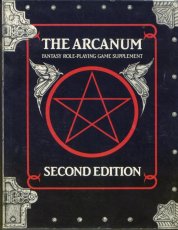
I have the Second Edition, but
I first played the First. I love
the understated covers.
Bard Games started their roleplaying products with a series including The Compleat Alchemist, along with some other The Compleat… titles. Those were intended as optional expansions for use with Dungeons & Dragons, but eventually they were expanded into a full game. This is a really common situation, actually, in the late '70s and early '80s, where someone would publish what amounted to their own house rules for D&D. There are people now who complain about the glut of retroclones and such, but we've always had those, from The Palladium Roleplaying Game and Arduin to Thieves' Guild and The Arcanum, among many, many others. Even RuneQuest began as the Perrin Conventions for D&D combat and Empire of the Petal Throne is self-evidently based on D&D.

Like many of these D&D variants, The Arcanum is explicitly tied to a specific setting, in this case, the Atlantean world, where Atlantis has not yet sunk beneath the waves, and rules most of the known world with a velvet glove cast in iron. Most of the setting information is contained in the second and third books in the series (The Lexicon and The Bestiary, later published under one cover as Atlantis: The Lost World, including art by Bill Sienkiewicz), though, and I won't hash it out here.

The First Edition cover was also
pretty cool.
Character creation involves choosing a race from the usual suspects and a few unusual ones (Druas are a little like dark elves, but will be later found in Talislanta as the Ariane, so they aren't elves at all, nosiree; Aesir are half-giants; Andamen are animal-headed humanoids; Nethermen are a lot like half-orcs; Zephyr are winged humans; plus Elves and Dwarves), then dividing 100+2d6 points among the 8 characteristics, sticking to the limits set by the chosen race of the character. Next, select a "Profession" (aka character class) from among the 32 possibilities, 2 of which are found in the Second Edition but not the First. Each of these is described as either "single-classed" or "dual-classed", which determines which experience point chart the character will use for increasing in level, and as "untrained", "skilled", or "highly trained" in Combat Capabilities. Each profession gives a special ability or two, plus some free skills. As the character rises in level, it will gain more free skills, and can choose to spend experience points on other skills instead of increasing level. Combat ability is handled in this way, by giving the character who can become better at fighting an accumulating +1 to hit at various levels. Like Lamentations of the Flame Princess Weird Fantasy Role Playing, non-fighters don't generally get these bonuses. There are some other refinements, such as Background and Hit Points (start equal to Constitution, plus a bonus for the Combat Capability of the class of 2, 4, or 6 points and a possible additional bonus for 15+ Constitution), but this is basically all there is to it.

Characteristics give various benefits to the character when they are at high enough level (usually 15+), such as Perception allowing a Detect Invisibility percent check, Constitution giving even more Hit Points (and that bonus is given each level, like the Combat Capability bonus), and so forth. Then we come to the core of the system. Like D20/3.X and Original Edition Delta will later do, The Arcanum simplifies saving throws and combat "to hit" checks down to a d20. Success is achieved with a total of 11+ after modifiers are applied, so if there's a +4, a roll of 7+ will succeed.

Money is treated in the usual D&D manner of gold, silver, and copper pieces, with about 100 coins to the pound. Characters roll on a table to determine their starting economic situation ("Down and Out", giving 20+1d10 GP, to "Flourishing", with 10 times as much).

Characters get experience points for a number of reasons, starting with the traditional D&D pair of 100xp per level of a defeated monster and 1xp per GP acquired, but also "Avoiding or deactivating any trap, figuring out any riddle or puzzle, overcoming any obstacle or hazzardous [sic] situation, or making any discovery of note", "Saving, rescuing, or aiding any character or creature" (which nets the same xp as defeating a foe), successfully turning undead (again, as defeating a foe), converting an individual to one's own religion (a flat 100xp per individual, regardless of level), making a magical or alchemical item, binding a spirit into service, or "influencing any individual or creature by non-magical means" (as defeating a foe). In addition, during down time, the character can gain xp by study or practice, either solitary or under a teacher. There's also an optional 10% bonus for funny voices and such ("Game Judges who would like to improve the quality of role-playing in their campaigns can adopt a policy of awarding a + 10% X.P. bonus for players who make an effort to role-play their game personas. This simple rule can go a long way towards improving the game by giving players a real incentive to think and role-play, instead of just hacking away at everything they see.")

Before getting to skills, there are listed 8 abilities that are common to all characters: Climbing, Finding a Track or Trail (but not following it), Hiding, Keeping Afloat (not swimming), Moving Silently (though the Stealth skill makes this awesomer), Noticing Hidden Persons or Creatures, Leaping, and Brawling.

Skills include all the usual stuff you see in games, from Languages and Haggling (which is different than Barter for whatever reason) and the like to unusual options like Internal Alchemy (increased lifespan for Mystics) and Inventing. Some skills have two levels (like Acrobatics I and Acrobatics II), which give more advanced abilities when the second skill is acquired after the first one. For no apparent reason, skills do not use the "d20 for 11+" system, but instead use a percentage chance set by the skill and the levels the character has gained since acquiring the skill.

Combat, as noted above, relies on a base 11+ to hit, and targets get to make a defense roll. Hits do damage based on weapon type. Simple, basic, D&D stuff. Armor absorbs damage (1 to 6 points, depending on type, heavy cloth to plate), with an optional rule for armor damage (requiring two percent checks in various circumstances, from immersion in salt water or long-term exposure to wet weather, to taking a fall from 20' or more or taking 20+ points of damage from a single attack).

Spellcasters can cast spells from lists determined by their particular profession (so, a Priest gets to use Divine Magic, while a Magician uses Enchantment, and so on). The character can learn spells of a spell level no higher than half (rounded up) of the level in the profession. A character can cast (level+1) spells per day, chosen at the time of casting. There are fiddly bits, like learning spells from other professions and casting spells in combat, but most of it is common sense. The oddest, most metagame-y, restriction is that no character may carry more than 7 magic items.

Alchemy gets a full treatment in the game, with a long list of alchemical operations that can be attempted. There's also discussion of summoning spirits and demons, and making a pact with them. There's a section where a character with the Runes skill can inscribe runes and effectively make minor magic items (they count against the limit of magic items, plus they have an additional limit of no more than 3 for those classes not associated with Rune Magic).

Alchemical operations include making simple potions (taking a few hours and requiring some easily-acquired ingredients) and more complex potions (taking a day or so, and requiring some more expensive ingredients), special devices (secret compartment rings, prisms, lenses, puzzle locks, whatever), scrolls, and such, on up to major operations like making Alchahest (a universal solvent), essences like Variable Mercury (the Philosopher's Stone) or True Copper (provides defensive benefits), Golems and Machina, or even the secrets of Life. Itself!

There isn't a lot of material on the traditional endgame, but there are some "NPC Professions" listed, which basically tell how much it costs to hire various professionals.

OK, let me list and briefly describe the 32 Professions of the game:

Alchemist - Pretty self-explanatory, actually. Learns how to make magic stuff using the principles of Alchemy.

Assassin - Pretty much a ninja, but no funky ninja magic.

Astrologer - A magic-using type who specializes in the powers of the celestial bodies.

Beastmaster - YES! You can play Dar in The Arcanum! Gets the ability to communicate and bond with animals.

Bounty Hunter - Hunts people down for the reward.

Charlatan - Another awesome option, the Charlatan gets some minor magical ability (limited to first level spells), but mainly relies on being a con artist. Though limited to first level spells, can learn more spell lists as the character goes up in level.

Corsair - Another self-explanatory profession. These are pirates.

Druid - Pretty much the traditional RPG depiction. Nature-loving hippies who can shape shift. There are some good limits on the shape-shifting (no bigger than 2' in length or height per level of the character, no smaller than a sparrow or mouse).

Enchantress/Enchanter (found in Second Edition only) - A little bit like bards in some games, these are artist- or musician-magicians.

Gladiator - A particular type of fighter.

Harlequin - Actors, musicians, performers, whatever.

Hunter - Like Rangers, but without the magical abilities.

Mage - There are actually three different sorts of Mage. All use Astrology (see Astrologer, above), but the Magus also uses Divine Magic, the Cabalist also gets High Magic, and the Archimage gets Enchantment.

Magician - The basic magic-using profession. Uses the Enchantment list.

Martial Artist - Chop Sockey!

Monk - Martial Artists who also learn to cast Mysticism spells.

Mystic - The main Mysticism spell-users.

Necromancer - Use Black Magic to summon demons and create undead monstrosities.

Paladin - Champions of Goodness and Justice. You know. Use Divine Magic.

Priest - The main spell-user that gets Divine Magic, plus can turn undead and convert the heathen.

Rogue - The basic thief profession.

Savant - There are two types of these. Both learn obscure facts (like the Scholar, below), but one gets Divine Magic and the other learns Mysticism. The latter tend to be hermits.

Scholar - Ivory-tower intellectuals. They learn stuff.

Shaman - The primary spell-user of the Low Magic list, they get to bind spirits to their service and have a Power Animal.

Sorcerer - Not only do they get the Sorcery spell list (with lots of pseudo-science-y spells like Negate Gravity or Structural Analysis), they also choose either Enchantment or Black Magic as a back-up.

Spy - Ever wanted the disguise ability of the AD&D Assassin without the requirement to be Evil? This is what you wanted to be. Basically, this is the AD&D Assassin, though (the Assassin profession in The Arcanum is all ninja-y, with Martial Arts skillz).

Thaumaturge (the other class new to Second Edition) - This is like the alchemist, but uses a different way of going about it that is somehow more related to what other spell-using professions do. Instead of gaining the ability "Projection of Will" like Alchemists get, they cast a spell called "Thaumaturgic Enchantment". They have some limits in what they can do compared to Alchemists, but they can do it way more often.

Warrior - Your basic fighter.

Witch/Warlock - They get Elemental Magic, like Druids, plus either Black Magic (for Evil Witches) or Enchantment (for the rest).

Witchdoctor - Like Shamans, they use Low Magic, but they also use Black Magic. There are no Good Witchdoctors. Which is kinda racist, given that the person in the picture is one of only two black guys in the book (other than the Druas, who are not dark elves; the other black guy is the Gladiator).

Witch Hunter - Like a Bounty Hunter, but specializing in spell-users. They learn to use the Mysticism spell list.

Wizard - The main users of High Magic, they also learn either Enchantment or Black Magic.

Anyway, if you've gotten this far, let me just say that, if you're looking for a game that is like D&D, but not, then The Arcanum is an excellent choice.