I'm working on a more complete essay on the subject, but I wanted to get some initial thoughts down about the difference between what I am calling "raygun fantasy" and "scientifiction". The basic idea is that raygun fantasy takes ideas and themes that are most common in fantasy stories, such as spirituality, heroism, and other human concerns, cloaking them in imagery related to technology but without concerning itself too closely with the actual plausibility of those images. Scientifiction (the term is taken from Hugo Gernsback's preferred term for science-oriented fiction), on the other hand, tends toward matters of the sciences, dramatizing either scientific concepts or technological speculation, without much concern for realistic human issues. I use the term specifically for "retro" forms of SF, which are based in forms of science, technologies, and hypotheses that have not proven to be useful or practical, from theories of the luminiferous ether to ideas of negative mass. Of course, there is a certain overlap where raygun fantasy fades into scientifiction, and certainly other terms could be coined to more precisely situate various stories along a continuum between the two poles.
For example, many episodes of the original Star Trek series were basically raygun fantasy. The various episodes in which powerful aliens - or computers! - who masquerade as gods, angels, or who act in much the way that spiritual beings are said to act here on Earth are especially indicative of this. "And the Children Shall Lead", "Metamorphosis", "Wolf in the Fold", "Arena", "Who Mourns for Adonais?", and many other episodes of that series typify that sort of approach. Northwest Smith encountered many beings that were from other dimensions or planes of existence and were no different than otherplanar beings in fantasy fiction. Star Wars is notable for its fantastic elements, especially the various manifestations of the Force, and draws many of its plot concepts from myth and legend. The Lensman stories tend toward scientifiction, but the Arisians resemble occult concepts of Ascended Masters to a great degree, the Eddorians invade our universe from an alien space-time continuum, and the telepathic powers of the Galactic Patrol are largely similar to magic.
Another frequent element of raygun fantasy is the use of swords. This can be either unexplained, as in Flash Gordon where fighting with swords just happens or Krull where the presence of swords is taken for granted, or else given a rationale of some sort, such as the interaction of light sabers and the Force in Star Wars or the shield belts of Dune. This happens often enough that I had considered calling the subgenre "sword & blaster".
That last brings up an important area of crossover in subgenres of SF. The SF New Wave frequently drew inspiration and concepts from the era that gave us the core of raygun fantasy, and as a result often fits well into the concept. In fact, the influence occasionally went the other way as well, after a fashion, as when the 1980 film of Flash Gordon featured an Emperor Ming who controlled and enhanced his soldiers with drugs, a common New Wave motif.
To my way of thinking, the ideal of raygun fantasy stories are C.L. Moore's Northwest Smith stories, Flash Gordon, and Star Wars. Those form the core around which I am building my ideas of the subgenre. There are many other examples, from Lost in Space and Battlestar Galactica (the 1978-79 series more than the 21st century remake) to Richard Corben's "Den of Earth" stories and Leigh Brackett's Eric John Stark tales, plus the Masters of the Universe toy line and television series, not even to mention videogames like Final Fantasy. One of the most recent manifestations of the idea is found in the blockbuster film Guardians of the Galaxy. I'll discuss this all more completely later.
My babblings on roleplaying games, of a variety of sorts including "old school" ones, but focused on adventure gaming principles over media emulation
Showing posts with label science fiction. Show all posts
Sunday, April 26, 2015
Saturday, August 16, 2014
Flanaess Sector
One of the campaigns that runs around in my head, that I'd like to run or better still play in, is what I tentatively call "Flanaess Sector". This is AD&D as a science fiction/science fantasy setting, though running it as a nearly hard-SF game (as "hard" as Traveller, say) could be very interesting indeed. Psionics and the Psionicist replace magic, technology is used instead of magic items, and the alien races are drawn from the more outré AD&D monsters. What it would need is a collection of new character classes, new technological items, starship rules, and perhaps trade and commerce rules (to handle Traveller style merchant campaigns, which are wonderfully flexible).
The aliens are mainly what I've given my thought to, little though it has been so far. I imagine an empire of Illithids, Ropers (which I imagine as being the first race that the Illithids were parasitic upon, drawing on the Urophion from The Illithiad) in a small sphere of resistance to the Illithids, Grell (in the Colonial Grell variety from Spelljammer), Neo-Otyugh, Neogi from Spelljammer with their Umber Hulk servants, maybe Xorn treated as a silicon-based life form, Flumphs, Ixitxachitl (suitably modified to not be based around Clerics, though they would make a great evil theocracy), Aboleths, and maybe a few others. I also greatly enjoy the Tyranids from Warhammer 40,000, so maybe those too. I don't have much love for humanoid aliens, but who knows? Maybe there are orcs or tabaxi among the stars.
The character classes might be based on the ones in Stars Without Number or maybe even Starships & Spacemen 2nd Edition, but rewritten to fit better with AD&D rather than B/X. Or, more likely, a set of interesting classes could be written from nearly whole cloth. I envision, in addition to the Psionicist I mentioned, Soldier, Pilot, Engineer (or Technician), maybe Merchant, Conman, and a few others. It being AD&D, there would be room for quite a few character class options. The classes in the old WotC Star Wars game might not be a bad set of choices.
Starships could be handled with any of a variety of systems. The aforementioned Starships & Spacemen and Stars Without Number are the obvious choices, but Terminal Space or some other OD&D-based SF supplement would be workable, as well. For that matter, Traveller's starships would work well, too. As an alternative, perhaps a system of Gates, similar to the ones in the Judges' Guild "Portals" trilogy, could connect the worlds. Perhaps not, though, as starships are half the reason to play SF instead of fantasy.
Here's a list of all the intelligent monsters from AD&D that I think would make good aliens: Aboleths, Beholders (but I don't want to use them, although there is a whole society built around them, especially in Spelljammer), Dopplegangers, Dragons (maybe, but if so, then especially the Blue or Black varieties), Flumphs, Formians (centaur-ants), Galeb Duhr (maybe, they're perhaps a little "magicky"), Grell (Colonial), Intellect Devourers, Ixitxachitl, Lizard Men, Mind Flayers, Myconids (there's also an ecology of mobile fungi for their homeworld, not to mention the special molds and slimes could be from their native environment, too), Neo-Otyughs, Ropers, Thri-kreen (mantis warriors), Treants (should they keep their ability to animate trees? I don't know; probably not, which is also a way to "fix" Galeb Duhr), Umber Hulks, and Xorn. Mi-go (if the DM has the first print Deities and Demigods) would fit perfectly into the setting.
As I said, I would prefer not using any humanoids (other than Lizard Men, Dopplegangers, and Myconids, perhaps), but if I did I would stick to the less common ones like Crabmen, Aarakocra (bird-men), Tabaxi (cat-men), Banderlogs, Grippli, and the like. Xill could be interesting, though they should probably have their ethereal powers and nature removed.
It might be interesting to include a "transcended" species that manifests as the faery creatures like Sprites, Pixies, and the like (there's a useful "ruling caste" for them to be found in Adventures Dark and Deep called Faeries). There's a race like that in the Star Fleet Universe, in the Omega Octant, called the Loriyill. Their starships have semi-magical effects like space fireballs and such.
Anyway, it seems like it could be a lot of fun, and leveraging the more science fiction/science fantasy elements of D&D seems like a good idea to me.
The aliens are mainly what I've given my thought to, little though it has been so far. I imagine an empire of Illithids, Ropers (which I imagine as being the first race that the Illithids were parasitic upon, drawing on the Urophion from The Illithiad) in a small sphere of resistance to the Illithids, Grell (in the Colonial Grell variety from Spelljammer), Neo-Otyugh, Neogi from Spelljammer with their Umber Hulk servants, maybe Xorn treated as a silicon-based life form, Flumphs, Ixitxachitl (suitably modified to not be based around Clerics, though they would make a great evil theocracy), Aboleths, and maybe a few others. I also greatly enjoy the Tyranids from Warhammer 40,000, so maybe those too. I don't have much love for humanoid aliens, but who knows? Maybe there are orcs or tabaxi among the stars.
The character classes might be based on the ones in Stars Without Number or maybe even Starships & Spacemen 2nd Edition, but rewritten to fit better with AD&D rather than B/X. Or, more likely, a set of interesting classes could be written from nearly whole cloth. I envision, in addition to the Psionicist I mentioned, Soldier, Pilot, Engineer (or Technician), maybe Merchant, Conman, and a few others. It being AD&D, there would be room for quite a few character class options. The classes in the old WotC Star Wars game might not be a bad set of choices.
Starships could be handled with any of a variety of systems. The aforementioned Starships & Spacemen and Stars Without Number are the obvious choices, but Terminal Space or some other OD&D-based SF supplement would be workable, as well. For that matter, Traveller's starships would work well, too. As an alternative, perhaps a system of Gates, similar to the ones in the Judges' Guild "Portals" trilogy, could connect the worlds. Perhaps not, though, as starships are half the reason to play SF instead of fantasy.
Here's a list of all the intelligent monsters from AD&D that I think would make good aliens: Aboleths, Beholders (but I don't want to use them, although there is a whole society built around them, especially in Spelljammer), Dopplegangers, Dragons (maybe, but if so, then especially the Blue or Black varieties), Flumphs, Formians (centaur-ants), Galeb Duhr (maybe, they're perhaps a little "magicky"), Grell (Colonial), Intellect Devourers, Ixitxachitl, Lizard Men, Mind Flayers, Myconids (there's also an ecology of mobile fungi for their homeworld, not to mention the special molds and slimes could be from their native environment, too), Neo-Otyughs, Ropers, Thri-kreen (mantis warriors), Treants (should they keep their ability to animate trees? I don't know; probably not, which is also a way to "fix" Galeb Duhr), Umber Hulks, and Xorn. Mi-go (if the DM has the first print Deities and Demigods) would fit perfectly into the setting.
As I said, I would prefer not using any humanoids (other than Lizard Men, Dopplegangers, and Myconids, perhaps), but if I did I would stick to the less common ones like Crabmen, Aarakocra (bird-men), Tabaxi (cat-men), Banderlogs, Grippli, and the like. Xill could be interesting, though they should probably have their ethereal powers and nature removed.
It might be interesting to include a "transcended" species that manifests as the faery creatures like Sprites, Pixies, and the like (there's a useful "ruling caste" for them to be found in Adventures Dark and Deep called Faeries). There's a race like that in the Star Fleet Universe, in the Omega Octant, called the Loriyill. Their starships have semi-magical effects like space fireballs and such.
Anyway, it seems like it could be a lot of fun, and leveraging the more science fiction/science fantasy elements of D&D seems like a good idea to me.
Wednesday, August 8, 2012
An Unearthly Child
I didn't have anything to write about last week's Traveller game, and unfortunately I was unable to participate this week due to some personal matters. Anyway, it seems like it's time to write something on this here blog thing.
One of the things I've been doing is catching up on Doctor Who, including watching some of the older series episodes. That's all well and good, but the ideas there have given me some things to think about in terms of a possible game. Right now, I'm thinking of it in terms of GURPS, but I'm sure that other systems could serve as well.
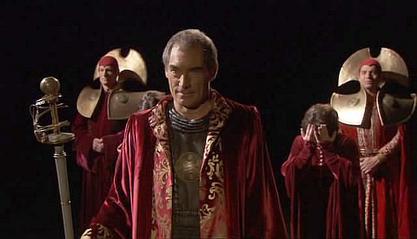
Every once in a while, I'll see a possibility in Doctor Who that isn't explored by the official writers. Some of those possibilities would require circumventing the particular canon of that series, though, so that isn't a big problem. Still, I'd like to take those ideas and work out a campaign involving time and other dimensional travel, exploring some of those matters that I see as possibilities. For instance, there is an incredibly good scene in one of the recent seasons in which [SPOILERS] several members of the Time Lord species attempt to escape the Time War and re-engage with the regular universe. The scene includes some very mythic (I can't think of another word to describe it) imagery, such as the two figures covering their eyes (said to be the ones who voted against escaping the Time War). Combining that with my own predilections, I thought about the idea of existing outside of time - that is, not participating in time at all, but existing instead in an eternal sense. That's a complex topic, touching on the ideas of explicate and implicate order, myth, and so on. The best way that I've seen to handle those ideas is in the concept of Hero Questing from RuneQuest and HeroQuest. In these, there is a mythic dimension which can be entered into, and where, effectively, the players interact with mythic scenes and figures. In these, then, a player may walk through the scenes of a story as though they were rooms, with each scene recurring in the same basic form each time it is encountered. There are good ways and bad ways to interact with those scenes, but the scene "resets", as it were, each time. This should allow exploration of the idea of implicate order in a gaming context. I'd need to develop exactly what would happen as a result of leaving time and returning into it, of course. Perhaps things could be manifested in time from outside of it, or alterations could be made to the shape of time from the metatemporal zone (something like a wish in fantasy games, perhaps) if the metatemporal sequence is engaged properly.
I am also quite fond of alternate timelines, so that would violate one of the critical canon rules of Doctor Who (which has made a significant plot point of the near-complete separation of alternate timelines). So, my idea would be that there are several dimensions, or spheres, in which players can interact with the game universe: different areas of space, different areas of time, different timelines (with their own areas of space and time), and metatemporal/mythic "space".
At least one of the characters would be a "Time Lord" equivalent (not sure what they'd be called), who has undergone an initiatory experience similar to the Gallifreyans' exposure to the Time Vortex or Zelazny's Amberites' walking of the Pattern. That character would have access to a trans/metatemporal vessel like the Doctor's TARDIS which would have the ability to travel anywhere in space, time, across transtemporal lines, or into metatemporal space. There should probably be limits to that, for dramatic purposes, but I am not sure at the moment what they should be exactly. Something that limits how often the players can change their position in space/time/transtime/metatime would probably be important, and perhaps also how "far" the vessel can change position in any given period. That latter, though, may not be necessary, and might even be undesirable.
The players should be given access to some extreme high-tech items that minimize their need to engage in normal commerce, as the point would be exploration, not normal economics. We don't want to have the players setting themselves up as transtemporal merchants, for instance. So, some sort of food dispenser would be required, and perhaps other post-scarcity items of technology (replicators? utility fog? some sort of immortality or other cure for death?) would have a useful place in the setting. The point, after all, would be universal tourism, not the normal sorts of adventure drivers. Certainly, giving the players' vessel more space inside than out would be a given, allowing the vessel to more easily serve as a base of operations while also letting it be unobtrusive when necessary.
Basically, I don't think that many gaming versions of time travel have really touched on the possibilities and intense strangeness involved in the subject. It would be fun to explore those.
One of the things I've been doing is catching up on Doctor Who, including watching some of the older series episodes. That's all well and good, but the ideas there have given me some things to think about in terms of a possible game. Right now, I'm thinking of it in terms of GURPS, but I'm sure that other systems could serve as well.
| This scene exists forever, always, embedded in every moment. |
I am also quite fond of alternate timelines, so that would violate one of the critical canon rules of Doctor Who (which has made a significant plot point of the near-complete separation of alternate timelines). So, my idea would be that there are several dimensions, or spheres, in which players can interact with the game universe: different areas of space, different areas of time, different timelines (with their own areas of space and time), and metatemporal/mythic "space".
At least one of the characters would be a "Time Lord" equivalent (not sure what they'd be called), who has undergone an initiatory experience similar to the Gallifreyans' exposure to the Time Vortex or Zelazny's Amberites' walking of the Pattern. That character would have access to a trans/metatemporal vessel like the Doctor's TARDIS which would have the ability to travel anywhere in space, time, across transtemporal lines, or into metatemporal space. There should probably be limits to that, for dramatic purposes, but I am not sure at the moment what they should be exactly. Something that limits how often the players can change their position in space/time/transtime/metatime would probably be important, and perhaps also how "far" the vessel can change position in any given period. That latter, though, may not be necessary, and might even be undesirable.
The players should be given access to some extreme high-tech items that minimize their need to engage in normal commerce, as the point would be exploration, not normal economics. We don't want to have the players setting themselves up as transtemporal merchants, for instance. So, some sort of food dispenser would be required, and perhaps other post-scarcity items of technology (replicators? utility fog? some sort of immortality or other cure for death?) would have a useful place in the setting. The point, after all, would be universal tourism, not the normal sorts of adventure drivers. Certainly, giving the players' vessel more space inside than out would be a given, allowing the vessel to more easily serve as a base of operations while also letting it be unobtrusive when necessary.
Basically, I don't think that many gaming versions of time travel have really touched on the possibilities and intense strangeness involved in the subject. It would be fun to explore those.
Labels:
GURPS,
HeroQuest,
ideas,
RuneQuest,
science fiction,
worldbuilding
Saturday, July 14, 2012
A Little Bit Of A Personal Gaming Update
I have a number of projects ongoing, and some news on my own gaming front. Since I can't seem to sit down and write content that I want to put up on this here blog thing, I guess that a personal update is in order.
In general, I am doing a lot less than I would like to be. In part, this is because I really can't stand the heat, and there's no way to get out of the kitchen. Of course, people in other parts of the country are sneering at me right now, as I am in one of the most temperate parts of the Lower 48, but I am acclimatized to here ("here" being the Pacific Northwest), and it is hot for here (and humid, which is very unusual). Other parts have to do with life issues.
First up, the project on which I want to be spending a lot more time than I am is the Top Secret retroclone. I am working on it, but like this blog, gaming takes second place to things that are happening in real life. I am considering how to get art for it, which leads me to thinking about Kickstarter, which further leads to the idea of doing a real print run rather than, or in addition to, a Lulu.com product. I'm not sure about the ins and outs of that, though. I'll talk to people and see what can be done.
Second, it looks like I'll be trying out this newfangled online gaming by teleconferencing thing. Happily, it looks to be a Traveller game, albeit the Mongoose version. I still have to make a character and whatnot, but that should go pretty quickly.
Next there's the AD&D game I've been working on. I've done a reasonable amount of work on it. I've got some of the main city of the campaign mapped, along with some sketches toward the ground floor of the tower-citadel of the city's masters. I have ideas about the megadungeon, but haven't gotten to putting lines on paper for the map yet. I don't know whether to wait until I have at least the sketches of the city's sewers done first (the dungeon is located underneath the city) or fit the sewers around the dungeon. However, those issues have dropped in priority because…
Thinking about Traveller has made me realize that I really, really love that game. I have a science fiction setting that I had been working on for some short stories, and decided that now would be a fine time to put it in gaming form. Some of the themes I want to explore with the setting include the value of multiple cultural expressions to the long-term viability of intelligent species, the nature of human institutions like honor, empire, and such, and the ability of varying worldviews to coexist or not. There are a dozen human interstellar polities, and a dozen aliens. Players will only be human, and at least at first, I intend to limit them to the central Terran Federation. Things are not always what they seem, of course, but sometimes they are. The setting has a lot of secrets sitting in my head. For now, I'll be using MegaTraveller, with some ideas taken from GURPS Traveller: Far Trader and First In. Eventually, I'll convert it to T5.
Other projects, like the WRG Game, are on hold right now.
What have you been doing in regard to gaming these days?
In general, I am doing a lot less than I would like to be. In part, this is because I really can't stand the heat, and there's no way to get out of the kitchen. Of course, people in other parts of the country are sneering at me right now, as I am in one of the most temperate parts of the Lower 48, but I am acclimatized to here ("here" being the Pacific Northwest), and it is hot for here (and humid, which is very unusual). Other parts have to do with life issues.
First up, the project on which I want to be spending a lot more time than I am is the Top Secret retroclone. I am working on it, but like this blog, gaming takes second place to things that are happening in real life. I am considering how to get art for it, which leads me to thinking about Kickstarter, which further leads to the idea of doing a real print run rather than, or in addition to, a Lulu.com product. I'm not sure about the ins and outs of that, though. I'll talk to people and see what can be done.
Second, it looks like I'll be trying out this newfangled online gaming by teleconferencing thing. Happily, it looks to be a Traveller game, albeit the Mongoose version. I still have to make a character and whatnot, but that should go pretty quickly.
Next there's the AD&D game I've been working on. I've done a reasonable amount of work on it. I've got some of the main city of the campaign mapped, along with some sketches toward the ground floor of the tower-citadel of the city's masters. I have ideas about the megadungeon, but haven't gotten to putting lines on paper for the map yet. I don't know whether to wait until I have at least the sketches of the city's sewers done first (the dungeon is located underneath the city) or fit the sewers around the dungeon. However, those issues have dropped in priority because…
Thinking about Traveller has made me realize that I really, really love that game. I have a science fiction setting that I had been working on for some short stories, and decided that now would be a fine time to put it in gaming form. Some of the themes I want to explore with the setting include the value of multiple cultural expressions to the long-term viability of intelligent species, the nature of human institutions like honor, empire, and such, and the ability of varying worldviews to coexist or not. There are a dozen human interstellar polities, and a dozen aliens. Players will only be human, and at least at first, I intend to limit them to the central Terran Federation. Things are not always what they seem, of course, but sometimes they are. The setting has a lot of secrets sitting in my head. For now, I'll be using MegaTraveller, with some ideas taken from GURPS Traveller: Far Trader and First In. Eventually, I'll convert it to T5.
Other projects, like the WRG Game, are on hold right now.
What have you been doing in regard to gaming these days?
Monday, June 18, 2012
Inspiration
Some links of inspiring content from around, because I can't think of any useful content that isn't more V&V characters right now:
If you can't come up with story or scene ideas from these pictures, you aren't trying. Best of all, these things are all images from real life.
If your heroes aren't as brave as these children, then they're doing it wrong.
This company makes real-life secret doors. You may find their ideas of value.
Tap-dancing Satan. Your argument is irrelevant. Also, let me reiterate, tap-dancing Satan. On Lawrence Welk.
There are people who are looking forward to "uploading" their minds to computers. This should prove a useful corrective to their wide-eyed optimism.
If you can't come up with story or scene ideas from these pictures, you aren't trying. Best of all, these things are all images from real life.
If your heroes aren't as brave as these children, then they're doing it wrong.
![]() |
| A psychopomp god at the symbolic crossroads of a city. You can't make this up. What are the Secret Masters of the World up to here? |
This company makes real-life secret doors. You may find their ideas of value.
Tap-dancing Satan. Your argument is irrelevant. Also, let me reiterate, tap-dancing Satan. On Lawrence Welk.
There are people who are looking forward to "uploading" their minds to computers. This should prove a useful corrective to their wide-eyed optimism.
Tuesday, September 13, 2011
Science Fiction Film Space Travel
Note: For the purposes of this post, I am using "Science Fiction" to refer to reasonably plausible scenarios. This includes what is sometimes called "Hard Science Fiction", but is not limited to that, as some minor bending of the rules of reality is acceptable in the interests of the story. Hopefully, what exactly I mean will be made apparent by some of my examples below.
I love Science Fiction movies. I also love Science Fantasy movies, but here I'll just talk about the former. First, my nominations for best Science Fiction movies of several decades:
1950-1959: (tie) Forbidden Planet and The Day The Earth Stood Still
1960-1969: 2001: A Space Odyssey
1970-1979: Alien
1980-1989: Blade Runner
1990-1999: Gattaca
2000-2009: Eternal Sunshine Of The Spotless Mind
Of those, I'd say that the 1960s-1980s were the best time for Science Fiction film, and would count those three as far and away the best three of all time (in which specific order? That would vary depending on my mood, I think. Right now, Blade Runner is pretty much leading the pack).
Did you notice something about those? After the 1970s, spaceships are passé. Gattaca has a trip on one as the ultimate goal, Blade Runner mentions them almost offhandedly as something that other people go on, but they're pretty much removed from the table otherwise. Before then, anyone can go into space (with one exception). There's a stereotyped cook in the 1950s who makes bootleg liquor. In the 1960s, there are low-level receptionists on the space stations. In the 1970s, we're back to an updated version of the 1950s-era lowlife spacemen. After that, it's only the élite who travel beyond the bounds of gravity, if anyone does at all.
I've been kinda obsessing on this topic for the last few weeks, in the wake of the effective end of the USA's space program (yeah, yeah, they're working on another one - wake me when it flies, but I'm going to go out on a limb and say that it won't happen in the next decade or more; don't even get me started on the private space companies). Before we went, space was full of possibilities. Anything could happen, and we imagined so much.
Then we actually got there.
I will never denigrate the achievements of the Apollo program. Landing a man on the Moon and returning him safely to Earth was, frankly, an absolutely incredible success. As I've learned more about rocketry and space travel in the real world, it has become more and more apparent to me just how amazing it was.
But, that success is leavened by the lack of anything of real interest to humans on the Moon. Sure, there's a wealth of scientific information that we should be glad we have, and there are potentially valuable resources if we can just work the bugs out of the devices that will hopefully use them. But there's not much that we can use now. We can't plant crops, because the Lunar soil lacks many of the necessary nutrients available in an organic biosphere, so we'd pretty much have to bring those with us. There aren't many useful metals that we don't already have in abundance on Earth. There are no organics, such as petrochemicals, at all. It's an expensive trip with little material return.
When we found that out, it seems, there was a drop in interest in space travel. Some visionaries tried to leverage concepts that would make space productive, but those haven't gotten very far. There are a few industrial processes that might be improved by microgravity, but that hasn't been proven yet. Microgravity might make a useful retirement community for the wealthy (who might desire the reduced strain on aging organs), but that isn't exactly "productive".
Basically, we've learned that space is mostly good for communications and observation satellites (possibly weaponized ones, as well, but those are currently agreed to be banned), which don't really need people. It isn't all that long until they plan to de-orbit the International Space Station, and that would pretty much be the end of space for humans. Sure, we might build another one, but we couldn't even build a new highway system at this point. We can barely maintain the one we already have. I think that we're done in space, and Science Fiction movies have been reflecting that, for the most part. There are occasional examples otherwise: Avatar, for instance, but those border on the realm of Science Fantasy (as, really, does Forbidden Planet. I make no claims to a foolish consistency, and one could dismiss this argument on that basis if one were so inclined. Keep in mind that the idea is that of "plausibility", which varies depending on the state of knowledge). Moon is the big exception, but it is an exception.
So, some other Science Fiction films I really like:
Alphaville: une étrange aventure de Lemmy Caution (1965)
Solyaris (aka Solaris, also remade as Solaris) (1972)
Outland (1981)
Escape From New York (1981)
War Games (1983)
Aliens (1986)
Hardware (1990)
Until The End Of The World (1991)
Strange Days (1995)
Hackers (1995)
Koukaku Kidoutai (aka Ghost In The Shell) (1995)
Abre Los Ojos (aka Open Your Eyes, remade as Vanilla Sky) (1997)
Banlieue 13 (aka District B13) (2004)
Children Of Men (2006)
A Scanner Darkly (2006)
District 9 (2009)
Inception (2010)
Limitless (2011)
This is not, of course, a complete list, just what I can think of offhand. Also, I left out some after considering them (such as WALL-E and Paprika), as they went too far into the realm of Science Fantasy for what I am trying to discuss here.
What you see in all of those is that space travel is definitely something that becomes more uncommon with time, and more relegated to élites when it is present. Even Moon fits into this latter category by limiting its spacemen to one individual at a time, not having entire colonies with janitors, receptionists, store clerks, and so on.
For our games, this might mean that it is worthwhile to consider Science Fiction settings that don't include space travel. Even (perhaps especially) cyberpunk, postcyberpunk, and realistic transhumanist settings might start to consider that we might not be getting off of this planet in any significant way.
Some time, I'll discuss the whole Peak Oil/Limits of Growth thing and how that affects this possibility.
I love Science Fiction movies. I also love Science Fantasy movies, but here I'll just talk about the former. First, my nominations for best Science Fiction movies of several decades:
1950-1959: (tie) Forbidden Planet and The Day The Earth Stood Still
1960-1969: 2001: A Space Odyssey
1970-1979: Alien
1980-1989: Blade Runner
1990-1999: Gattaca
2000-2009: Eternal Sunshine Of The Spotless Mind
Of those, I'd say that the 1960s-1980s were the best time for Science Fiction film, and would count those three as far and away the best three of all time (in which specific order? That would vary depending on my mood, I think. Right now, Blade Runner is pretty much leading the pack).
Did you notice something about those? After the 1970s, spaceships are passé. Gattaca has a trip on one as the ultimate goal, Blade Runner mentions them almost offhandedly as something that other people go on, but they're pretty much removed from the table otherwise. Before then, anyone can go into space (with one exception). There's a stereotyped cook in the 1950s who makes bootleg liquor. In the 1960s, there are low-level receptionists on the space stations. In the 1970s, we're back to an updated version of the 1950s-era lowlife spacemen. After that, it's only the élite who travel beyond the bounds of gravity, if anyone does at all.
I've been kinda obsessing on this topic for the last few weeks, in the wake of the effective end of the USA's space program (yeah, yeah, they're working on another one - wake me when it flies, but I'm going to go out on a limb and say that it won't happen in the next decade or more; don't even get me started on the private space companies). Before we went, space was full of possibilities. Anything could happen, and we imagined so much.
Then we actually got there.
I will never denigrate the achievements of the Apollo program. Landing a man on the Moon and returning him safely to Earth was, frankly, an absolutely incredible success. As I've learned more about rocketry and space travel in the real world, it has become more and more apparent to me just how amazing it was.
But, that success is leavened by the lack of anything of real interest to humans on the Moon. Sure, there's a wealth of scientific information that we should be glad we have, and there are potentially valuable resources if we can just work the bugs out of the devices that will hopefully use them. But there's not much that we can use now. We can't plant crops, because the Lunar soil lacks many of the necessary nutrients available in an organic biosphere, so we'd pretty much have to bring those with us. There aren't many useful metals that we don't already have in abundance on Earth. There are no organics, such as petrochemicals, at all. It's an expensive trip with little material return.
When we found that out, it seems, there was a drop in interest in space travel. Some visionaries tried to leverage concepts that would make space productive, but those haven't gotten very far. There are a few industrial processes that might be improved by microgravity, but that hasn't been proven yet. Microgravity might make a useful retirement community for the wealthy (who might desire the reduced strain on aging organs), but that isn't exactly "productive".
Basically, we've learned that space is mostly good for communications and observation satellites (possibly weaponized ones, as well, but those are currently agreed to be banned), which don't really need people. It isn't all that long until they plan to de-orbit the International Space Station, and that would pretty much be the end of space for humans. Sure, we might build another one, but we couldn't even build a new highway system at this point. We can barely maintain the one we already have. I think that we're done in space, and Science Fiction movies have been reflecting that, for the most part. There are occasional examples otherwise: Avatar, for instance, but those border on the realm of Science Fantasy (as, really, does Forbidden Planet. I make no claims to a foolish consistency, and one could dismiss this argument on that basis if one were so inclined. Keep in mind that the idea is that of "plausibility", which varies depending on the state of knowledge). Moon is the big exception, but it is an exception.
So, some other Science Fiction films I really like:
Alphaville: une étrange aventure de Lemmy Caution (1965)
Solyaris (aka Solaris, also remade as Solaris) (1972)
Outland (1981)
Escape From New York (1981)
War Games (1983)
Aliens (1986)
Hardware (1990)
Until The End Of The World (1991)
Strange Days (1995)
Hackers (1995)
Koukaku Kidoutai (aka Ghost In The Shell) (1995)
Abre Los Ojos (aka Open Your Eyes, remade as Vanilla Sky) (1997)
Banlieue 13 (aka District B13) (2004)
Children Of Men (2006)
A Scanner Darkly (2006)
District 9 (2009)
Inception (2010)
Limitless (2011)
This is not, of course, a complete list, just what I can think of offhand. Also, I left out some after considering them (such as WALL-E and Paprika), as they went too far into the realm of Science Fantasy for what I am trying to discuss here.
What you see in all of those is that space travel is definitely something that becomes more uncommon with time, and more relegated to élites when it is present. Even Moon fits into this latter category by limiting its spacemen to one individual at a time, not having entire colonies with janitors, receptionists, store clerks, and so on.
For our games, this might mean that it is worthwhile to consider Science Fiction settings that don't include space travel. Even (perhaps especially) cyberpunk, postcyberpunk, and realistic transhumanist settings might start to consider that we might not be getting off of this planet in any significant way.
Some time, I'll discuss the whole Peak Oil/Limits of Growth thing and how that affects this possibility.
Subscribe to:
Posts (Atom)