Saturday, May 26, 2012

Obscure Games: Fantasy Wargaming, Part Six

Conjuration! And more penises!
This series begins here. The first part dealing with magic is here.

Continuing on about magic, we come to a significant portion of the rules, the means by which mana is accumulated. Unlike most other games with spell points, mana does not just regenerate naturally. The magician needs to actively acquire it. There are four primary means to do so: Incantation & ululation, Shamanistic dancing/frenzy, Deep meditation or arcane study, and Fasting (includes sexual abstinence). In addition to these, there's a brief discussion on gaining mana by sacrifice, which seems mostly aimed at the Dennis Wheatley crowd in that it refers exclusively to the killing and, generally, consumption of a living being (if I were writing the game, I can tell you that "sacrifice" would be handled somewhat, though not entirely, differently). I really like this because it tends to push magicians toward performing a stereotypical activity (arcane study, for example) that adds to the feel of the magician in the game world, and that stereotypical activity has a real in-game benefit. Each of the different means of gaining mana is paralleled by an equivalent religious rite, which will become important when we come to the religion rules. The four main methods gain mana at different rates, and all can be accelerated by magicians with high skill (magic level), various characteristics appropriate to the particular method (Faith is good for all, while meditation is improved by Intelligence, incantation by Charisma, and so on), and some other factors. In addition, such preparations give a positive modifier to creating a Link (see the previous post). This seems to indicate that the designers wanted magic to be centered on ritual activity, but the details of the rules don't really support that, because of the next rule, which is that magicians can concentrate mana up to 16 times their magic level. While the "normal operating level" is 8 times their level, that only affects how quickly mana is gained through ritual preparations (and that effect is very slight). Ethereal and Self-conjured beings double these limits. Basically, the game works that a magician will start an adventure full up on mana, then will regain it over a period of rest. Each day, a magician can gain about 10 points through 2 hours of arcane study, 12 points through an hour and a half of incantation, and 15 points from an hour of frenzied dancing (if necessary, he can get a further 2 points a day from fasting, but that can be hard on his body). He doesn't need to dance or fast in most cases, really. By the rules, the only people who need to perform ritual ceremonies to cast magic are people with a level of zero in magic. My inclination is to drop the allowed amount of stored mana dramatically (perhaps to a maximum of 4 times magic level, with a "normal operating level" of twice magic level, doubled for Ethereals and the Self-conjured).

To protect himself from magic or conjured beings, a magician can draw a Pentacle. This is a generic term for circles of protection, which range in value from -1 to -3. They are normally created by ceremony, in which the magician draws the circle slowly while reciting incantations. The length of time required is as per gaining mana by Incantation/ululation, at one mana point per point of protection. These affect the ability of hostile magicians to gain a Link. In addition, words of Absolute Command or the names of Ethereal powers can be inscribed in the circles. the former act as the type of spell (see below), while the latter act as an Appeal to the named power (God or a saint, for example) asking for a miracle in response to the incursion of an attacker. However, invoking higher powers for personal gain is a significant Sin, and affects the character's Piety (a measure of the favor in which the character is held by the Ethereal hierarchies, which we will be discussing when we get to Religion).

The game defines Conjuration as "the use of arcane forces to summon an Ethereal being on to the Earthly plane - and, by extension, to control, bind and compel such beings." It is that aspect of control that makes magic different than religion in the game. A holy man might call on the saints to perform miracles, while a magician would bind a demon to service - or try to bind a saint, if he were arrogant enough! Basically, Conjuration consists of forming a Link to the Ethereal being in question, then casting an Absolute Command to "Appear". Usually, a magician will have created a "circle of appearance", which is like a Pentacle in reverse, but limited to -1. Mainly, though, it just lets the summoner know when the entity is getting out of control, as only a being no longer under the magician's influence will step outside of the circle. After the being appears, the magician will give another Absolute Command, to "Obey". Though it is possible, normally, to make a Command permanent, this Command can only be temporary, lasting 10-60 minutes.

Self-conjuration is the process by which a person Conjures their own spirit and attempts to bind it to their own body. Similarly, a familiar can be created by
Conjuring the spirit of an animal and binding it to that animal. This makes the person or animal so affected into a sort of living Enchanted item. Dead people can be Conjured and bound to their mortal remains, as well. These can be made permanent, though the Command to "Obey" is still one that can only be temporary. Furthermore, a Demon can bind itself to a person, which is Possession. There are some implications of these ideas that aren't really explored in the game, such as the nature of spirit and soul, and what the animating force of the body is, exactly. It might, or might not, be worth exploring such ideas in a future development of the game.

The other kind of Active magic is the various kinds of Spells. This includes the aforementioned Absolute Commands, which are short, stereotyped commands that can be used to compel behavior from the target. Examples include: like/dislike, move/stop moving, grovel, kill, defend (me, etc), be furious (go berserk), be stunned (go into a coma state), and so on. In addition, Absolute Commands can be used to alter characteristics by ±3 points. Other categories of spells include Curing/Disease and Death, Illusion, Protection from Magic, Elemental Matters, Complex Matter, and Miscellaneous. Most of these allow creation of spells to fit the requirements of the magician. For instance, Elemental Matters spells may be used to create a fireball, a wall of stone, control weather, and so on. One of the problems with the system is that the authors never really considered the limits they should set, apparently trusting the Referee and players to stick within a certain, obvious to the authors, realm of plausibility. However, there is nothing in the rules that prevents a magician from creating a planet (using the size category "a mountain", which is defined as "anything bigger" than a 100 foot cube). Given time and mana, he could then proceed to populate it with creatures (their spirits Conjured and bound to their Complex Matter forms). I'd want to set firmer limits, myself, by making such enormous projects unfeasibly expensive in terms of mana, but I have had abusive players in the past (such as the one who wanted to take the equipment list in Fantasy Wargaming at face value and buy a "Guard god" for his character). Miscellaneous spells are the ones that don't really fit into the other categories, and include the likes of Lightning bolt, Flight, Animal speech, and so on.

Unlike the other types of spells, Miscellaneous spells are given a different DD depending on the type of magician the character is. Each magician character picks a type, depending on his Social Class and Background (Rural, Townsfolk, Clergy, or Landowning). The types are: Wise woman/Cunning man, Witch, Wizard, High Sorcerer (or Runic Sorcerer in Dark Ages settings), and Cabalist (only available to Jews and Muslims). Each type sets a limit on which preparations the magician can use for accumulating mana (a Wise woman/Cunning man can only use Incantation/ululation, a Wizard can add Deep meditation/arcane study when he gets to level 4, a Witch can also use Shamanistic dancing, and so on). Cabalists are the most proficient magicians in the game, though High/Runic sorcerers are close behind them. It is possible to change from one sort of magician to another when certain conditions are met, usually by rising to a certain magic level and having the appropriate Social Class. A magician who changes type can use the better factor of the types he has been, if there is a difference. In some cases, a Wise woman/Cunning man might be better at casting a particular type of spell than a High sorcerer, for instance, but if a magician started as the former and became the latter over time (possible, if difficult, by becoming a Wizard first), then he would retain those instances where it was better to be the village healer.

Passive magic mainly consists of Divination, which is performed by creating a Link and asking a Question. Questions include the likes of "Detect the whereabouts of the caster", "Detect presence of enemies", and so on. As the rules note, a question like "Will I be able to do what I want to do without getting VD?" would be at least partly answered by a "Detect disease" Question. The Referee is told, if no other way exists to answer the divinatory question, to roll 1D100, with a 1-60 indicating "yes". In addition, there is a brief system for prophetic dreams and visions, which I think should be made more important in the game.

The final part of the magic chapter is a list of actions that give XP for the magic level, including casting spells (and counter-spells), gaining mana points (no more than 6 XP per day from this, though), divination, and detecting ethereal influences.

Next time, we turn to the rules on religion.

Friday, May 25, 2012

Obscure Games: Fantasy Wargaming, Part Five

What does this have to do with Fantasy Wargaming?
I don't know, but it came up on a Google image
search for the words. Taylor Momsen has sure
grown up since she played Cindy Lou Who, hasn't
she? Plus, hey, we're talking about the magic system
now, which has demons and whatnot. So…
(The original picture that was here has vanished
from the internet, so I have replaced it with
this, very similar, image.)
This series begins here.

The magic system is, in many ways, the centerpiece of this game. Many of the otherwise mundane calculations are affected by the system of correspondencies, which indicates an intent that the "physics" underlying the game world are basically magical in nature. This is an interesting idea in itself, which was also explored, though not as strongly, in Lands of Adventure.

Magic in the game is divided into two broad categories: active magic and passive magic. Active magic is magic that creates an effect, while passive magic is sensory in nature. Both types start with creating a Link. This is a "path" of sorts through the "Ethereal Plane" (which is the game's usual term for the spirit world or Otherworld) from the magician to the target. The most important factors are the magician's magic level and his Faith characteristic, but other factors come into play, as well. One problem that I've found with the Link system is that it is affected by the "DD" ("Degree of Difficulty") of the spell being cast, but then the link lasts for up to three spells (or seven Absolute Commands, which are a specific type of spell that we'll discuss in a bit). There are provisions for ending the link after 30 minutes or if there is a "radical change in circumstances". I suppose that the latter could apply to spells of a greater DD, but that is one of the cases that should have been spelled out specifically. I also disagree with many of the exact factors listed, for instance the "Availability of target" factors. All told, the factors given make magic far too effective.

Anyway, when the Link is made, the target may feel a "touch" if they have a high enough Faith, magic level, or religious level. If they feel a touch, they may put up a quick Absolute Command to "desist" through the Link. The Link belongs to the original caster, though, so this Command is more difficult than if the Link belonged to the target. If this fails, or is not done, the final part of a spell is the spell itself. Again, I disagree with a number of the factors that affect the column on the success chart, but those are mere quibbles. There is a separate success table for the Link and for the spell itself. I'm not sure why. The caster gains XP equal to 100-success chance. We found that it's worthwhile to divide this by the magician's level, because a magician can cast an increasing number of spells as they go up in level, but that's not a part of the rules. Both the Link and a spell cost points of energy called "mana". I think that this game may have been the first, or at least one of the first, to use "mana" to mean "magical energy".

The System of Correspondencies is next. This is a chart which shows the symbolic connections between various aspects of the world and the twelve zodiac signs. Zodiac signs are connected to the character, of course, through the birth sign that is determined in character creation. Each sign is also associated with a planet, calendar dates (the dates during which the sun is in that sign), a day of the week, hours of the day, a classical element (earth, air, fire, or water), a metal, a type of gem, a type of wood, herbs, a color, a number, a part of the human body, a type of animal, a type of place, and particular aspects of human life. Each sign also has an opposite sign, which is the sign six places away from it (that is, the sign that is on the opposite side of the sky). There is a calculation for a magician to divine the amount of astrological influence on a situation. In play, my inclination has been to assume that most places have a level of influences that cancel each other out. Specific areas might be given more influence from one or another sign, for instance a grove of beech trees (which are the tree associated with Pisces) might have a little more Pisces influence, and even more if there are 10 beech trees in the grove, as 10 is the number associated with Pisces. What I'd do in creating the setting is note areas that have such influences, by noting the number of influences in an area - that way, I can simply add the number of influences that the characters are carrying to specifically affect the astrological correspondence of a situation and quickly come up with the factor to use. It requires more than just a couple of factors to affect calculations, though. The basic amount is that 3 factors associated with a single sign give ±1, 5 give ±2, 8 are ±3, and 12 or more factors result in a ±4. So, the beech grove wouldn't give any bonus, but if there were also a patch of rosehip (one of the herbs associated with Pisces), that would be 3 factors and give a ±1 to calculations affected by Pisces. Notice how particular such a situation would have to be, though. It's also noted that the modifier affecting mundane calculations should never exceed ±1.

Next in the rules is a section discussing enchanted items and magical devices. In the game, such a device is one which has been designed to concentrate astrological forces by creating an object out of materials associated with a sign, and fixing the forces of a particular time into it as well. So, a wand made of beech wood, set with bronze wire and pearls and painted blue (the metal, gem, and color associated with Pisces, giving four factors) might be enchanted on the open water on a Thursday from February 19th to March 20th, between the 3rd and 4th hours of the day in order to gain an extra 4 factors for place and time, giving a total of eight factors, making a wand that is rated at ±3 for Pisces-affected calculations - and it would retain that value even when it wasn't that time of year, day of the week, hour of the day, or in that location. Without that enchantment, the wand would still have 4 factors, giving a ±1 on its own.

An item can be enchanted with a practical purpose as well. This limits its use as a modifier in magical calculations to ±1, but its factor can affect other matters up to its value. So, a sword might be enchanted to give up to a +4 in combat calculations, a shield to give up to +4 points of protection (and reduce its encumbrance modifier to Agility by the same value), and so on. These are not specified in the rules, by design. The Referee would decide what effects are allowed, and use the modifier value as the numerical rating when necessary. Players with magician characters could certainly come up with effects to try to design into magical items, subject to Referee approval.

A magic item always retains a link to its creator. Anyone touching such an item is subject to spells by the enchanter, as he will have an automatic Link in magic. In addition, magic items will attempt to resist those who acquire them through dishonest means… or even legitimately if bought from a thief. There is also a warning to beware of items inscribed with words you don't understand, as these could be commands to the device requiring diligent service. I love this bit, as it makes the written word into a source of mystery and danger!

There is also a note that Enchanted items and Conjured creatures are similar, different only in that the item is not alive. We'll discuss that when we come to Conjuration.

This is getting long, so I'll continue tomorrow.

Obscure Games: Fantasy Wargaming, Part Four

"Compleat" is an exaggeration, but still there's
a lot in there.
This series began here.

The Large scale combat rules in Fantasy Wargaming were the first time I saw miniatures rules in a roleplaying game. I knew that there was a connection, but this was the place that I saw the connection firsthand.

The system is designed to handle a variable scale. That is, the number of warriors per figure can be changed easily, and the ground scale recalculated to fit. That way, if the players are limited in the number of figures available, they can still manage battles of nearly any size. There are some problems with the system as presented, but they could probably be easily overcome with a little development. For instance, in the rules as written there is no provision for changing the time scale of a turn, so that if, say, a figure represents 300 warriors and the ground scale is therefore 1" = 150 paces, the movement of open order infantry remains 80 paces per turn, or about a half inch!

For convenience, the designers chose to use the basing conventions common at the time, specifically the ones set out in the WRG Ancients/Medieval rules (which I have mentioned before).

In each turn of the miniatures game, there are four phases. Movement comes first, and is pretty simple. Different types of troops are given a base move, and different types of terrain modify that movement. Next comes Distant combat, which is missile fire. There is a formula for determining the number of casualties from missile fire each Distant combat phase. The third phase is Close combat. This uses the smaller force as a base 100%, and the larger force as the percentage of the smaller force (so that if one force is 100 men, and the other 150, then the larger force counts as 150%). This is then modified by a number of factors and then applied to a base a tenth of the men involved in the combat. So, if a force has 320 men and a total percentage of 161, they would inflict 32 x 1.61 = 52 casualties (the number is rounded up). Whichever side inflicts fewer casualties then recoils. This leads to the fourth phase, Morale. This is figured by a quick calculation from a base level (90 to 110), modified by situation. The result is compared a table (another table!) giving a result from (at the low end) "Drop everything, scatter and run like hell away from enemy" through the best "Obey orders" on up to "Charge as a disorganized open order mob at nearest enemy". Morale is good to have, but too much can be as bad as none at all!

There's a short section regarding personality and leader type figures, which gives some basic guidelines, but nothing too constraining (or helpful). And that's it. There is no provision for incorporating the magic system, monsters, particular characters, and so on, that being left to the Referee. In general, the Large scale combat system is not well integrated into the roleplaying rules, and you get the impression that the designers just wanted to present their own miniatures rules.

I also see that I did forget one element of character creation. A warrior character should select a troop type appropriate to his or her culture and time. This gives the weapons and armor that the character uses best. Those troop types are also used to select troops for mass combat. So, even though a starting character has zero in all three levels, there should still be a "class" of sorts selected. We'll be looking at the ones for magicians and religious types soon enough, but warriors have their own set of options.

Next time, we'll start to look at the magic rules.

Tuesday, May 22, 2012

Obscure Games: Fantasy Wargaming, Part Three


This series starts here.

Layout in this game is pretty bad. Important sections are given little more than a line and a boldface title.

Like a lot of early games, combat is treated pretty abstractly in Fantasy Wargaming. The combat sequence works in several phases. First is a "pre-combat phase" that includes morale and berserk checks, declaration of intent, missile fire, and instant magic use. Next comes the combat phase, which includes three attack rounds: first, for characters who get the opportunity for a first blow, then a retaliatory blow, followed by a simultaneous flurry, or exchange, of blows (which can be replaced by an attempt to parry or dodge, or to disengage from melee). Each round is considered to be 10 seconds, so every character gets two attacks in each 10 second round. The final phase, the "post-combat phase", doesn't seem to be well thought-out, and includes a new morale check, followed by going back to the combat phase. This would mean that characters are only allowed to fire missiles or use magic once per combat. I'd replace that with simply returning to the "pre-combat phase", rather than bothering with the "post-combat phase".

Morale involves a modification of the basic mechanic, using a new table. It results in various levels of effect, from "Obey orders", which is the level at which a character will act as desired, through "Dither", which allows continuing difficult/dangerous actions, but not beginning new ones, "Act selfishly", which requires attempting to retreat, "Panic or surrender", which removes player control, to "Flee", which also loses player control. There are also notes on what happens on subsequent morale checks. Morale has always been contentious in roleplaying/adventure games, but I've long been in favor. Related to morale, there is also a "Control test", which is the chance that a character might go berserk. This is mainly for cultures that have a tradition of berserk (in the rules, Vikings), but also for characters with the combination of high Bravery plus low Intelligence.

An attack is either of missile or mêlée type, with different factors for each. As with most other checks in the game, this is done by adding together a number of factors to determine which column to use on a table. The table includes results ranging from a miss to various body parts. Characters can add 15 to the roll on the table by either charging or lunging, which then prevents them from choosing parry, dodge, or disengage options in the next flurry phase.

Now is as good a time as any to talk about one of the problems with the basic system. As presented, it is a clumsy system to use at the table, though not as clumsy as some. It takes time to look through the list and add up the relevant factors. This is mainly a problem with the way the list is organized, however. If the factors were divided into groups of similar factors (like listing the modifiers for each of the various characteristics together), rather than listing all of the factors of the same modifier together, that might work better by allowing a player to determine a value and modify it more easily on the fly as situations change.

The same chart is used to determine the success or failure of parry, dodge, and disengage actions. Various results are grouped into categories of "Failure", "Partial success", "Substantial success", and "Total success", which give various benefits ranging from no effect through reducing damage, shifting the opponent's attack column and reducing damage, all the way to taking damage on the weapon, completely dodging, or moving out of range. If the weapon is hit, damage is rolled as normal, then compared to a chart and the fragility of the weapon to determine if it breaks or is dropped. As an aside, the chart as printed includes one section that is not labeled. I think that this is supposed to be included in the "Total success" category.

Some locations, when hit, give special effects. These are effectively critical hits, and include double damage, stunning, temporarily blinding (from blood in the eyes), knocking down, causing weapon or shield to drop, or crippling or laming a leg. These could probably use some excessive results, too, like chopping off a limb or head and the like.

There are three pages of weapons tables, one of which is mistakenly left out of the large hardcover edition. All three pages can be found in the SFBC edition. The game includes no information on unarmed attacks. Weapons in the table are given weights that are very heavy in comparison to real-world weapons. A Short sword, for instance, is listed at "6lb-8lb". I personally own a short sword that is around 2 lbs, and that is fairly heavy, actually, for such a sword, so these weights are clearly far higher than they probably should be. Even stranger, the Long one-handed sword is listed as weighing "5lb-8lb", so the weights in the game are not even consistent with themselves.

There's a table of armor that takes up most of a page. Armor subtracts from damage on the areas it covers, but subtracts from Agility while worn. Shields are also rated with a "Defensive value", which corresponds to the rating weapons have to avoid being damaged when hit. I think that the values for Defensive values on the table are backward, but that's a matter for discussion, I guess.

Anyway, the next installment, we'll be talking about the Large scale combat rules.

Taking The Day Off

I haven't finished the third Fantasy Wargaming post. Life has been a little hectic the last couple of days. I should have it up tomorrow.

Monday, May 21, 2012

Obscure Games: Fantasy Wargaming, Part Two

Last time, we looked at the introductory material briefly and the character creation in some more detail. Now, we're going to look at the action resolution systems.

First of all, you have to keep in mind that gaming was different back in the olden days. Most people who played "roleplaying games" were wargamers. They had very specific ideas on what gaming was for, and those agendas were at a variance to many modern ideas on gaming. Simulation was the order of the day, and game rules were intended as a means of making simulation possible. Surprisingly, some of those ideas have reemerged in the story gaming community for entirely different reasons.

For example, the first full resolution system in the game is for Leadership of the party. It is assumed that the the character who has the highest Leadership value will be leading the party, acting in the same function as the "Caller" of early D&D. That is, the party would discuss what actions they wanted to take, but it was up to the Leader (or Caller) to make the final decisions as to actions that the players' characters would take and present those decisions to the Referee. This was formalized in Fantasy Wargaming by means of the Leadership value. In any party, there would be three leaders. The primary leader was the character with the highest Leadership. The highest Leadership among characters from the other two classes (that is, those whose primary levels, from the choices of Combat/General Adventuring, Magic, and Religious, were other than those of the main Leader) were Deputy Leaders. If there was disagreement in the party, a Deputy Leader could Challenge the Leader directly, or characters with lower Leadership could Challenge by going through the intervening Leaders. Challenges would be resolved by calling out the Leader in the Leader's arena of expertise (combat for a Combat/General Adventuring Leader, magic for a Magic Leader, and so on) if the Challenger and the Leader shared primary class, or by appeal to the party for support if of a different class or if the Challenger wished to avoid overt conflict. Specific rules are given for how to resolve this (time limits for presenting the opposing cases), and the character who gains more Leadership value support from other party members wins the Challenge (requiring a clear, 10% superiority by the Challenger for successful Challenge). The losing character loses Charisma and Leadership points for the rest of the adventure, or until a successful counter-challenge. Similar resolution covers simply questioning the orders of a Leader.

Yeah, that's really very different from the way that gaming occurs today, isn't it? The assumption is that individual characters are a part of a group, not a group of individuals. This could definitely work to help give a sense of pre-modern social structures in a playing group that is amenable to it.

Another set of rules that may seem odd, compared to the way gaming is done in most cases today, is the section on Temptations. This is a method of resolving matters that are important to the character, but not necessarily to the player (such as the temptation of seduction, or the whispers of a demon attempting to drag a character into betraying his friends). If the Referee thinks that a player is not roleplaying his character in these circumstances, the Temptation rules serve as a semi-impartial court. Basically, the character compares his personality factors (Greed, Selfishness, and Lust, mainly, but also Bravery) against various degrees of temptation. This system is not perfect, but is at least serviceable for what the designers were attempting. It wouldn't be until Pendragon that a similar system would be designed that improved on the idea. However, the important thing is that the system shows off the main resolution mechanic of the game. Various factors are summed, a "Luck Die" rolled for variation (which can be modified by a character's special traits from the "Bogey table"), and the result compared to a D100 roll on a chart, giving results from "Accept with alacrity" to "Reject with indignation". This is the original of the "Black Box" systems that will become fashionable with the Pacesetter games (Chill, Timemaster, and Star Ace, mainly), as well as Marvel Super Heroes. Persuasion is the next factor covered in a similar way, using slightly different factors, but the same chart and general approach.

Despite the fairly heavy-handed approach of these rules, recent games like The Burning Wheel have returned to very similar systems, so they can't really be said to be bad or entirely alien to the methods of current gamers on the face of them. I'd like to see them made a little more subtle, if I were to revise the game, but that's not really what we're doing here, is it? As the rules stand, they're usable, and an interesting indication of how modern OSR concepts like player autonomy were not really regarded by everyone back then.

The rules continue on to discuss one of the neatest little "chrome" rules I've seen. Each game day, the Referee rolls 2D6 for each character. On a 12, the character suffers a minor complaint for the first 2-12 hours of the day, which reduces all Luck rolls by 1. Examples given include head cold, violent diarrhea, abject melancholy, hangover, feelings of rejection or inadequacy, or post-coital tristesse (so you don't have to look that one up, it's a type of sadness that sometimes follows sexual activity). The Referee selects what exact complaint is suffered, but I'd suggest that working with the player would be the best idea.

Standard rules for fatigue, starvation and fasting, and healing come next. Hit points, by the way, are Endurance points. When hit, Endurance is reduced. Points return at a variable rate based on the level of activity, from 0 to 1½ points per day.

Experience points for combat and general adventuring are defined similarly to D&D, with 100 points base per opponent's combat level, divided by the character's current combat level (I assume that a level of zero is treated as 1 in this calculation, however this is never specified! This oversight will also become a problem elsewhere, as we shall see), or the chance of success for a general adventuring action subtracted from 100, then divided by 2. That is, if there is a 50% chance of success for an action or saving throw, XP are (100-50=50/2) 25 points if successful.

This is followed by the section on performing various adventuring feats, from finding secret doors and compartments, opening locks, or negotiating an obstacle (which is a general process that can be applied to anything from climbing a wall to leaping a chasm) to picking a pocket or escaping a trap as it is sprung. This is basically the section on Thief skills and saving throws. These systems are all basically like the one for Temptations, where a value is determined to provide a column on a black box table. The table in this section can be considered the basic one for the game, as it is used for all of the activities listed and gives results of "Failure", "Partial success", and "Success". I assume that XP are given for the category of success, so that a character who rolls a Partial success will get experience as though the Partial success chance was the chance, while those who roll Success get the higher value from the lower success chance (e.g. column 1 gives a Partial success chance of 82 or less on 1D100, while Success is 54 or less; XP would then be (100-54=46/2) 23 points for Success or (100-82=18/2) 9 points for Partial success).

This does get a little unwieldy in play, but if the players are simply told to write down an amount, or if the Referee keeps a sheet sectioned off for each character that she updates as needed, it is, as I recall, not that onerous. Certainly less so than, for instance, keeping track of END loss and recovery in HERO system. The authors do take a swipe at XP for Gold systems, but as with all opinions in games, they mainly serve to identify the author's biases.

One idea I had was to import the Glory system from Pendragon as the XP system for Fantasy Wargaming Combat/General Adventuring levels. I think that this would work well, and keep the tone of the game, while making XP tracking a little less unwieldy. (I'm probably going to keep on making little notes like this, toward a hypothetical second edition of the game, as it were.)

Next time, we'll start discussing the combat system.

Sunday, May 20, 2012

Obscure Games: Fantasy Wargaming, Part One

OK, I'm probably stretching "obscure" in talking about this one, as it has quite a reputation, at least in the online gamer community. Still, though, it's not D&D and it's not Monopoly, so it's pretty much obscure in a general sense. Whatever.

There's a lot to this game, and I really like it a lot, so I'm breaking this overview up into a series of posts. I don't know how many there will finally be, but I'll try to get through them quickly.

Hahaha! They got major book
chains (and the Science Fiction
Book Club) to stock a book
with a penis on the cover!
Let's start with some quick bits in response to actual reviews of the game that I've read online. It's not called The Highest Level of All Fantasy Wargaming. That's stupid, and takes a stupid reading of the cover to come to that conclusion. "The Highest Level of All" is marketing copy, not part of the title. The title, as is clear from the title page, is Fantasy Wargaming. There are some ticklish bits in the rules in regard to sexism and Antisemitism. However, these are marginally justifiable in that an explicit design goal of the game was to provide a closer simulation of the medieval European period than D&D or Tunnels & Trolls provided. I don't, however, intend to defend those design choices, and will simply note that they can be largely ignored (with one exception, which is more like exoticism than Antisemitism; problematic on its own, but less offensive at least).

OK, I'm going to mostly gloss over the first half of the book pretty quickly. The first six chapters lay out the vision of the designers, along with some useful notes on world design for a Dark Ages/Medieval setting. They provide some information on the fringes of Europe (especially Wales, Ireland, and Scotland) with enough to get a Referee looking in the right direction for further research, but the focus is on England, France, Germany, and Scandinavia, and maybe a little bit of the Slavic lands, Spain, Italy, and the Balkans, in the period from about 500CE to about 1500CE. It can be stretched to cover the Middle East and North Africa, but those are largely the limits of the game as written. With some more extensive modification, it could probably be made to cover other parts of the world as well. The advice given in the first six chapters also covers fantasy fiction, though it is clear that Melniboné and Hyboria are not intended as the focus of the game.

One chapter that is almost essential for understanding the design choices made is Chapter II "Myth, magic and religion", which goes into the rationale for magic and religion in the game. The ideas seem to parallel ideas that were current in the occult community in England at the time, but I don't know how much the authors were influenced by that, or how much was convergent thinking. There is one pair of sentences in that chapter which sets out the underlying magical theory of the game (all games with magic have an underlying magical theory, though it may not be explicit, or even coherent), and that sentence is spelled out in capital letters in order to emphasize it: "THEIR POWER COMES FROM YOUR BELIEF. THE GREATEST SOURCE OF MANA IS YOURSELF." I don't think that this game is the first to make use of the term "mana" to mean "magical power", but it is certainly the first place I encountered the term used in that sense. This is a precursor to the idea in Mage: The Ascension that reality is determined by belief paradigms, and as far as I can tell is the first place that such an idea appeared in gaming. Mage took the idea explicitly from Chaos Magicians, while Fantasy Wargaming was merely concurrent with them. Anyway, this sentence will become manifest in the rules in various ways, which we will examine as we come to them.

Skipping through all of that (interesting and useful as it may be, as both a directly valuable set of essays and as a document of how some gamers approached gaming at the time - some of the essays are very opinionated, and fun reading as a result), let us move on to the rules presented. First up, as in most games of the time, is the section on creating a character. It starts with a chart to determine the character's astrological sign. While labeled as "optional", astrology is pretty deeply woven into the game, and so should be recommended. This is done with a simple D12 roll, and results in a range of characteristic modifiers. The signs are not balanced, in the sense that there is a variation in the benefits provided, which can be quantified (I simply added up the modifiers, switching the signs on three of the characteristics which are negative qualities) as ranging from -5 (Gemini) to +4 (Sagittarius). There are 11 (!) rolled characteristics which can be modified by the astrological sign. They are: Physique, Agility, Endurance, Charisma, Greed, Selfishness, Lust, Bravery, Intelligence, Faith, and Social Class. Each of those characteristics is rolled on 3D6, modified by the astrological sign chart, and then the player rolls 2D6-7 for astrological aspecting, adding (or subtracting) those points to the characteristics within certain limits. In the rules, female characters are given significant penalties to reflect the patriarchal societies of Europe in the period covered. This can be easily ignored, or possibly altered if the Referee is ambitious and stupid enough to try to enforce penalties on female characters. Height is based on Physique, Weight on Endurance. Next comes the first figured characteristic, Leadership. This is by formula, adding three times Charisma, four times Social Class, Physique, Intelligence, and Bravery, and dividing the sum by 10. There's a bonus of half (round down) of the character's highest level, but all levels start at zero, so starting characters do not see it. All characters start at age 16 (unless given previous experience by the Referee).

Next comes the so-called "Bogey table". This is a chart which gives positive and negative attributes to a character. For instance, a character might have "Keen eyesight" or "Agoraphobia" from the chart. This is where some of the controversial aspects of the game reside. The chart includes "Jewish" (described as "You will be persecuted and shunned by all right-minded Christians", which description is also given to "Heretic" and "Atheist") and "Homosexuality". Homosexuality is listed in the negative side of things, but then so is "Homophobia". Meanwhile, "Bisexuality" is listed in the beneficial part of the table. The table is a hot mess, with largely pointless results (from a gaming standpoint, though perhaps not from a narrative one) like "Impotence" or "Green Fingers" ("Can make any plant grow") existing alongside "Clairvoyance", "Healing Hands", or various characteristic modifiers, with the exact same chance of each. Fun stuff!

After the "Bogey table", there's a section that might throw some gamers into a state of fear: Skills. The skill system here is very utilitarian, though, with only six skills listed (Riding, Swimming, Climbing, Tracking, Stealing, and Singing), and all of them rated as "yes", "no", or "well".

After skills, we learn about character levels. Every character has levels in all three areas of expertise: Combat/General Adventuring, Magic, and Religious. 1000XP in a category (XP are tracked separately for each, and go into the category appropriate to the source of the XP - so, winning a fight gives Combat/Adventuring XP, while casting a spell gives Magic XP) gives a level. At each level, the character gains a couple of points to apply to characteristics (and recall that level affects Leadership).

There's some complex discussion surrounding the Social Class characteristic, but I won't detail it here. Suffice it to say that it is an important characteristic, shaping the character in many ways, both overt and subtle. After that is an equipment list (the money system is complex, a synthesis of incompatible money systems from all over Europe, with Sovereigns, Marks, Ducats, Florins, Shillings, Groats, Pennies, and Farthings). And that's it for character creation. If you want to be a magician or holy person, you've got some more to do, but all of that is in the sections on Magic and Religion.

Next up: the action resolution mechanics, or "Role-playing rules".

Wednesday, May 16, 2012

Wednesday Morning Randomness

1) I've been re-reading MegaTraveller. I'm surprised at how very simple the rules are, except for the vehicle design sequences. Most of the first two books are taken up with either those design sequences, the world generation sequences, or the character generation tables. Only a very small amount is taken up with resolution systems.

2) Work proceeds on the Top Secret clone. I'm keeping things pretty close to the basic book, but there are bits from the Top Secret Companion that I feel like I really want to include. I'm also making sure that some of the material from Dragon magazine would be usable by including the extra stats from, for instance, the space program articles and the wilderness survival article. I'll probably include highly simplified ways of using those.

3) Almost no one seems to be voting on the poll to the right. Please vote.

4) One of my projects for this year is to finish all of the Burroughs Barsoom books. I'm on the eighth, Swords of Mars, now.

5) I'm really looking forward to Prometheus. I may go see it in the theater, something I only rarely do - most recently, I've gone to see John Carter and Pirates of the Caribbean: On Stranger Tides. I can't even remember what movie I went out to previous to that (the first Iron Man, maybe?). Yeah, I don't go to the theater much.

Sunday, May 13, 2012

Obscure Games - High Colonies

It's no Traveller cover, but it'll do.
In the late '80s, Star Frontiers and Traveller (well, MegaTraveller) were rather moribund, with Star Frontiers about to be turned into a completely different game because TSR were too much in love with the "black box" table system they'd been so successful with in Marvel Super Heroes, and not really finding a dedicated audience yet, and MegaTraveller being caught up in the metaplot crap that would ultimately kill it (and soon it would be replaced by Traveller: The New Era, which was neat, but pretty much destroyed the setting in order to move on). Other SF games existed, sure, like Space Opera or FTL: 2448, but none of them were very successful.

Into this situation, a few designers stepped up to try to make their mark. One of those designers was Eric Hotz, mostly known at the time for his excellent artwork illustrating the Hârn series of products. His entry took a little bit of a different direction than the previous SF games. Most such games had been designed as starfaring space operas, with FTL travel in almost every case. Eric Hotz decided that, with High Colonies, such interstellar action would not be necessary. After all, the Solar System is huge, and there's a lot that can be done within the bounds of the orbits of Pluto and Neptune (remember that Pluto hadn't yet been reclassified as a dwarf planet in 1988).

Background was important to the game, and takes up the first 48 of the 102 pages in the game book. Like many settings of the time, the fall of the Soviet Union was not an obvious event, and so we find entries discussing the USSR doing things in 2005. That's one of the potential pitfalls of near-future games, which I suppose is a characteristic of this one, even though the year of the setting is 2188. In the timeline, we learn that a group of aliens, the Chakon, have shown up in a generation ship (the setting does not have any FTL, as noted), and there is a hint that there might be other aliens hiding somewhere in the system. After the timeline (which includes an event that makes the Earth uninhabitable, leaving only the various colonies of the game title), there is a list of 165 colonies, including "every station mentioned in the text, and every colony with a population of 20,000 or more". There's a note that there are several hundred smaller stations scattered around the Solar System. Each listing includes the name (and the colonies are listed in alphabetical order, which is less useful than other arrangements might have been), location, general purpose of the colony, population capacity and actual population, and some short notes on features of interest, including the political factions (there are 9 main ones described, from the Band of Humanity and the Belt Miners' Association to the Solar Federation of Labour and the Pan-System Enterprise League) to which the colony subscribes, the type of government, and so on. A table at the beginning indicates the approximate size of orbital colonies designed for various levels of population (so that a colony designed for 2 million people might be around 1.3 miles in diameter and 6 miles long). The list of colonies runs from the last half of the second column of page 21 through all of page 39, including a few pieces of Hotz's excellent artwork. This is followed by more detailed descriptions of the political factions (called "Major Organizations") and some discussion of mercenaries in the setting, along with some sample mercenary companies.

Pages 93 through the end are taken up by a sample adventure ("Hard Times At Lyric 3"), while everything in between (the 44 pages from 49 to 92) are rules, equipment, and a page of Referee advice. Players can play human or Chakon characters. There are tables for generating a character's sex and birth place. Starting age is rolled on 1D6+19. Attributes are like D&D, but there is no Wisdom stat. Humans roll 2D6+6 for each of the five basic attributes, Chakon roll various dice and adds from 2D6+4 to 2D6+10, depending on the attribute. There are a couple of derived attributes, including Injury Points (the game's name for Hit Points), which are equal to Strength and Constitution added together (then location-based IPs are figured based on taking half of the total IP value and adding an amount from zero to 4, depending on the location). Skills are rated by skill levels, and a character starts with a number of skill points equal to all the stats added together, plus the age of the character, and multiplied by 6. The skill list is pretty much as you'd expect in a near-future SF game written in the late '80s. Referees then give the players whatever amount of money they think is appropriate, and the players choose equipment for their characters.

Combat is resolved using a dice pool system with a number of modifiers. Modifiers can be either to the number of dice in the pool, a single modifier, or a modifier to the number rolled on every die in the pool. Attacking totals are compared to defending totals, and a result determined. Hits are allocated on a hit location table, armor subtracts from damage in protected locations, and damage taken as expected. Melee combat is similar, but uses different modifiers and includes "Special Tactics", like aiming for a specific location or wrestling. Characters don't die until they lose 1.5 times their IPs. Then come the rules for healing and ship to ship combat.

Happily for old school gamers, there are a number of encounter tables in the game, for encounters in space (in deep space, on a trade route, rolled each day, or near a station, rolled each hour) or in/on a station (rolled every 10 minutes in an active station, or every hour in an abandoned station).

In addition to the Chakon, there are "Bio-Gens", who are genetically engineered humans of four varieties (Miners, Laborers, Soldiers, and Ram-Soldiers). Ram-Soldiers were designed by the Band of Humanity, a group of "racist Christian fundamentalists, extreme right-wingers, paranoid survivalists and the like", in 2164. The Soldiers were designed to fight the Ram-Soldiers in the Purge War. There is also a secret group of aliens, just as the timeline hinted, called the Selo-Esra. They are catlike and highly xenophobic, with advanced technology. Finally, there are rules for robotic characters, called Bots.

Weapons include a generic mix of conventional and energy weapons. There's a short list of generic SF equipment (including laptop computers, but no handhelds).

And that's it. Not a bad game, but nothing that really grabs you. The setting is interesting, but Solar System-only settings have been done better several times since, from GURPS Terradyne and Transhuman Space to Jovian Chronicles. The good news is that the rules are very lightweight, allowing a Referee and players to really grow them through rulings and house rules into something that is well-suited to the play style of the group. Still, chances are that there isn't a group out there that needs this, what with the availability of universal systems and better settings.

There's a poll over to the right. Vote! If you have any other suggestions, feel free to email me or comment.

Thursday, May 10, 2012

I Want To Believe

I really want to believe that the runaway success of the Ogre Kickstarter, various OSR projects such as the Dwimmermount Kickstarter, and such are an indication that gaming, as I came to know it in the period of the end of the '70s and the early 1980s, has returned. I'd like to think that it is more than a temporary nostalgia. But I always remember what John Shirley said in Eclipse, or something like what he said since I don't have the book anymore to examine for the exact quote: "You only get a year out of a retro act". I keep looking nervously for the signs that all of this is going to end.

Yeah, that's short and to the point. Good enough.

Tuesday, May 8, 2012

I Got A Moth In The Mail Today

And There Was A Troglodyte
Underneath It
I looked in the mail, and there it was. A greeting card-sized envelope that indicates a zine, and on the envelope was a creepy moth stamp.

I'm pretty sure that he has more copies to order, and if he doesn't you can always wuss out and get a pdf version from RPGNow.

What are you waiting for? You need to know more, you say? OK…

There's some nifty art, from the Troglodyte cover by Jason Sholtis (which you can see there to the left in a smaller, fuzzier version) to the Umber Hulk inside by Johnathan Bingham.

There are six articles and an introduction. The first two are useful together (one is a mini-adventure, the other is a table that can be used at one point in the mini-adventure or elsewhere). One is an encounter/mini-adventure for a fantasy modern setting, set in rural PA. Next up is a short bit of gaming poetry. The fifth article is a set of 20 random encounters for a small forest. Finally is a description of an interesting NPC and his associates, along with some scenario seeds, sort of like the old Traveller Casual Encounters in the Journal of the Travellers' Aid Society.

Tim uses a silver standard for his treasure and ascending AC (which latter, well, is one of the places I disagree with him, but he does it because too many retroclones use it these days), writes for people who aren't afraid of the word "shit", and includes guest contributors in each issue. That's all pretty cool.

The only typos I could find were on the contents page (seriously, Tim, "blogstop"?), but I might have missed something. I doubt it, though, because The Happy Whisk was one of the proofreaders, and the other one was Trey Gausey.

So, in short, you know you want it. What you didn't know was that you need it. Neeeeeeeeed it.

Friday, May 4, 2012

The Trait System

Several times in this blog, I've mentioned that I designed a fairly well-received roleplaying system that's gotten some use in the local gaming community (mostly among story gamers, as that's where my former gaming group decided to present it, and two of the members of that group were instrumental in developing the system). I called it the Trait System, but other names included the Two-Die System (because it uses 2d6 for most resolution checks) or the Bridge System (as it was seen by one of the developers as a bridge of sorts between "trad" and "story" games).

Briefly, character creation consists of selecting three traits (sometimes, one of the traits is considered the character's "core" trait, and largely defines the character, like "Gunslinger" or "Veteran Mercenary", though I don't know that I am overly fond of that). A trait might be "Strong", "Hard-headed", "Goth As Fuck", or whatever. The point is that the three traits selected define the character. I wanted to provide a list of automatically acceptable traits, with an "Other" category that would allow negotiation with the Referee for something else, but I never got around to creating that list, and it made the game easier to propagate without the need for any written rules set. Perhaps, after finishing the Top Secret clone, I'll get back to the Trait System.

Anyway, resolution is by determining what is attempted, and if any of the character's traits apply to it. Then, roll 2d6 and add 2 for each applicable trait (or add 1 - the developers thought that it was easier to remember that way) and hope for a 9 or better for success (I think that the version which adds 1 per trait looked for a 7+). If a character was on the receiving end of an attempt, he would gain a negative trait, such as "Wounded" or "Confused". We never got around to really working with those, but the general rule turned into "if you have 5 negative traits, you are out for the rest of the scene, or whatever is appropriate". We also didn't really define "scene", but just went with what felt right at the table.

There are, of course, other aspects of the game (like wealth or negative traits), but they aren't necessary for this brief overview.

Now, I've just learned about Technoir, and discovered that it uses a similar mechanic. They came up with an awesome way of handling injury traits and similar setbacks, too, in which if a character gains a "wound" type trait, they roll a die for each such trait they have. If a 6 comes up, they also gain "Dying". If a 6 comes up and they have the "Dying" trait, they also gain the "Dead" trait. (In Technoir, "traits" are called "adjectives" in this sense, to separate them from basic character definition traits, but that isn't necessary or desirable in the Trait System). I'm going to have to get that game to examine it for things I can use.

The games which originally inspired the Trait System were:

Tales of the Arabian Nights from West End Games - This was the original inspiration. I loved the game when I first played it, and wanted a way to use the ideas in a broader roleplaying context, with no limits based on the board or paragraph book. Basically, I was looking for a way that a Referee could extend the game.

Magic Realm from Avalon Hill - Another approach at a boardgame/roleplaying game hybrid. Not much survived the development process, largely because my developers had never played it. I hope to reintroduce aspects of it.

Car Wars - Uses 2d6 for resolution, and has characters that are described by their skills without any stats (though it still operates from the traditional paradigm of rating skills by numbers).

Where Fools Dare to Tread - In the early '90s, Space Gamer/Fantasy Gamer magazine sometimes included entire roleplaying games. This one was a game of modern horror and conspiracy. It used singular traits to describe a character, though there were five central ones that pretty much made up the basis of a character.

To a lesser extent, I also looked at Mind's Eye Theater, the White Wolf LARP system. I wouldn't be surprised if there were some other games that had an influence on the basic design, too.

After looking at these, I wanted to get away from having numeric values on the character sheet. We don't describe someone as "14 Strength" in the real world, we just say "he's strong". I wanted to gain that feeling, and set a design goal of "no numbers on the character sheet". Because not everyone who is strong is the same strength, though, I added the idea of advanced versions of the traits, so that someone who had "Strong" twice might trade both in for "Very Strong" or whatever. Some of those ideas got lost in development, but I think I will return to them. I have some more ideas, too, so I'll hope to get a chance to work them out at the table, then write them up for publication in some manner.

Wednesday, May 2, 2012

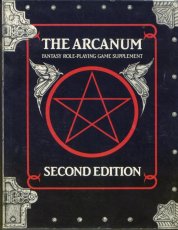
Obscure Games - The Arcanum

I have the Second Edition, but
I first played the First. I love
the understated covers.
Bard Games started their roleplaying products with a series including The Compleat Alchemist, along with some other The Compleat… titles. Those were intended as optional expansions for use with Dungeons & Dragons, but eventually they were expanded into a full game. This is a really common situation, actually, in the late '70s and early '80s, where someone would publish what amounted to their own house rules for D&D. There are people now who complain about the glut of retroclones and such, but we've always had those, from The Palladium Roleplaying Game and Arduin to Thieves' Guild and The Arcanum, among many, many others. Even RuneQuest began as the Perrin Conventions for D&D combat and Empire of the Petal Throne is self-evidently based on D&D.

Like many of these D&D variants, The Arcanum is explicitly tied to a specific setting, in this case, the Atlantean world, where Atlantis has not yet sunk beneath the waves, and rules most of the known world with a velvet glove cast in iron. Most of the setting information is contained in the second and third books in the series (The Lexicon and The Bestiary, later published under one cover as Atlantis: The Lost World, including art by Bill Sienkiewicz), though, and I won't hash it out here.

The First Edition cover was also
pretty cool.
Character creation involves choosing a race from the usual suspects and a few unusual ones (Druas are a little like dark elves, but will be later found in Talislanta as the Ariane, so they aren't elves at all, nosiree; Aesir are half-giants; Andamen are animal-headed humanoids; Nethermen are a lot like half-orcs; Zephyr are winged humans; plus Elves and Dwarves), then dividing 100+2d6 points among the 8 characteristics, sticking to the limits set by the chosen race of the character. Next, select a "Profession" (aka character class) from among the 32 possibilities, 2 of which are found in the Second Edition but not the First. Each of these is described as either "single-classed" or "dual-classed", which determines which experience point chart the character will use for increasing in level, and as "untrained", "skilled", or "highly trained" in Combat Capabilities. Each profession gives a special ability or two, plus some free skills. As the character rises in level, it will gain more free skills, and can choose to spend experience points on other skills instead of increasing level. Combat ability is handled in this way, by giving the character who can become better at fighting an accumulating +1 to hit at various levels. Like Lamentations of the Flame Princess Weird Fantasy Role Playing, non-fighters don't generally get these bonuses. There are some other refinements, such as Background and Hit Points (start equal to Constitution, plus a bonus for the Combat Capability of the class of 2, 4, or 6 points and a possible additional bonus for 15+ Constitution), but this is basically all there is to it.

Characteristics give various benefits to the character when they are at high enough level (usually 15+), such as Perception allowing a Detect Invisibility percent check, Constitution giving even more Hit Points (and that bonus is given each level, like the Combat Capability bonus), and so forth. Then we come to the core of the system. Like D20/3.X and Original Edition Delta will later do, The Arcanum simplifies saving throws and combat "to hit" checks down to a d20. Success is achieved with a total of 11+ after modifiers are applied, so if there's a +4, a roll of 7+ will succeed.

Money is treated in the usual D&D manner of gold, silver, and copper pieces, with about 100 coins to the pound. Characters roll on a table to determine their starting economic situation ("Down and Out", giving 20+1d10 GP, to "Flourishing", with 10 times as much).

Characters get experience points for a number of reasons, starting with the traditional D&D pair of 100xp per level of a defeated monster and 1xp per GP acquired, but also "Avoiding or deactivating any trap, figuring out any riddle or puzzle, overcoming any obstacle or hazzardous [sic] situation, or making any discovery of note", "Saving, rescuing, or aiding any character or creature" (which nets the same xp as defeating a foe), successfully turning undead (again, as defeating a foe), converting an individual to one's own religion (a flat 100xp per individual, regardless of level), making a magical or alchemical item, binding a spirit into service, or "influencing any individual or creature by non-magical means" (as defeating a foe). In addition, during down time, the character can gain xp by study or practice, either solitary or under a teacher. There's also an optional 10% bonus for funny voices and such ("Game Judges who would like to improve the quality of role-playing in their campaigns can adopt a policy of awarding a + 10% X.P. bonus for players who make an effort to role-play their game personas. This simple rule can go a long way towards improving the game by giving players a real incentive to think and role-play, instead of just hacking away at everything they see.")

Before getting to skills, there are listed 8 abilities that are common to all characters: Climbing, Finding a Track or Trail (but not following it), Hiding, Keeping Afloat (not swimming), Moving Silently (though the Stealth skill makes this awesomer), Noticing Hidden Persons or Creatures, Leaping, and Brawling.

Skills include all the usual stuff you see in games, from Languages and Haggling (which is different than Barter for whatever reason) and the like to unusual options like Internal Alchemy (increased lifespan for Mystics) and Inventing. Some skills have two levels (like Acrobatics I and Acrobatics II), which give more advanced abilities when the second skill is acquired after the first one. For no apparent reason, skills do not use the "d20 for 11+" system, but instead use a percentage chance set by the skill and the levels the character has gained since acquiring the skill.

Combat, as noted above, relies on a base 11+ to hit, and targets get to make a defense roll. Hits do damage based on weapon type. Simple, basic, D&D stuff. Armor absorbs damage (1 to 6 points, depending on type, heavy cloth to plate), with an optional rule for armor damage (requiring two percent checks in various circumstances, from immersion in salt water or long-term exposure to wet weather, to taking a fall from 20' or more or taking 20+ points of damage from a single attack).

Spellcasters can cast spells from lists determined by their particular profession (so, a Priest gets to use Divine Magic, while a Magician uses Enchantment, and so on). The character can learn spells of a spell level no higher than half (rounded up) of the level in the profession. A character can cast (level+1) spells per day, chosen at the time of casting. There are fiddly bits, like learning spells from other professions and casting spells in combat, but most of it is common sense. The oddest, most metagame-y, restriction is that no character may carry more than 7 magic items.

Alchemy gets a full treatment in the game, with a long list of alchemical operations that can be attempted. There's also discussion of summoning spirits and demons, and making a pact with them. There's a section where a character with the Runes skill can inscribe runes and effectively make minor magic items (they count against the limit of magic items, plus they have an additional limit of no more than 3 for those classes not associated with Rune Magic).

Alchemical operations include making simple potions (taking a few hours and requiring some easily-acquired ingredients) and more complex potions (taking a day or so, and requiring some more expensive ingredients), special devices (secret compartment rings, prisms, lenses, puzzle locks, whatever), scrolls, and such, on up to major operations like making Alchahest (a universal solvent), essences like Variable Mercury (the Philosopher's Stone) or True Copper (provides defensive benefits), Golems and Machina, or even the secrets of Life. Itself!

There isn't a lot of material on the traditional endgame, but there are some "NPC Professions" listed, which basically tell how much it costs to hire various professionals.

OK, let me list and briefly describe the 32 Professions of the game:

Alchemist - Pretty self-explanatory, actually. Learns how to make magic stuff using the principles of Alchemy.

Assassin - Pretty much a ninja, but no funky ninja magic.

Astrologer - A magic-using type who specializes in the powers of the celestial bodies.

Beastmaster - YES! You can play Dar in The Arcanum! Gets the ability to communicate and bond with animals.

Bounty Hunter - Hunts people down for the reward.

Charlatan - Another awesome option, the Charlatan gets some minor magical ability (limited to first level spells), but mainly relies on being a con artist. Though limited to first level spells, can learn more spell lists as the character goes up in level.

Corsair - Another self-explanatory profession. These are pirates.

Druid - Pretty much the traditional RPG depiction. Nature-loving hippies who can shape shift. There are some good limits on the shape-shifting (no bigger than 2' in length or height per level of the character, no smaller than a sparrow or mouse).

Enchantress/Enchanter (found in Second Edition only) - A little bit like bards in some games, these are artist- or musician-magicians.

Gladiator - A particular type of fighter.

Harlequin - Actors, musicians, performers, whatever.

Hunter - Like Rangers, but without the magical abilities.

Mage - There are actually three different sorts of Mage. All use Astrology (see Astrologer, above), but the Magus also uses Divine Magic, the Cabalist also gets High Magic, and the Archimage gets Enchantment.

Magician - The basic magic-using profession. Uses the Enchantment list.

Martial Artist - Chop Sockey!

Monk - Martial Artists who also learn to cast Mysticism spells.

Mystic - The main Mysticism spell-users.

Necromancer - Use Black Magic to summon demons and create undead monstrosities.

Paladin - Champions of Goodness and Justice. You know. Use Divine Magic.

Priest - The main spell-user that gets Divine Magic, plus can turn undead and convert the heathen.

Rogue - The basic thief profession.

Savant - There are two types of these. Both learn obscure facts (like the Scholar, below), but one gets Divine Magic and the other learns Mysticism. The latter tend to be hermits.

Scholar - Ivory-tower intellectuals. They learn stuff.

Shaman - The primary spell-user of the Low Magic list, they get to bind spirits to their service and have a Power Animal.

Sorcerer - Not only do they get the Sorcery spell list (with lots of pseudo-science-y spells like Negate Gravity or Structural Analysis), they also choose either Enchantment or Black Magic as a back-up.

Spy - Ever wanted the disguise ability of the AD&D Assassin without the requirement to be Evil? This is what you wanted to be. Basically, this is the AD&D Assassin, though (the Assassin profession in The Arcanum is all ninja-y, with Martial Arts skillz).

Thaumaturge (the other class new to Second Edition) - This is like the alchemist, but uses a different way of going about it that is somehow more related to what other spell-using professions do. Instead of gaining the ability "Projection of Will" like Alchemists get, they cast a spell called "Thaumaturgic Enchantment". They have some limits in what they can do compared to Alchemists, but they can do it way more often.

Warrior - Your basic fighter.

Witch/Warlock - They get Elemental Magic, like Druids, plus either Black Magic (for Evil Witches) or Enchantment (for the rest).

Witchdoctor - Like Shamans, they use Low Magic, but they also use Black Magic. There are no Good Witchdoctors. Which is kinda racist, given that the person in the picture is one of only two black guys in the book (other than the Druas, who are not dark elves; the other black guy is the Gladiator).

Witch Hunter - Like a Bounty Hunter, but specializing in spell-users. They learn to use the Mysticism spell list.

Wizard - The main users of High Magic, they also learn either Enchantment or Black Magic.

Anyway, if you've gotten this far, let me just say that, if you're looking for a game that is like D&D, but not, then The Arcanum is an excellent choice.

Friday, April 27, 2012

Some Semi-Random Notes

1) After thinking about the setting of the Black-Blooded Earth, it's occurred to me that one of the elements I was planning to use is at odds with one of the major themes of the setting. So, no more portals or skyships. They conflict with the idea that there is nowhere to run if the world is rendered uninhabitable.

2) Over on Hill Cantons, there's an excellent series ongoing examining the domain game as presented in 1st edition AD&D. In addition, there's a discussion of what reading the situation as given says about the implied setting of AD&D. I have to consider this discussion and what it means for the Black-Blooded Earth, since I'll be running it with AD&D.

3) On that topic, I've decided that the house rules I outlined earlier will be the only ones in use that alter the rules as written. I may use other systems to cover specific situations that are not covered in the AD&D rules (material component availability and costs, for a notable one), but otherwise I'm sticking to the rules in the books and making up other stuff as it comes up (or grabbing a Dragon article as necessary).

4) Work continues on the Top Secret clone. Slowly, but it continues.

5) I'm considering several games for the next installment of Obscure Games. Should it be Fantasy Wargaming? I seem to be one of only two or three people in the world who like that game. How about  Celtic Legends? High Colonies? The Arcanum? I have others in the offing, but one of those will be next. Let me know which ones you're most interested in hearing about.

Wednesday, April 25, 2012

Short Post Pointing You To Someone Else's Post

Over at Hack & Slash, -C is analyzing a session in which one of the players died due to grabbing some yellow mold. There's some very interesting and important discussion there about refereeing an adventure game that you should probably read. Especially important, I think, is this observation: "The rule is, if it can have an effect or is important, then it must be mentioned to the players." The temptation, as a referee, to leave out some crucial bit of information unless the players specifically ask for it is always present. That leads to the problem of pixel-bitching (the situation in which a certain magic phrase must be guessed and said by the players in order to successfully resolve a situation), and must be avoided. The rule that -C gives is one that should minimize that problem.

Sunday, April 22, 2012

Obscure Games Special: Games I Wish I Had

Over the years, there have been a lot of games that have come and gone. Some of them are still around in various forms, but a lot of games have fallen by the wayside. The best of them (or at least, the most popular) become collectors' items and difficult to find. Here are some games that I missed out on getting, and would like to have.

Buck Rogers XXVc - When this was around, I was in an anti-TSR frame of mind. It was easier to laugh at a TSR attempt at SF than to actually look into it, especially when my only real experience of the property was the campy late-'70s-early-'80s TV show. I have since learned that this was a pretty interesting setting, and the system was apparently not bad. Ah, well.

Bunnies & Burrows - I was much too much of a "serious" gamer when I was a kid, and this was pretty much, conceptually, the antithesis of what I wanted. Yeah, I was dumb. The GURPS version was excellent (and I still have it), but I wish I'd had the presence of mind to get the original.

Lords of the Middle Sea - A wargame from Chaosium, set in a future where the seas have risen about a thousand feet, and a significant portion of the midwest has collapsed (due to all the helium being removed, if I recall correctly). Based on a short story, the title of which eludes me at the moment. Super-cool setting, now hard to find for less than a hundred bucks.

Skyrealms of Jorune - Although intrigued by the art and story bits in the advertising, I never got around to picking this up. Recently, a friend of mine showed me his copy, and I realized what I had been missing. Should have gotten it when I had the chance, years ago.

Worlds of Wonder - Chaosium's boxed set was, in some ways, the first "universal" RPG. I kinda have this, actually, as I photocopied a friend's books, but I wish that I'd gotten a copy of this game when it was around. I hear that Magic World is being redone in the new BRP system, and I do have Superworld. Future World was pretty spiffy, sort of a prototype of Stargate. The universal city was an interesting idea.

FTL:2448, Stalking the Night Fantastic, and Fringeworthy - The three games from Tri-Tac for sci-fi, horror, and another Stargate prototype, respectively. The system was unwieldy (and I think it was derived from Morrow Project, though the relationship was distant, as I recall) and the setting details were sketchy, but we had so much fun playing these in the '80s. I never got copies, though, and relied on the copies owned by the GM. What a mistake that was. At least I was smart enough to get the BTRC games that were (vaguely) similar, even if I don't think that I'd ever play them due to their complexity: TimeLords, SpaceTime, and Warp World.

Dune: Chronicles of the Imperium - Actually, I did own this. Then I stupidly put it up for auction at GenCon (the last one in Milwaukee, and the only GenCon I've been able to make it to). Someone got a great deal on it, and I got shafted. Stupid, stupid, stupid. Ah, well, at least I have Burning Sands: Jihad.

What games did you miss out on?

Saturday, April 21, 2012

The Game I'm Looking For

If I could find a game that portrayed my ideal fantasy fiction, it would make me quite happy. Let's give a list of the books that I would want as inspiration, my very own Appendix N, if you will:

Asprin, Robert, et al. - Thieves' World series

Burroughs, Edgar Rice - Barsoom series, Venus series

Cherryh, C.J. - THE DREAMING TREE

Herbert, Frank - Dune series

Holdstock, Robert - Mythago Wood series

Howard Robert E. - Conan series, Solomon Kane series, et al.

King, Stephen - Dark Tower series

L'Amour, Louis - THE WALKING DRUM

Lee, Tanith - Flat Earth series, Birthgrave trilogy, et al.

Llewellyn, Morgan - DRUIDS, RED BRANCH, et al.

Lovecraft, H.P. - THE DREAM-QUEST OF UNKNOWN KADATH, et al.

Martin, George R.R. - A Song of Ice and Fire series

Sabatini, Rafael - CAPTAIN BLOOD, THE SEA-HAWK, et al.

Tolkien, J.R.R. - Middle-Earth series

Tremayne, Peter - Sister Fidelma series, RAVENMOON

Edit on 24 April to add authors I forgot the first time around:

Erikson, Steven - Malazan Book of the Fallen series

Leiber, Fritz - Fafhrd and Grey Mouser series

Shea, Robert - ALL THINGS ARE LIGHTS, SHIKE, THE SARACEN

Smith, Clark Ashton - Averoigne series, Hyperborea series, Zothique series, et al.

Tierney, Richard L. - Simon of Gitta series

Vance, Jack - Dying Earth series, Lyonesse trilogy, et al.

Friday, April 20, 2012

Monday, April 16, 2012

Obscure Games - Lands Of Adventure

In my humble, but deadly accurate, opinion,
this is the best fantasy game cover to date.
Too bad about the game.
Fantasy Games Unlimited made some of the best games that no one played. This one is not one of their best, and is no longer in print, but it is full of good ideas presented badly.

Lee Gold, the force behind the long-running and well-received fanzine Alarums & Excursions, as well as the Chivalry & Sorcery variant Land of the Rising Sun, which presented a highly-detailed, fantasy-Japanese culture just as its inspiration presented a fantastic Europe. With credentials like those, one would think that this game would be a slam-dunk. Unfortunately, it seems that Ms. Gold chose not to actually develop the game. It even reads like a set of notes rather than a set of finished and polished rules.

Full of great ideas, the game leaves out a lot that would be necessary to actual play. Perhaps we could approach this like the Three LBBs of OD&D, but there's something else wrong here. It's more like the notes were never actually used in play before being thrown together and published.

There are a few weird design decisions in the character creation rules. First, there are 11 basic stats. These alternate being created by the roll of a d20 and taking one of the other stats divided by 2 and adding a d10. So, we get CRAFT (or CRF), rolled on a d20, and then DEXTERITY (aka DEX), which is CRF/2 + 1d10. The strangest pair is APPEARANCE (APP), on a d20, and AGILITY (the unusual abbreviation AGY is used), which is APP/2 + 1d10 (justified as "gracefulness of movement"). My immediate inclination would be to change all of the d20 rolls to 2d10, but that's an aesthetic choice, I guess. There are different variations for "specialized characters" (who exchange magical TALENT, or TAL, for technological CRF or vice versa), technology level (higher tech improves CRF and diminishes TAL), or non-human characters. It is actually important to generate Height and Weight, for reasons that will show up in a moment.

Next comes Piety. This is a measure of how much the character lives a religious life. Factors include the likes of "Attends major religious festivals", "Prays daily to deities", "Has Theology (a Knowledge Skill) at 76%+", "Per quest performed at deity's desire in the past year", and the like. It's not made clear whether missing a major festival once would eliminate that point of Piety (and would it come back at the next festival attended?), and that's especially a problem for minor festivals. If a character engages in a Blasphemous Action, then the Piety will drop to a negative value and can no longer be improved without atonement (requiring a completed Quest per point of negative Piety). Blasphemous Actions range from "Refuses to admit a deity exists" on the low end to "Destroys a deity's Holy Place" at the extreme. As an example of the sketched-out nature of the game, the whole description of Piety (not counting the lists of Pious and Blasphemous Actions) is shorter than the paragraph I have just written about it.

Next in the list of things to do in creating a character is figuring out the three kinds of hit points that a character has. These are Energy Points (EP), Body Points (BP), and Life Points (LP). EP are a combination of fatigue and magical power, determined by adding PRUDENCE (PRU), AGY, and STRENGTH (STR). BP are physical structural integrity, and are equal to the character's body weight in pounds divided by 10. LP are health and the strength of attachment of the character's life energy, and are equal to CONSTITUTION (CON). There's a quick note that EP are recovered based on the total of EP and LP remaining to the character, and that other healing occurs by transforming EP into other hit point types (at a ratio of 5 EP per LP or 2 EP per BP), with a chance of success based on the number of LP remaining (and no chance of healing if LP are 0). That's actually pretty clever, if a little convoluted and sketchily presented.

Next up is some stuff about encumbrance and pushing things that are all labeled as optional.

LoA is a skill-based system, as most of the FGU games tended to be. Unlike most such games, though, skills are grouped into categories which all have the same base percentage chance of success. That is, all "WEAPONS - MELEE" skills will have the same base chance, all "KNOWLEDGE" skills start at the same percentage, and so on. Individual skills can be "Specialized", which allows them to be improved above that baseline chance. A character starts with one Specialized Skill per point of PRU, and can have up to twice PRU, gaining one per adventure or game month. Improving Specialized Skills also improves the skill category's base chance by 1% per 10 in the Specialized Skill. There's a bunch of other stuff about how easy the skill is, training time and cost, and such. This is followed by the skill list, which is just a list of skill names divided into categories with some generic advice on adjudicating them (eg "Success in a Communication Skill indicates that the performance is satisfactory.")

There's some notes on how quickly a character moves in the Movement Skills section, which is based on either the character's height or shoulder height (if a quadruped). In the section on Combat Skills, we learn that natural weapons do damage based on the character's BP (and so on the weight of the character). For instance, a Punch does 1xBP/10, while a Kick does 1xBP/8. Observation Skills includes some tables of distances in various conditions at which things can be perceived. Weapons do damage based on the weight of the weapon (only), while Missile weapons have a more complicated calculation involving an "efficiency factor", but the upshot is that an arrow does 7 points, the same as a 3.5 lb. sword. There's a brief note that there are critical hits and fumbles, with a reference to later combat rules.

The armor rules are just strange. Instead of a simple subtraction from damage (or reduction of the chance to make an effective hit), armor multiplies the BP of the character. This is explained as easier than dividing the damage of each blow. I'll just leave it at that.

In each combat Round (12 seconds), there are 6 Phases of 2 seconds each. An attack in a Phase costs EP based on the weight of the weapon compared to the character's STR, ranging from 1-5 EP. This can be reduced by taking an extra Phase per point of reduction. When damage is taken, the character taking the damage can choose to take up to half of it as EP, the rest as BP (or LP if out of BP). On a Crit, the damage is doubled and the character takes LP equal to half of the BP taken. There's also an optional rule for a Critical Hit Location table that gives specific effects.

Magic is divided into four categories: Compulsions, Illusions, Enhancements, and Energy. Compulsions compel various behaviors or emotional states, Illusions affect senses, Enhancements improve various skills, and Energy has a number of relatively subtle physical effects (for instance, Energy can create an aura of damaging energy that only affects EP, can bind inanimate objects together, or can affect the intensity of other people's magical spells). There are guidelines given as to how to create spells of each type, giving the amount of EP that the spell requires and the difficulty of success with casting. Spell types can be combined as well to create more complex effects. One example given: MAGIC BINDING (Distant/Immediate Illusory Rope & Inhibit Escape), which is a combination of an Illusion and a Compulsion.

Miracles are dependent on spirits, gods, and demons. A character with a high Piety and Miracle Skill category base chance is more likely to get the attention of an appropriate entity. However, there is another way of getting this attention, which is Thaumaturgy. This is basically a way of using Magic to Invoke a Deity through a special type of Spell. Diabolists are people who sell their soul (that is to say, their LP) to a Demon in exchange for power.

Blah blah blah, animals, humanoids, skin shifters/weres. Dragons have ridiculously high BP and consequently base damage for their natural weapons, plus armor multipliers. Undead have no LP and so can't heal anything other than EP, but Ghosts (for instance) don't have any BP either. Vampires, oddly, don't seem to be able to heal BP at all.

Anyway, that's a quick overview of the basic notes in the main rule book. There's more in the "Culture Packs". Only two Culture Packs were ever published for the game (and were included in the boxed set), for Mythic Greece and Medieval England. Lee Gold was apparently heavily influenced by Robert Graves, as a lot of the concepts in those two Culture Packs are from his works.

So, like I said, a lot of neat ideas. Terrible presentation, and like OD&D there's a great need for the Referee to make interpretations of sections that are not really clearly discussed. This could be a good thing or it could be a bad thing, depending on the needs of a particular game.

Sunday, April 15, 2012

The Black Blood Of The Earth

Since the setting is named for it, I thought that I'd discuss a little bit about what the Black Blood of the Earth is, in the setting. It is the necessary component of all magic. It is the way that internal states are transformed into external realities. It is the lifeblood of the land, flowing through the underworld like a vital fluid.

OK, OK, so what does it do? In order to cast any magic, a magic-user (or illusionist, or cleric, or even druid) must imbibe a small amount when preparing the spell. About 1 fluid ounce per spell level is sufficient. This is not entirely cheap, however, as each fluid ounce costs (currently) 3 gold crowns, 18 silver nobles, and 8 copper wheels. This price fluctuates over time.

My host in Belwick had a houseguest who harangued us all about the abuse (as he termed it) of the Black Blood. He claimed that the increasingly intense weather being experienced in the world is one result of the depletion of this vital planetary resource. No one, though, seems willing to give up magic for alarmist and unproven theories of that sort. This guest claimed that there are ways to continue to practice some magic, but that it can't be as ever-present as it is now, and that society will need to undergo drastic changes if it is going to continue without collapsing into chaos. Since he wasn't forthcoming as to what these "other ways" were, he was gradually ignored by the other guests. Most likely, though, he was talking about the Sun Elixir, which is a very expensive alternative to the Black Blood. It currently costs upward of 80 platinum imperials per fluid ounce, largely due to its slow method of manufacture (and the requirement for a long period of sunlight, which is just not practical in some areas). As a result, few people bother with it.

In addition to being used to cast magic spells, the Black Blood is used to recharge magic items. Each fluid ounce will help to restore one charge to most magic items that have charges. It is also necessary to maintain long-term spells - such spells as Continual Light require a number of fluid ounces equal to the level of the spell per month (the first month is covered in the amount required to cast the spell) in order to keep functioning.